Etihad tops AirlineRatings' 2026 safety list ahead of Cathay Pacific and Qantas, with HK Express leading low-cost carriers. Full top 25s, methodology and movers.
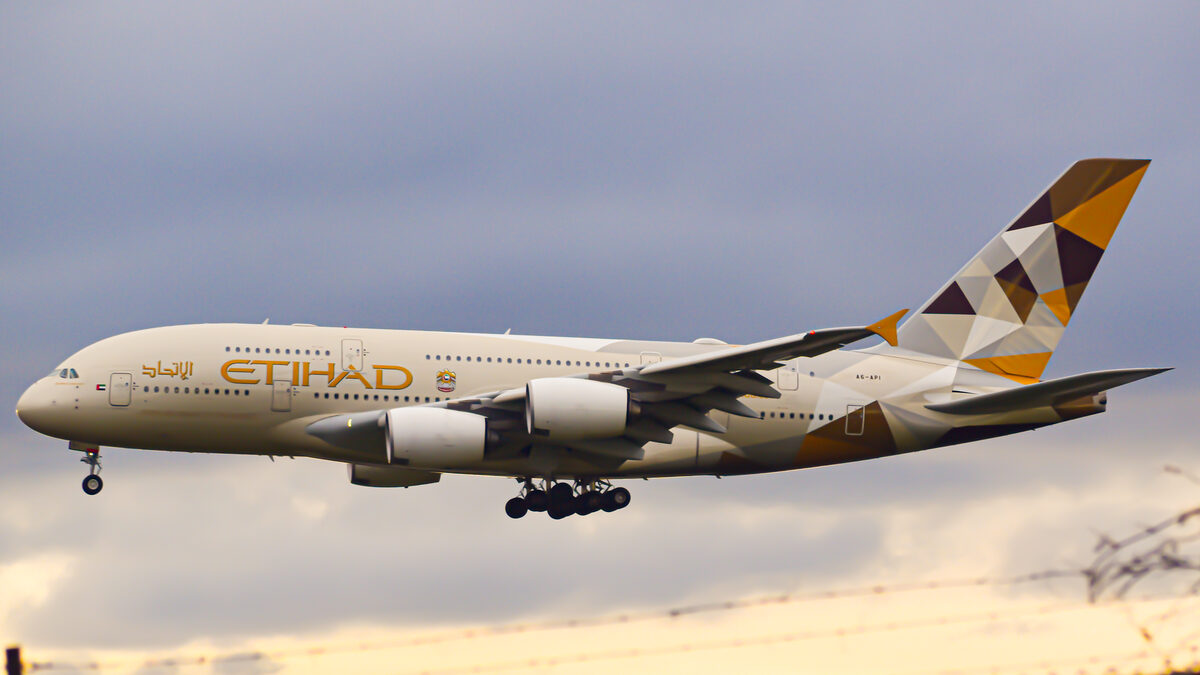
Cover image: Etihad Airways Airbus A380 on approach — photo by AVA Navigate, CC BY-SA 4.0, via Wikimedia Commons.
Etihad Airways is the world's safest full-service airline for 2026, topping AirlineRatings.com's annual safety ranking for the first time a Gulf carrier has taken the number one spot. Cathay Pacific placed second and Qantas third, in a list covering 320 airlines where less than four points separate the top 14. Among low-cost carriers, HK Express took the crown for the second time.
Safety rankings are one of the few airline lists that directly move booking behaviour. Corporate travel managers write preferred-carrier rules around them, agents use them to reassure nervous flyers, and insurers and lessors watch them as a proxy for operational discipline. This guide lays out the full 2026 lists, explains how AirlineRatings scores safety, and pulls out what changed this year, including Singapore Airlines' return after its 2025 exclusion and the first-ever Chinese carrier on any AirlineRatings ranking.
What are the safest full-service airlines for 2026?
AirlineRatings ranked the top 25 full-service carriers after reviewing 320 airlines worldwide. Etihad leads on the strength of a young fleet, cockpit-safety advances around turbulence, a crash-free history and the lowest incident rate per flight, plus participation in the site's independent onboard safety audit. Cathay Pacific and Qantas complete the top three, and just 1.3 points separate the top six, so the order at the summit is genuinely tight.
| Rank | Airline | Base |
|---|---|---|
| 1 | Etihad Airways | Abu Dhabi |
| 2 | Cathay Pacific | Hong Kong |
| 3 | Qantas | Sydney |
| 4 | Qatar Airways | Doha |
| 5 | Emirates | Dubai |
| 6 | Air New Zealand | Auckland |
| 7 | Singapore Airlines | Singapore |
| 8 | EVA Air | Taipei |
| 9 | Virgin Australia | Brisbane |
| 10 | Korean Air | Seoul |
The rest of the top 25 runs: STARLUX (11), Turkish Airlines (12), Virgin Atlantic (13), ANA (14), Alaska Airlines (15), TAP Air Portugal (16), SAS (17), British Airways (18), Vietnam Airlines (19), Iberia (20), Lufthansa (21), Air Canada (22), Delta (23), American Airlines (24) and Fiji Airways (25). STARLUX and Fiji Airways are both debut entries on the list. The Gulf dominates the summit with three carriers in the top five, while Asia-Pacific carriers hold eight of the top ten places.
What are the safest low-cost airlines for 2026?
HK Express claimed the low-cost title for the second time, credited with an almost flawless onboard safety audit. Jetstar Airways and Scoot complete the top three. Notably, flydubai appears fourth with a caveat: AirlineRatings now considers it a full-service airline and will assess it accordingly in future editions.
The low-cost top ten is: HK Express, Jetstar Airways, Scoot, flydubai, easyJet Group, Southwest, airBaltic, VietJet Air, Wizz Air Group and AirAsia Group. airBaltic made a significant jump into the top ten, a useful proof point for the Latvian carrier as it restructures; read our reporting on airBaltic's Chapter 11 filing and its cost pressures for the financial backdrop. The rest of the top 25 runs TUI UK, Vueling, Norwegian, JetBlue, FlyNAS, Cebu Pacific, Jet2, Ryanair (Ireland and UK), Spring Airlines China, Transavia Group, Eurowings Group, Volaris, WestJet Group, GOL and SKY Airline Chile, with Spring Airlines the first Chinese airline to appear on any AirlineRatings ranking.
How does AirlineRatings score airline safety?
The methodology stays largely consistent year to year. AirlineRatings weighs how frequently incidents occur normalised by flight count, fleet age, serious events, pilot training standards and global audit results, with scores in the published band running between 0.002 and 0.09 at the sharp end. Carrier openness counts too: the site says transparency from airlines is essential to the assessment.
New for 2026 is added weight for turbulence avoidance, because turbulence remains the primary cause of injuries in flight. The ranking now credits participation in programmes such as IATA Turbulence Aware and the site's own cabin-safety checks. The shift follows a string of high-profile turbulence injuries, including the Phuket-Delhi incident that left passengers hurt, which we covered in our report on the Air India turbulence injuries. For context on how regulators grade the industry, Indonesia's latest ICAO safety score, covered in our piece on Indonesia's 78.85 score, shows the same audit logic applied at state level.
Which airlines moved most in 2026?
Four moves stand out. Etihad's first-ever number one confirms the Gulf carrier's safety investment is now recognised ahead of the legacy leaders. Singapore Airlines is back after being excluded in 2025 following a serious turbulence-related incident, reinstated after a safety-centre review. STARLUX and Fiji Airways debuted, the Taiwanese boutique carrier cracking the top half at 11. And Spring Airlines put China on the board for the first time in the low-cost list.
Qantas holding third will interest agents selling Australia: the carrier's nonstop ambitions continue despite delays, as our coverage of the Perth-London nonstop delay to 2027 explains. A top-three safety rank is exactly the reassurance ultra-long-haul passengers ask for.
How should travellers and agents use safety rankings?
Use them as a shortlist, not a verdict. Every airline in the top 25 is, in AirlineRatings' words, a world leader in aviation safety, and the scoring gaps are tiny. For corporate programmes, the lists justify preferred-carrier tiers and help travel managers defend policy choices to risk committees. For leisure agents, a top-ten rank answers the nervous-flyer question with an independent source rather than a personal opinion.
Keep two limits in mind. Rankings measure the airline, not the specific aircraft, route or crew on your client's day of travel, and they reward transparency, so secretive carriers can score below their true standard. Pair the ranking with practical checks: aircraft type,停留 stops and connection times, and current advisories. A top-ranked airline on a well-chosen itinerary beats a mid-ranked one on a punishing one every time.
Why Gulf carriers own the top of the 2026 list
Three of the top five full-service airlines fly from the Gulf: Etihad first, Qatar Airways fourth and Emirates fifth, with flydubai fourth among low-cost carriers before its reclassification and FlyNAS fifteenth. No other region clusters like that at the summit, and it reflects two decades of fleet renewal. Young aircraft, heavy investment in training infrastructure and IOSA-registered operations across the big three have compounded into measurably lower incident rates.
Etihad's win is also a commercial story. The airline has been expanding aggressively through 2026, as our coverage of Etihad's record summer expansion detailed, and a number-one safety rank lets it sell that growth to risk-averse corporate accounts. Qatar Airways pairs fourth place overall with the Skytrax business-class crown covered elsewhere this week, giving Gulf hubs a safety-plus-service double argument against European and Asian rivals.
For agents, the implication is straightforward. Gulf routings already win on schedule and price to much of Asia, Africa and Europe; the 2026 lists add an independent safety endorsement that answers the last common objection. When a client hesitates over an unfamiliar connection point, the ranking is the evidence to reach for.
How the regions compare in 2026
Asia-Pacific owns the full-service list. Eight of the top ten carriers are based in the region: Cathay Pacific, Qantas, Air New Zealand, Singapore Airlines, EVA Air, Virgin Australia, Korean Air and, by ownership structure debate aside, the Gulf three sit just west of it. Add STARLUX at 11, ANA at 14, Vietnam Airlines at 19 and Fiji Airways debuting at 25, and the Pacific Rim accounts for nearly half the entire top 25. For agents selling long-haul east, that concentration is a selling point in itself.
Europe's best-placed carrier is Turkish Airlines at 12, followed by Virgin Atlantic (13), TAP Air Portugal (16), SAS (17), British Airways (18), Iberia (20) and Lufthansa (21). Respectable depth, seven carriers in the top 25, but no European airline cracks the top ten this year. North America lands four: Alaska Airlines (15), Air Canada (22), Delta (23) and American Airlines (24), with United absent entirely. US-based corporate buyers should read that carefully: the home carriers cluster at the bottom of the list, which weakens any fly-domestic default in travel policy debates.
The low-cost geography is more spread. Europe contributes easyJet, airBaltic, Wizz Air, Vueling, Norwegian, Jet2, Ryanair, Transavia and Eurowings; Asia contributes HK Express, Jetstar, Scoot, VietJet, AirAsia Group, Cebu Pacific, Jet2's peers and now Spring Airlines; the Americas add Southwest, JetBlue, Volaris, WestJet, GOL and SKY Airline Chile; the Gulf and South Asia add flydubai and FlyNAS. No African low-cost carrier makes the cut. The pattern favours large, well-capitalised groups with standardised young fleets, which is worth remembering the next time a startup carrier pitches on price alone.
Frequently asked questions
What is the safest airline in the world for 2026?
Etihad Airways, ranked number one full-service airline for 2026 by AirlineRatings.com. It is the first year a Gulf carrier has taken the top spot, ahead of Cathay Pacific in second and Qantas in third.
What is the safest low-cost airline for 2026?
HK Express, which claimed the low-cost title for the second time on the strength of an almost flawless onboard safety audit. Jetstar Airways placed second and Scoot third.
How is airline safety ranked?
AirlineRatings reviews 320 airlines on incident frequency normalised by flights, fleet age, serious events, pilot training and audit results, with extra 2026 weight for turbulence avoidance programmes. Less than four points separate the top 14 full-service carriers.
Is Singapore Airlines safe after the 2025 turbulence incident?
AirlineRatings reinstated Singapore Airlines at seventh for 2026 after a safety-centre review, following its exclusion in 2025 over a serious turbulence-related incident. Turbulence avoidance now carries extra weight across the whole ranking.