Emirates' pre-tax profit fell 68% to AED 3.7bn in April to September 2026. An AED 7.1bn fuel hedging gain was almost twice that profit, and seat factor fell to 72%.
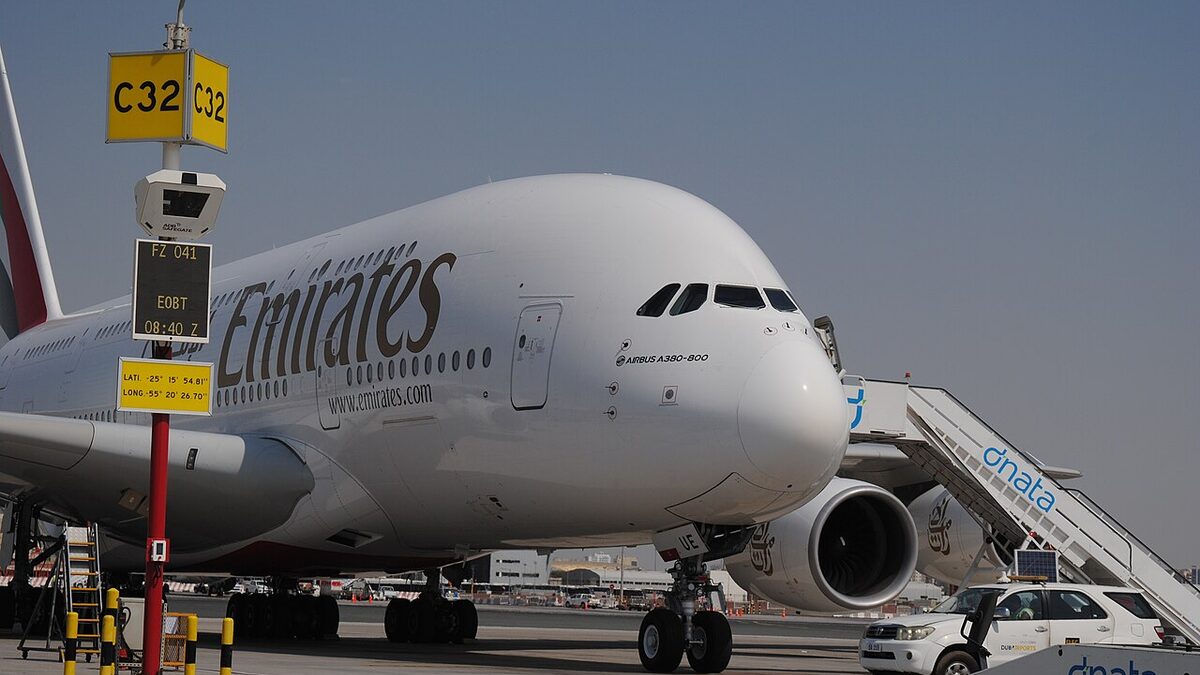
Cover image: An Emirates Airbus A380 at a contact gate at Dubai International Airport (2024 file photo) — photo by Andy Mabbett, CC BY-SA 4.0, via Wikimedia Commons.
Emirates' half-year results for 2026-27, published on Thursday 5 November, show a pre-tax profit of AED 3.7bn (US$1.0bn) for the six months to 30 September, down 68 per cent from a record AED 11.4bn a year earlier. Gains of AED 7.1bn from fuel hedging were almost twice that profit, and they cut the rise in the airline's fuel bill from 60 per cent to a net 13 per cent.
The passenger business is weaker than the headline suggests. Emirates filled 72.0 per cent of its seats, against 79.5 per cent a year earlier, and carried 21.8 million passengers, six million fewer. Freight is the part running hot: cargo revenue rose 52 per cent on slightly lower tonnage.
What did fuel hedging do for Emirates' half-year results 2026-27?
Flying less, Emirates uplifted 12 per cent less fuel, yet its fuel bill before hedging gains rose 60 per cent. Sheikh Ahmed bin Saeed Al Maktoum, chairman and chief executive, said global jet fuel prices had doubled year on year.
The hedging gain, about US$1.9bn at the 3.67 dirhams-per-dollar rate Emirates uses, held the net increase to 13 per cent. Fuel is still the airline's largest cost, at 34 per cent of operating costs.
By our arithmetic the gain is 1.9 times pre-tax profit. That is a comparison, not an estimate of unhedged earnings.
The release gives no hedge cover for later periods, though Sheikh Ahmed said in May that Emirates was "well-hedged until 2028-29". Air France-KLM expects a hedging result of about US$2.0bn for all of calendar 2026, roughly what Emirates booked in six months, and has hedged 54 per cent of its 2027 fuel.
Why did Emirates fill only 72 per cent of its seats?
Revenue passenger kilometres fell 25 per cent on seat capacity down 17 per cent. Emirates cites "intermittent airspace restrictions and closures across the region" and government travel advisories that "reshaped consumer choices and travel flows".
Rivals' results this week suggest who stayed away. Air France-KLM said on 5 November that demand on its nonstop routes to Asia, India and East Africa reflected "corporate customers' continued preference to avoid Gulf hubs", even as Gulf carriers' capacity on its Asia and East Africa routes returned to near-normal levels in the third quarter. IAG said on 6 November that its unit revenue in Africa, the Middle East and South Asia was helped by business customers "now flying from North America via London".
Our analysis of UK Civil Aviation Authority data found UK–Gulf passengers 20.6 per cent below 2025 levels in August, with Dubai down 19.0 per cent, even though Emirates flew more UK flights than a year earlier (1,240 against 1,178).
Emirates says customer demand "held firm", particularly for its premium cabins.
What kept Emirates' revenue up?
Revenue fell 13 per cent to AED 56.9bn. Emirates SkyCargo carried 1.24 million tonnes, 1 per cent fewer, but cargo revenue rose 52 per cent because the conflict cut airfreight capacity while shipping disruption pushed shippers into the air, the airline said.
Air France-KLM's network cargo revenue rose 24.9 per cent in the third quarter, which it said was supported by a shift from sea to air amid disruption around the Suez Canal and the Strait of Hormuz.
| Emirates (airline), six months to 30 September | 2026-27 | 2025-26 | Change |
|---|---|---|---|
| Revenue | AED 56.9bn | AED 65.6bn | -13% |
| Profit before tax | AED 3.7bn | AED 11.4bn | -68% |
| Passengers carried | 21.8m | 27.8m | -22% |
| Seat factor | 72.0% | 79.5% | -7.5 pts |
| Cargo carried | 1.24m tonnes | 1.25m tonnes | -1% |
| Cargo revenue | Not disclosed | Not disclosed | +52% |
Sources: Emirates Group half-year 2026-27 fast facts and results release.
What do the results mean for agents and partners?
Emirates was operating 91 per cent of its pre-disruption network on 30 September, serving 150 airports in 78 countries and territories. To boost customer confidence it offers free date changes, what it calls generous refund policies, and a travel cover product not restricted by government travel advisories.
The fleet reached 289 aircraft, 12 more than in March. Group cash fell to AED 54.1bn from AED 59.6bn in March as the Group funded aircraft pre-delivery payments and debt service and paid the remaining AED 2bn of its 2025-26 dividend to its owner, the Investment Corporation of Dubai.
At dnata, pre-tax profit fell 51 per cent to AED 410m. Its travel division's revenue fell 31 per cent, mainly because it sold Travel Republic and Netflights in the UK.
The release gives no full-year forecast. Sheikh Ahmed said the group enters the second half "with measured optimism". Our round-up of Q2 2026 airline results covers the US majors and Lufthansa.
Frequently asked questions
How much profit did Emirates make in the first half of 2026-27?
The airline made a pre-tax profit of AED 3.7bn (US$1.0bn) from 1 April to 30 September 2026, down 68 per cent from a record AED 11.4bn. The wider Emirates Group, including dnata, made AED 4.1bn before tax, down 66 per cent, on revenue of AED 66.2bn.
How big was Emirates' fuel hedging gain?
Emirates reported AED 7.1bn of gains from fuel price risk management, about US$1.9bn at the 3.67 rate it uses. The gains held the rise in its net fuel cost to 13 per cent, against 60 per cent before hedging, and were almost twice its pre-tax profit.
Why did Emirates' seat factor fall to 72 per cent?
Traffic fell faster than capacity: revenue passenger kilometres dropped 25 per cent while seat kilometres fell 17 per cent. Emirates cited airspace restrictions and government travel advisories, and Air France-KLM said corporate customers still preferred to avoid Gulf hubs.
Is Emirates' network back to normal?
Not fully. On 30 September Emirates was operating 91 per cent of its pre-disruption network, serving 150 airports in 78 countries and territories.