An agency debit memo is an airline's bill to a travel agent for a ticketing error or rule breach. How ADMs work in BSPlink, what airlines charge and how to dispute one.
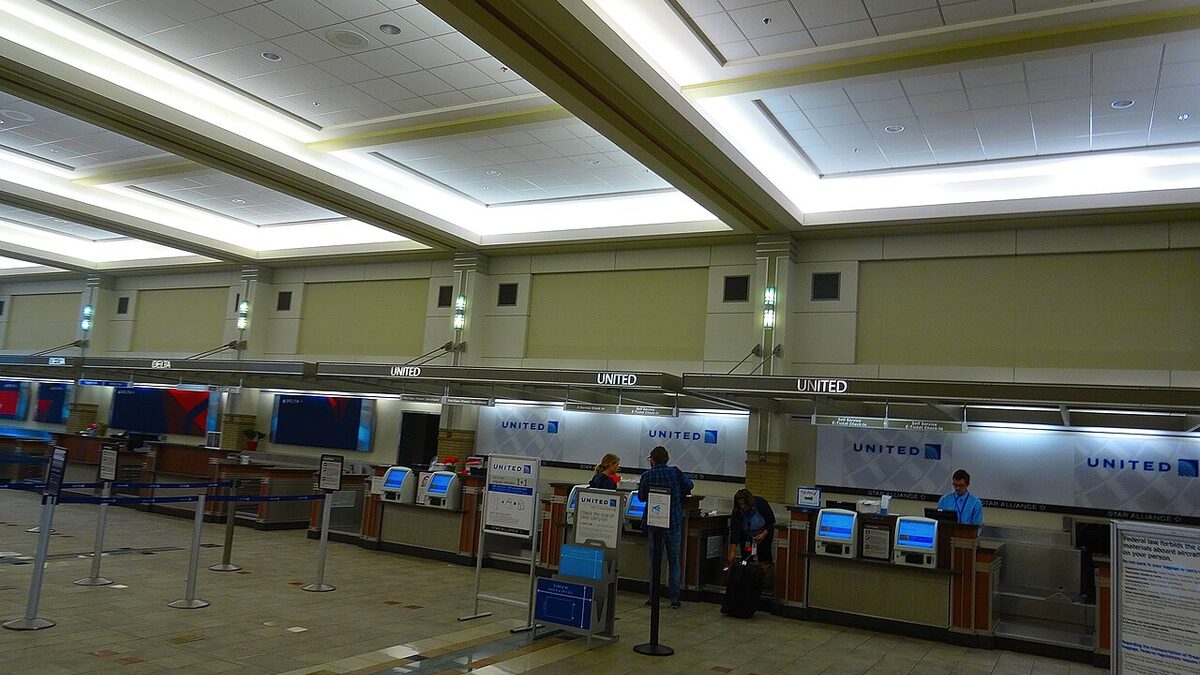
Cover image: A United Airlines ticket counter (file photo) — photo by Corey Coyle, CC BY 3.0, via Wikimedia Commons.
An agency debit memo (ADM) is a bill an airline raises against a travel agency for money it says the agency owes on a ticket: an under-collected fare or tax, an over-claimed commission, a wrong refund or a booking-rule penalty. IATA Resolution 850m, which governs ADMs in BSP markets outside the United States, says the memo tells the agent that, "unless there is some justification to the contrary", it owes the amount shown. An agency credit memo (ACM) does the reverse.
The clock is short. Under Resolution 850m, an agent has a maximum of 15 days to review and dispute an ADM before it is submitted to the BSP for processing. IATA's public copy is from the 40th edition of its Passenger Agency Conference Resolutions Manual (June 2019), but ANA's policy, valid from 1 April 2026 and based on the resolution, keeps the same 15-day window and 60-day settlement limit. The sums add up: Virgin Atlantic charges at least £500, €500 or $600 a ticket for hidden-city ticketing, and IATA's ADM User Group found that in 2019 card chargebacks were 3 per cent of ADMs that could be categorised but about 20 per cent of the total value of ADMs issued globally.
Last checked: 1 November 2026.
What is an agency debit memo and who issues it?
IATA defines ADMs and ACMs as "adjustments issued by an Airline for any incorrectly reported document". Resolution 850m calls the ADM "a legitimate accounting tool" and says each memo must be specific about why a charge is being made.
The issuer is the validating carrier. Cathay Pacific (policy posted October 2024) and Virgin Atlantic raise ADMs on their documents whichever other airlines are in the itinerary. Lufthansa Group's March 2022 policy also bills reservation transactions before ticketing, with reservation manipulations handled under IATA Resolution 830a. Our explainer on ticket prefixes, validating carriers and BSP settlement covers the mechanics.
Resolution 850m makes BSPlink (ASD in China) "the exclusive medium through which ADMs must be billed and disputed", and airlines must publish their ADM policies there. The US is excluded: agencies report through ARC, and Delta handles memos in ARC Memo Manager, reserving the right to charge $20 to agencies that do not use it.
NDC does not remove the memo. ANA sends ADMs or invoices for NDC sales to the NDC seller.
How is an ADM processed and disputed in BSPlink?
- Issue. An ADM goes through the BSP only if issued within nine months of the final travel date, or nine months after a refund the agent made. Later claims are settled directly between airline and agent.
- Review. The agent has up to 15 days to dispute in BSPlink, with reasons and documents. IATA points agents to the "ADM & ACM query" menu for each memo's detail.
- Decision. The airline must settle disputes within 60 days of receipt. An invalid ADM must be cancelled, and any administration fee on a memo issued in error withdrawn or refunded. Lufthansa Group promises clarification within 30 days.
- Credit. If the agent wins after the ADM was billed, Cathay Pacific issues an ACM to offset it.
- Escalation. If both sides agree, a disputed ADM can go to the Travel Agency Commissioner. A memo already in the BSP billing is paid, and later disputes fall under the Passenger Sales Agency Rules.
After billing, Virgin Atlantic considers written disputes for six months from the ADM's issue date; Cathay Pacific may charge a late fee and rejects anything later than six months.
A hypothetical example: ANA counts 15 calendar days from the date of issue, so an ADM issued on Monday 2 November would have to be disputed by 17 November, counting from the next day. If the agent disputed on 10 November, the 60-day settlement limit would run to 9 January 2027.
What are the most common reasons for an ADM?
Delta lists improper fare collection, penalties, undercharges, unreported sales, credit card rejections and commission errors. ANA's policy, valid from 1 April 2026, runs to more than 40 items.
Booking-class abuse, ticketing a fare in a class other than the one booked, appears on the Virgin Atlantic and Cathay Pacific lists; our guide to booking classes and fare buckets explains why the class matters. Hidden-city ticketing, a fare from a point before the real origin or to a point beyond the real destination in Virgin Atlantic's definition, is the agency-side version of the skiplagging risks travellers run.
| Cause | What a published policy charges | How to avoid it |
|---|---|---|
| Fare-rule breach (advance purchase, minimum or maximum stay) | Virgin Atlantic: fare raised to the next applicable fare, plus £30 / €30 / $50 | Price automatically; recheck rules before any reissue |
| Booking-class mismatch | Virgin Atlantic: fare difference plus £30 / €30 / $50; Cathay Pacific: fare difference plus EUR 25 | Ticket in the class booked; rebook rather than override |
| Churning (cancelling and rebooking to extend the ticketing time limit) | ANA: USD 40 per passenger per segment; Virgin Atlantic: £1 per segment plus £30 | Ticket by the time limit or release the seats |
| Duplicate, fictitious or out-of-sequence bookings | ANA: USD 40 per passenger per segment; out of sequence USD 400 (economy, premium economy) or USD 1,200 (business, first) | Check for existing bookings; book segments in travel order |
| Inactive segments (HX, UN, UC, NO) left in the booking | ANA: USD 40 per passenger per segment unless removed 24 hours before departure; Virgin Atlantic's deadline is 72 hours | Work the GDS queues daily |
| Hidden-city or throwaway ticketing | Virgin Atlantic: fare difference or £500 / €500 / $600 per ticket, whichever is greater; ANA: fare difference | Price the trip the passenger will actually fly |
| Wrong taxes, fees or surcharges | Virgin Atlantic: under-collection plus £30 / €30 / $50, even for the right amount under the wrong code | Never edit taxes by hand |
| Commission over-claimed | Virgin Atlantic: overclaim plus £30 / €30 / $50 | Match commission and deal codes to the contract |
| Card that is not the customer's | ANA: 10 per cent of the sale plus the administration fee | Take the customer's own card |
How much do airlines charge per ADM?
Resolution 850m says ADMs should not in principle be raised just for administration fees, that any fee belongs in the ADM for the adjustment, and that fees should be "commensurate with the cost of the work incurred". Airlines set their own figures:
- Virgin Atlantic adds £30, €30 or $50, sets no minimum ADM value, and fines ticketing time-limit breaches by cabin, from £50 ($75) in economy to £250 ($375) in its Upper cabin.
- ANA charges JPY 3,000 in Japan and USD 25 elsewhere, per ticket in BSP markets and per ADM under ARC.
- Cathay Pacific charges EUR 25 for errors such as a missing tour code or child indicator, and USD 60 for an unauthorised name change.
- Lufthansa Group levies a fee on every ADM, set by country, and raises ADMs only above EUR 10, with exceptions for taxes, surcharges and commission.
To illustrate: Virgin Atlantic's hidden-city charge is the fare difference or $600 per ticket, whichever is greater. If the fare for the real trip was $420 more than the agent collected, the ADM is $600. If the gap was $900, it is $900.
How can agencies prevent ADMs and win disputes?
Price automatically, leave the result alone and read each airline's BSPlink policy before the memo arrives. Resolution 850m's model procedures require ticketing systems to send a Fare Calculation Mode Indicator (FCMI) when automated pricing was used "and there has been absolutely no manipulation", and airlines must pass it back on any ADM.
Keep the evidence in the booking. Virgin Atlantic says information must be available at audit; supplied later, it only cuts the ADM to the penalty charge. Where a GDS error or GDS fare guarantee is involved, Cathay Pacific and Virgin Atlantic tell agents to recover the cost from the GDS.
For card sales, IATA tells agents to be PCI DSS compliant, confirm the airline accepts the card brand in that market and record an authorisation code for every transaction.
Channel matters. Virgin Atlantic will not issue ADMs on bookings made and ticketed through its NDC channels, except for fraud, legal or tax failures, misapplied fares and breaches of its booking policies or fare rules.
Frequently asked questions
What is the difference between an ADM and an ACM?
An ADM charges a travel agent for money the airline says it is owed, such as an under-collected fare or tax. An agency credit memo (ACM) does the reverse and credits the agent. IATA describes both as adjustments for an incorrectly reported document. Airlines also use an ACM to refund an ADM found to be wrong after billing.
How long does a travel agent have to dispute an ADM?
Under IATA Resolution 850m, an agent has a maximum of 15 days to review and dispute an ADM in BSPlink before it goes to the BSP for processing. ANA counts 15 calendar days from the date of issue; Lufthansa Group counts 15 days from posting. In the United States, where ARC applies, ANA allows 30 calendar days and two 10-day appeals.
Can an airline issue an ADM a year after the flight?
Not through the BSP, as a rule. Resolution 850m allows ADMs through the BSP only within nine months of the final travel date, or of an agent's refund. Later claims are handled directly between airline and agent. Lufthansa Group says it may still raise ADMs after nine months if the claim is not statute-barred; if the agent rejects one in BSPlink, it bills by invoice.
Can a travel agency dispute an ADM for a credit card chargeback?
Usually not. IATA's chargeback guidelines say that under the Passenger Sales Agency Rules, an ADM raised for an actual chargeback, rather than a cardholder's enquiry, is not eligible for dispute. The exception is an NDC sale in which the agent took no part in the card transaction.
Sources
- IATA, Resolution 850m on ADMs (Resolutions Manual, 40th edition, 2019)
- IATA, What is an ADM and ACM?
- IATA, Card Chargeback Guidelines: ADM Prevention (version 3.0, 2020)
- Lufthansa Group, ADM Policy
- ANA, ADM/ACM Policy
- Virgin Atlantic, Global ADM Policy
- Cathay Pacific, ADM/ACM Policy
- Delta Professional, Debit Memo Information