What airline ancillary revenue includes, how big it is ($157 billion for 2025, per IdeaWorks), which airlines lead and how US and EU fee rules affect agents.
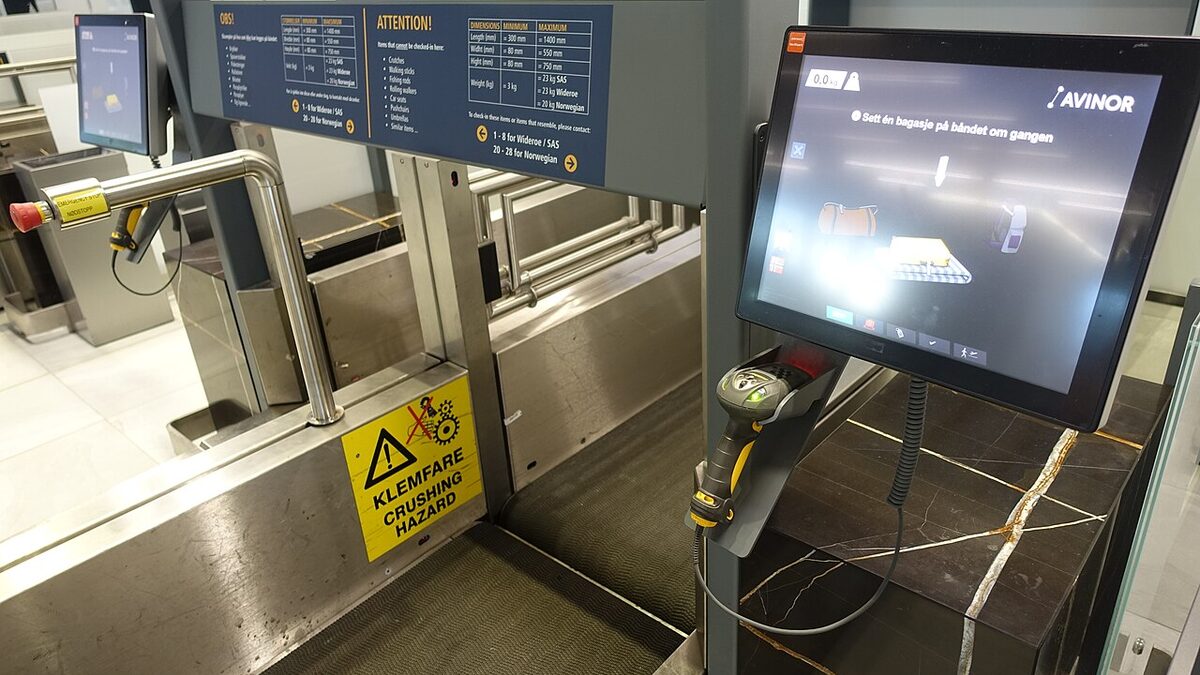
Cover image: Self-service bag drop at Bergen Airport, Norway (2019 file photo) — photo by Wolfmann, CC BY-SA 4.0, via Wikimedia Commons.
Airline ancillary revenue is the money an airline earns beyond the ticket itself: fees for bags, seat selection and priority boarding, commissions on hotels, car hire and insurance sold with the flight, and sales of frequent-flyer miles to banks and other partners. IdeaWorksCompany, the US consultancy whose definition it says the industry has broadly accepted, projected $157 billion of ancillary revenue worldwide in 2025, or 15.7 per cent of all airline revenue, up from 9.1 per cent in 2016.
Extras are outgrowing the business around them. Among 58 airlines tracked in both of IdeaWorks' last two yearbooks, ancillary revenue rose 13.4 per cent in 2025 against 7.2 per cent for total revenue. For anyone selling flights, a rising share of what passengers pay sits outside the fare on the screen, and the US rule that would have pushed those fees into the first search result has been struck down.
Last checked: 1 November 2026.
What counts as airline ancillary revenue?
IdeaWorks defines it as "revenue beyond the sale of tickets that is generated by direct sales to passengers, or indirectly as a part of the travel experience", in five categories.
| Category | What it includes | Who pays the airline | Data point |
|---|---|---|---|
| A la carte features | Checked and excess bags, seat assignment, onboard food, priority check-in, early boarding, Wi-Fi, call-centre and credit-card fees | Passenger | Southwest: ancillary revenue per passenger up nearly 20% to $58.25 in 2025 after it began charging for bags and seats mid-year |
| Commission-based products | Hotels, car hire and travel insurance, mainly on the airline's website; onboard duty-free | Hotel, car-hire or insurance partner | Wizz Air: €71.2 million in its 2025-26 financial year |
| Frequent-flyer programmes | Miles sold to co-branded card banks, hotels, car-hire firms and retailers, or to members | Bank, partner or member | American, Delta, Southwest and United: $27.9 billion in 2025, $37.72 per passenger |
| Advertising | Inflight magazines; ads on aircraft, loading bridges, gates and lounges | Advertiser | Thai AirAsia: THB 4.38 million in 2025 |
| Fare or product bundles | Value assigned to the bags, early boarding or legroom included in a bundled fare | Passenger, via the bundle price | Branded fares and seat fees powered the past five years' gains |
| Not ancillary (IdeaWorks view) | Cargo, mail, ground handling, inflight kitchens | Not applicable | Some carriers count these; IdeaWorks calls them other revenue |
Data points: IdeaWorks 2026 Yearbook. That last row matters: carriers draw the line in different places, so reported totals are only as comparable as their definitions.
Bundles are the blurriest category. IdeaWorks separates branded fares, where every "good, better, best" tier stays on sale at a fixed premium, from fare families, where cheaper fares sell out as the flight fills.
How big is airline ancillary revenue?
The latest worldwide figure is IdeaWorks' Global Estimate of 18 November 2025: $157 billion for 2025, against $148.4 billion for 2024 and $67.4 billion for 2016. IdeaWorks credits steady passenger growth and the spread of basic economy fares. It had not published a 2026 estimate as of 1 November 2026.
Its 2026 SeatMaps.com Yearbook of Ancillary Revenue, released on 8 September 2026, covers 63 airlines' 2025 results. Thirty earned at least $1 billion from ancillaries, up from 27 a year earlier.
Dependence varies enormously. In the previous yearbook, the ancillary share ranged from 3.2 per cent at one airline to 62 per cent at another.
Which airlines earn the most from ancillaries?
By total, United Airlines led with $11.5 billion in 2025, up 9.3 per cent. By share of revenue, low-cost carriers fill the top ten. Frontier Airlines led at 60.2 per cent, and the top five, all in the Americas, each took at least 55.4 per cent. Europe's entries were Wizz Air (44.5 per cent), Volotea (40.0) and easyJet (39.9), with Turkey's Pegasus tenth at 37.3. Jet2.com set a Yearbook record of $100.73 per passenger.
No Asia-Pacific airline made the top ten. Our guide to how low-cost airlines make money sets the fees against the rest of the budget model.
Worked example: calculating an ancillary share. Divide ancillary revenue by total revenue, then by passengers. Ryanair reported ancillary revenue of €4.99 billion for its 2025-26 financial year, on group revenue of €15.54 billion and 208.4 million passengers:
- Share: €4.99bn ÷ €15.54bn = 32.1 per cent.
- Per passenger: €4.99bn ÷ 208.4m = €23.94, which Ryanair rounds to €24.
Cebu Pacific said it earned ₱32.0 billion from ancillaries in 2025 on revenue of ₱119.9 billion and 26.9 million passengers: 26.7 per cent, or about ₱1,190 a passenger. Both shares match the Yearbook's own figures and sit below the 37.3 per cent that took tenth place.
How do US and EU regulators shape airline fees?
United States. The Department of Transportation's 2024 rule, Enhancing Transparency of Airline Ancillary Service Fees, would have required fees for a first and second checked bag, a carry-on and changes or cancellations to be shown the first time a fare appeared in a search, and obliged airlines to share that data with ticket agents. A Fifth Circuit panel stayed it on 29 July 2024; the full court vacated it on 3 February 2026 because DOT had not allowed comment on a study it relied on.
The ruling revived the 2011 standard, which a DOT rule effective 2 July 2026 wrote back into the regulations:
- airlines and ticket agents must say on the first fare screen that baggage fees may apply, and where to find them;
- e-ticket confirmations must show the free allowance and fees for a first and second checked bag and a carry-on;
- airlines must list all ancillary fees in one place online (non-baggage fees as ranges) and flag bag-fee increases or allowance changes on their homepage for at least three months.
European Union. Article 23 of Regulation (EC) No 1008/2008 requires the final price, including all unavoidable and foreseeable taxes, charges, surcharges and fees, to be shown at all times for flights from EU airports. Optional extras must be shown clearly at the start of booking and accepted on an opt-in basis.
Regulation (EU) 2026/2202, published on 2 October 2026 and applying from 23 October 2027, goes further. It requires a free personal item of up to 40 x 30 x 15 cm, or one that fits under the seat, and default display of fares that include hand baggage. Passengers cannot be denied boarding for not paying a charge to use their own printout of a digital boarding pass. Our baggage allowance guide compares current limits.
What does ancillary revenue mean for travel agents and travellers?
For agents, the problem is visibility. Extras bought separately go on their own document rather than a new ticket, as our explainer on airline ticketing, GDS, NDC and BSP sets out. IdeaWorks describes NDC (IATA Resolution 787) as a framework for merchandising a la carte services through a GDS or online travel agency, with pricing moving to the airline's own systems. What an agent can see and sell depends on the channel.
The US data-sharing duty fell with the 2024 rule. Agents may meet the first-screen notice by pointing customers to the airline's website, or their own, for fees. Commission-based extras also put airlines on agents' turf: IdeaWorks says they are sold mainly through airlines' own websites.
The EU changes in 2027, when intermediaries as well as airlines must state baggage allowances and any extra baggage charges at booking for flights to, from or within the EU.
For travellers, IdeaWorks argues unbundling has kept flying cheaper overall. It puts the 2016 average one-way fare at $294 plus $16 of extras, against $166.38 plus $21.21 in 2025, both in 2025 dollars: about 40 per cent less. About 45 per cent of travellers buy only the base fare, its president Jay Sorensen said. Compare prices with the bag and seat you need, and check whether a card or status waives them. Our tracker of 2026 loyalty and fee changes follows the latest moves.
Frequently asked questions
Is a checked bag fee ancillary revenue?
Yes. IdeaWorksCompany lists checked and excess baggage among the a la carte features at the core of ancillary revenue, alongside seat assignment, priority check-in, early boarding, onboard food and Wi-Fi. When a bag comes inside a bundled fare, the airline can allocate part of the bundle price to it and report that slice as ancillary.
Do frequent-flyer programmes count as ancillary revenue?
Yes. IdeaWorks counts miles or points sold to partners such as co-branded card banks, hotel chains, car-hire firms and retailers, plus miles sold to members. It says American, Delta, Southwest and United made $27.9 billion from their programmes in 2025, while for low-cost carriers loyalty remains a relatively minor factor.
Do US airlines have to show bag fees when you search for a flight?
Not as of 1 November 2026. The 2024 rule requiring bag and change fees at the first search display was vacated on 3 February 2026. Under the revived 2011 standard, written back into DOT's regulations on 2 July 2026, the first fare screen must say bag fees may apply and where to find them, and the e-ticket confirmation must list them.
Will EU airlines have to let passengers carry a bag for free?
Partly. From 23 October 2027, Regulation (EU) 2026/2202 requires airlines to let passengers bring a personal item of up to 40 x 30 x 15 cm, or one that fits under the seat, into the cabin at no extra cost. Fares including a piece of hand baggage must be shown by default, though airlines may still offer differentiated fares to passengers who choose to travel without one.
Sources
- IdeaWorksCompany, Global Estimate of Ancillary Revenue for 2025 (18 November 2025)
- IdeaWorksCompany, 2026 SeatMaps.com Yearbook of Ancillary Revenue (8 September 2026)
- IdeaWorksCompany, 2026 SeatMaps.com Yearbook of Ancillary Revenue, full report (version 1.1)
- IdeaWorksCompany, Industry definitions
- US Federal Register, Increasing Flexibility on Disclosure of Airline Ancillary Fees (2 July 2026)
- EUR-Lex, Regulation (EC) No 1008/2008, Article 23 on price transparency
- EUR-Lex, Regulation (EU) 2026/2202 on air passenger rights
- Ryanair, 2025-26 full-year results
- PortCalls Asia, Cebu Pacific 2025 results