A GSA is an airline's outsourced sales office in a market where it has no staff. How GSAs and cargo GSSAs work, how they are paid and how IATA rules treat them.
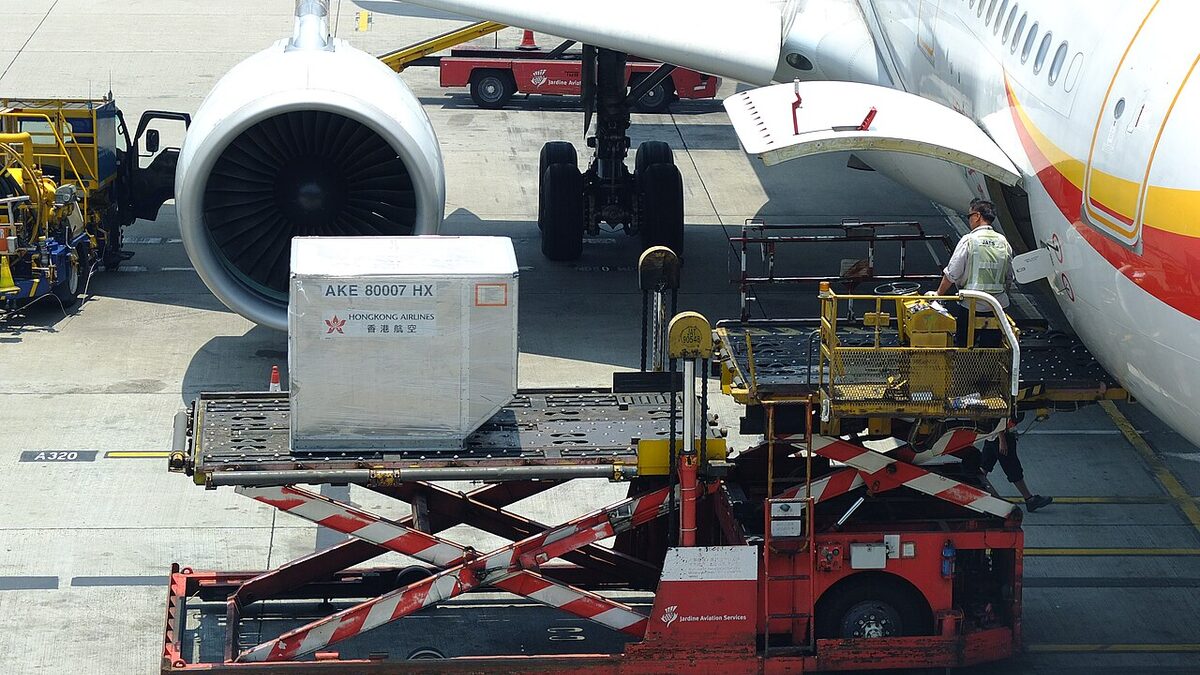
Cover image: A ULD loader lifting an air-cargo container to an aircraft hold (2014 file photo) — photo by Jamesshliu, CC BY-SA 3.0, via Wikimedia Commons.
An airline general sales agent (GSA) is an outside company that acts as an airline's sales office in a country or region where the carrier has no staff of its own. The 2022 edition of IATA's BSP Manual for Agents defines a GSA as any person to whom an airline "has delegated general authority to represent it for purposes of sales of passenger and/or cargo air transportation in a defined territory and who is remunerated accordingly". A general sales and service agent (GSSA) also runs local operations, which in air cargo can include reservations, customer service and handling coordination.
Sebastiaan Scholte, chief executive of cargo GSSA Kales Group, told Air Cargo Week in March 2026 that GSSAs' share of total sales has risen from 24 per cent to 27 per cent over five years. He expects the shift to continue because airlines find it "harder to get (good) people" and boards still want headcount held flat or cut.
Last checked: 1 November 2026.
What does an airline general sales agent do?
APG, a GSA network that says it works with more than 250 airline clients, lists outsourced "passenger and cargo sales, marketing, fare filing, and customer support" among its services, plus settlement plan services and interline and codeshare arrangements that extend an airline's reach.
Cargo GSSAs go further into operations. When South Korea's Asiana Airlines appointed ECS Group for its international belly cargo from 1 August 2025, the scope covered sales, reservations, customer service and ground handling coordination at 33 locations in nine countries across Europe, the Americas, China, Japan and Southeast Asia, Air Cargo Week reported. Kales says its scale lets it include its airlines in "tenders & incentive deals" run by some of the biggest freight forwarders.
Why do airlines use a GSA instead of their own office?
Cost, speed and local contacts. An own office is a fixed overhead before the first sale; APG pitches its service as operating "on a variable cost, success basis", so the cost moves with revenue. A GSA also arrives with relationships the airline would take years to build.
Two recent cargo cases show the pattern. In January 2026 Alaska Airlines appointed Wexco, part of Kales Group, to lead its UK cargo sales from May 2026, when Alaska began daily widebody flights between Seattle and London Heathrow. Asiana, required by European and Japanese regulators to sell its freighter operations, outsourced belly cargo sales in those nine countries to ECS.
The trade-off is control. Once demand is proven, airlines may take sales back in-house to gain "greater control over pricing, data, and customer relationships", Air Cargo Week wrote in May.
| Our comparison (as of 1 November 2026) | General sales agent (GSA/GSSA) | Airline-owned office | Online-only distribution |
|---|---|---|---|
| Who sells locally | A third party with delegated authority | Airline employees | Nobody: website, apps, remote agents |
| Cost structure | Mostly variable: commission or success-based fees | Mostly fixed: staff, premises, local company | No local payroll |
| Local trade relationships | Brought in on day one | Built over time | Minimal |
| Control of pricing, data and customers | Shared with the agent | Full | Full |
| Speed to market | Fast | Slow | Fast, no local servicing |
| IATA agency accreditation | Cannot be held in the same market (Resolution 812) | Not applicable | Not applicable |
| Typical use | New routes, smaller markets, cargo sales | Large home and core markets | Direct-selling, often low-cost carriers |
Online-only selling suits carriers built around direct sales, as our guide to how low-cost airlines make money explains.
How are general sales agents paid?
Mostly by commission on sales, sometimes with overrides, incentives or shared risk.
Danila Maslennikov of Delta Cargo Shipping Service told Air Cargo Week in May 2026: "Usually a GSA works on 7%, 5%, sometimes even 3%, and for an airline that already feels like a lot. If they believe they can do the same job internally for 0.5%, then from their perspective the decision is very simple."
An illustration: on $1 million of cargo sales, a 5 per cent commission costs the airline $50,000; at the 0.5 per cent in-house cost in Maslennikov's example, it would be $5,000.
Some GSSAs take on risk to win business. Kales "does also not shy away of taking commitment, sometimes on a full flight or rotation basis", Scholte said.
Illustrative example: an override structure. A historical passenger contract shows the mechanics. In a 2002 report, India's Comptroller and Auditor General (CAG) examined the 1986 agreement under which Air India appointed Welcome Travels as its UK GSA: 9 per cent normal commission plus a 3 per cent override on Air India international passenger sales, with the 9 per cent to be passed on to sub-agents on their sales.
If a sub-agent sold £100 of tickets, the GSA earned £12 in commission, paid the agency £9 and kept £3. On its own direct sales it kept the full £12.
The leaks were in the extras. The CAG found Air India paid a productivity-linked incentive (PLI) outside the agreement, with slabs as low as £2 million of net sales and rates approved after sales were known. PLI paid from 1987 to 2000 totalled £10.79 million, equivalent to Rs 57.02 crore.
How does a GSA fit with IATA accreditation and BSP?
IATA treats a GSA as the airline's representative, not as a travel agency, and its rules keep the two apart. Under Resolution 812, the Passenger Sales Agency Rules in the edition dated 1 January 2026, an agency applying for accreditation "must not trade as a General Sales Agent for any air carrier" in the market where it is based, and its offices must not be "jointly occupied or operated with an airline or an airline's General Sales Agent".
Airlines also may not name a GSA as their representative on the local Agency Programme Joint Council, and GSAs may not attend as observers.
Resolution 812 covers dozens of markets outside the US; in Asia-Pacific they include China, Hong Kong, India, Indonesia, Japan, Korea, Malaysia, the Philippines, Singapore, Thailand and Vietnam. Accredited agencies issue tickets on the airline's stock and settle through BSP, the mechanics covered in our guide to ticket stock, GDS and BSP.
National rules can add a licence. In the Philippines, the text of Presidential Decree 1462 of 11 June 1978, which amended Republic Act 776, bars any "general sales agent, cargo sales agent or aircraft forwarder" from operating "unless there is in force a permit or any other form of authorization issued by the Board", the Civil Aeronautics Board.
Which are the biggest GSA and GSSA groups?
No independent league table exists; size claims are the companies' own.
- APG calls itself "the world's largest and most successful passenger and cargo GSA representation network", with 130-plus offices, coverage of more than 170 countries and over 250 airline clients.
- ECS Group (cargo) became GSSA for CMA CGM Air Cargo in April 2024 and won the nine-country Asiana mandate in August 2025, Air Cargo Week reported, listing EFIS Maroc and International Airline Marketing among ECS's acquisitions.
- Kales Group (cargo) includes Wexco. In March 2026 Scholte cited new offices in Turkey, Kazakhstan and Nepal, said he expects Asia to drive growth alongside e-commerce and foresaw "more consolidation in the GSSA market globally".
How do airlines and agents evaluate a GSA?
The CAG audit and the trade press point to five checks.
- Licences. Confirm local permits, such as the Philippine board's, and that any agency arm complies with Resolution 812.
- Incentives. Fix slabs and rates in advance. Air India approved its 1997-98 PLI rates in May 1998, after the year closed.
- Pass-through. Air India got no certificate that the 9 per cent reached sub-agents for 1998-99 and 1999-2000.
- Reach. Check forwarder tender access, offices and which rival airlines the GSA also represents.
- Exit terms. Agree who owns accounts and data if sales move in-house. As Air Cargo Week summed up Maslennikov's view: "Perform badly and you lose the airline; perform well and you risk being removed once the market is established."
Frequently asked questions
What is the difference between a GSA and a GSSA?
A GSA sells an airline's passenger or cargo transport in a territory under authority delegated by the carrier. A general sales and service agent (GSSA) adds service and operational work. Air Cargo Week reported that ECS Group's Asiana Airlines mandate, which began in August 2025, covered belly cargo sales, reservations, customer service and ground handling coordination in nine countries.
Is a general sales agent the same as a travel agent?
No. A travel agent sells many airlines' tickets to the public; a GSA represents one or more airlines in a territory. IATA keeps them apart: under Resolution 812, an agency seeking accreditation must not trade as a GSA in the market where it is based, or share offices with an airline's GSA.
How much commission does an airline GSA earn?
There is no published market rate. A cargo manager quoted by Air Cargo Week in May 2026 said a GSA usually works on 7, 5 or sometimes 3 per cent. A 1986 Air India agreement audited by India's CAG paid its UK GSA 9 per cent plus a 3 per cent override, with the 9 per cent to be passed on to sub-agents on their sales.
Do airlines still need GSAs now that they can sell online?
Many do, especially for cargo and new routes. Kales Group's chief executive said in March 2026 that GSSAs' share of total sales grew from 24 to 27 per cent in five years, and Alaska Airlines hired a UK cargo GSA for its Heathrow launch. The risk for agents is that airlines bring sales in-house once a market is proven.
Sources
- IATA, BSP Manual for Agents (effective 1 September 2022)
- IATA, Resolution 812 Passenger Sales Agency Rules (1 January 2026)
- Lawphil, Philippines Presidential Decree No. 1462 (1978)
- CAG of India, 2002 audit report: Air India's UK GSA
- Air Cargo Week, ECS Group selected as GSSA partner for Asiana Airlines (18 August 2025)
- CAPA, Alaska Airlines launches Seattle-London Heathrow service (22 May 2026)
- Air Cargo Week, Airlines outsource more cargo sales (11 March 2026)
- Air Cargo Week, GSSA/GSA market trends since 2020 (11 March 2026)
- Air Cargo Week, The GSA Paradox (5 May 2026)
- APG, About APG Network