SIA Group net profit fell 43.9% to S$134m in the six months to 30 September as jet fuel averaged US$171 a barrel. Its share of Air India's losses narrowed to S$361.7m.
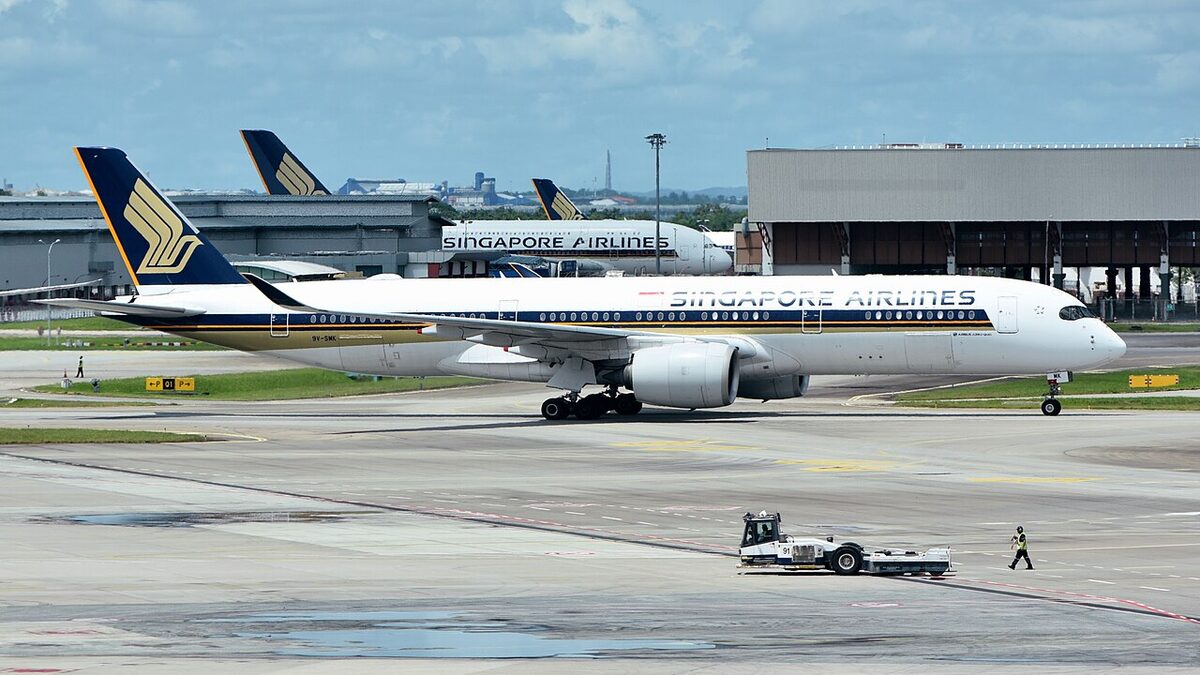
Cover image: A Singapore Airlines Airbus A350-900 at Singapore Changi Airport (2025 file photo) — photo by Bahnfrend, CC BY-SA 4.0, via Wikimedia Commons.
Singapore Airlines' H1 FY2026/27 results show a group carrying a record number of passengers at higher fares and still earning less. Net profit for the six months to 30 September fell 43.9 per cent to S$134 million, the group said on 11 November, after jet fuel averaged US$171 a barrel, 86.7 per cent more than a year earlier.
Revenue rose 16.8 per cent to a half-year record of S$11,297 million, and SIA and Scoot together carried a record 21.8 million passengers. One drag eased: SIA's share of Air India's losses narrowed to S$361.7 million from S$429.5 million, according to its interim financial statements.
What do the Singapore Airlines H1 FY2026/27 results show?
Operating profit fell 29.1 per cent to S$569 million. On our calculation that is 5.0 per cent of revenue, against 8.3 per cent a year earlier.
The damage came early. SIA said first-quarter operating profit dropped 73.8 per cent, while the July to September quarter improved: operating profit rose 16.3 per cent to S$463 million and net profit reached S$210 million, against S$52 million. The April to June quarter had brought a net loss of S$76 million, which SIA reported on 28 July.
| SIA Group, six months to 30 September | 2026 | 2025 | Change |
|---|---|---|---|
| Total revenue | S$11,297m | S$9,675m | +16.8% |
| Fuel cost before hedging | S$4,705m | S$2,472m | +90.3% |
| Fuel hedging result | S$731m gain | S$75m loss | S$806m swing |
| Net fuel cost | S$3,974m | S$2,547m | +56.0% |
| Operating profit | S$569m | S$803m | -29.1% |
| Net profit | S$134m | S$239m | -43.9% |
| Share of Air India losses | S$361.7m | S$429.5m | -15.8% (our calculation) |
| Passengers carried | 21.8m | 20.8m | +5.0% |
How much did fuel cost Singapore Airlines?
Fuel before hedging cost S$4,705 million, up 90.3 per cent. Hedging swung from a S$75 million loss to a S$731 million gain, which held the net bill to S$3,974 million. That is 37 per cent of group expenditure on our calculation, up from 29.
Passenger yields rose 12.1 per cent and cargo yields 25.4 per cent. SIA said fare and cargo-rate adjustments "do not fully offset the impact of sustained high fuel prices".
Emirates told a similar story earlier this month: pre-tax profit down 68 per cent, propped up by hedging gains of AED 7.1 billion.
Scoot is the weak spot. The interim statements show the low-cost segment made an operating loss of S$24.0 million, against S$39.0 million a year earlier, and its breakeven load factor was 97.3 per cent against an actual 90.8 per cent. The parent airline filled 85.6 per cent of seats against a breakeven of 84.6 per cent.
What is SIA's share of Air India's losses?
The interim statements put it at S$361.7 million, 15.8 per cent less than a year earlier. The carrying value of the 25.1 per cent stake fell to S$799.9 million at 30 September from S$1,134.6 million at 31 March.
Air India has not published a half-year result. Dividing SIA's share by 25.1 per cent points to a loss of roughly S$1.44 billion for the Air India group, against about S$1.71 billion a year earlier. That is our derivation from SIA's accounts, assuming a simple pro-rata share. It is a rough guide, not an Air India figure: SIA's equity-accounted share can include its own accounting adjustments. Daijiworld reached about Rs 10,500 crore on the same basis, using S$1 to Rs 73. The last full-year number is Air India's Rs 22,238 crore loss for FY26.
SIA said it and Tata Sons "recognise that a transformation of this scale will take time". Air India chief executive Tewolde Gebremariam said earlier in November that the airline's cost per available seat kilometre was "too high and needed to come down", Forbes India reported. Any further funding is a call the Singapore government has said it will leave to SIA.
What changes in the network this winter?
SIA's Dubai flights and Scoot's Jeddah flights remain suspended, and the launch of SIA's Riyadh service has been deferred to March 2027, the release said.
In the northern winter season to 27 March 2027, SIA will launch Madrid via Barcelona five times a week and daily flights to Western Sydney International Airport, taking it to five Sydney flights a day.
Shareholders get interim dividends of 7 Singapore cents a share on 11 December (2 cents ordinary, 5 cents special), down from 8 cents a year earlier.
Frequently asked questions
What was Singapore Airlines' net profit in the first half of FY2026/27?
The SIA Group reported a net profit of S$134 million for the six months to 30 September 2026, down 43.9 per cent from S$239 million a year earlier. Operating profit fell 29.1 per cent to S$569 million, while revenue rose 16.8 per cent to a record S$11,297 million.
How much did Air India cost Singapore Airlines in the half?
SIA's interim financial statements put its share of Air India's losses at S$361.7 million for April to September 2026, down from S$429.5 million a year earlier. The carrying value of its 25.1 per cent stake fell to S$799.9 million. Air India has not published its own half-year result.
What did Singapore Airlines pay for jet fuel?
The group said jet fuel averaged US$171 a barrel over the six months, 86.7 per cent higher than a year earlier. Fuel cost before hedging rose 90.3 per cent to S$4,705 million. A hedging gain of S$731 million held the net fuel bill to S$3,974 million, up 56.0 per cent.
Is Singapore Airlines flying to Dubai and Riyadh?
Not as of the 11 November 2026 results release. SIA said its Dubai services and Scoot's Jeddah services remain suspended because of the geopolitical situation in the Middle East, and that the launch of its Riyadh services has been deferred to March 2027.
Sources
- Singapore Airlines, first-half FY2026/27 results news release
- Singapore Airlines, first-quarter FY2026/27 results news release (28 July 2026)
- Singapore Airlines, interim financial statements to 30 September 2026
- Forbes India, Singapore Airlines backs Air India as share of losses narrows
- Daijiworld, Air India reports estimated Rs 10,500 crore loss in first half of FY27