Non-mainland visitor arrivals at Hong Kong airport fell 3.9% in June-October 2026 while West Kowloon rail rose 27% and Shenzhen land crossings 19.7%, our analysis of Immigration data shows.
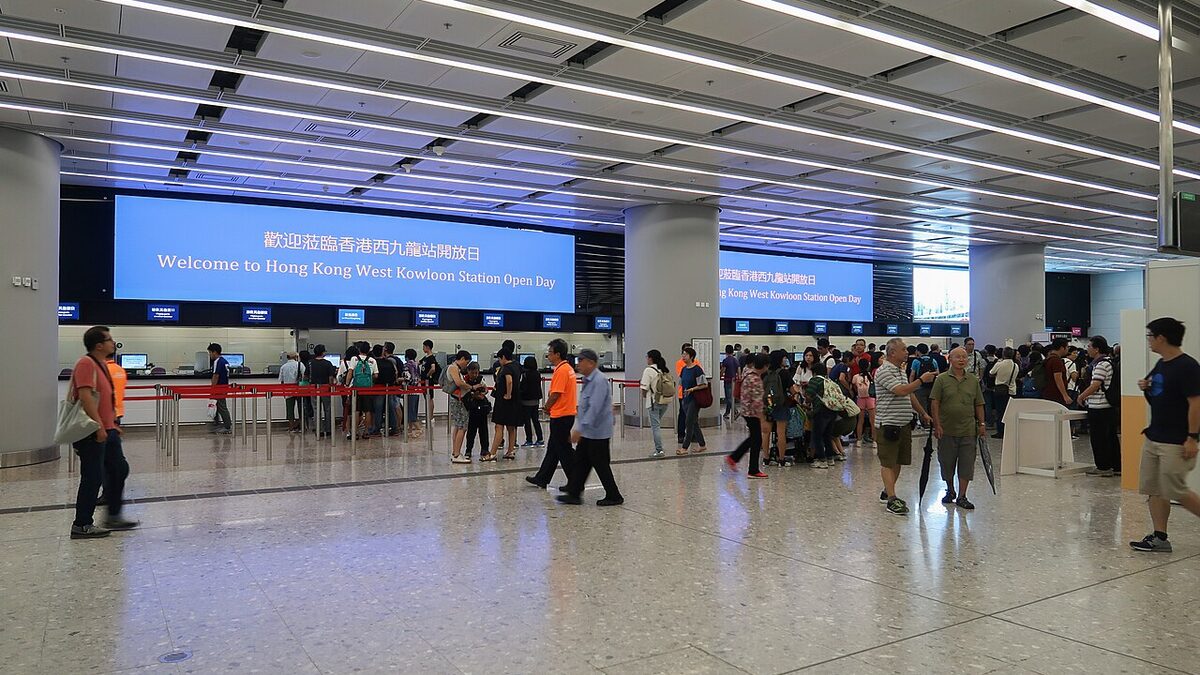
Cover image: The concourse of Hong Kong West Kowloon Station, the city's high-speed rail terminus (2018 file photo) — photo by Wpcpey, CC BY-SA 4.0, via Wikimedia Commons.
Hong Kong is clearing as many non-mainland visitors as a year ago, but fewer of them at the airport. A Travel Market News analysis of Hong Kong Immigration Department data shows that non-mainland visitor arrivals at Hong Kong International Airport fell year on year in each of the five months from June to October 2026, while arrivals by high-speed rail at West Kowloon and through the Shenzhen land crossings rose every month.
Across June to October the airport recorded 2,661,542 arrivals in the department's "Other Visitors" category, down 107,803 or 3.9 per cent on the same months of 2025, by our calculation. West Kowloon gained 76,749 (up 27.0 per cent) and the Shenzhen land crossings 103,977 (up 19.7 per cent). The total across all control points barely moved, at 4,652,557.
What do Hong Kong visitor arrivals by control point show for 2026?
The shift began in June. From January to May, non-mainland arrivals at the airport were 5.1 per cent ahead of 2025. Then came falls in June (5.3 per cent), July (0.4), August (8.8), September (2.8) and October (2.4, to 671,109).
In 2025 the airport figure rose in all 12 months.
Rail and road went the other way. West Kowloon's monthly growth ran between 24 and 31 per cent from June to October, and the Shenzhen crossings between 18 and 23 per cent. Their combined share of the total rose from 17.4 to 21.3 per cent, while the airport's slipped from 59.4 to 57.2 per cent.
| Control point group | Jun–Oct 2025 | Jun–Oct 2026 | Change | Jan–Oct 2026 | Change on Jan–Oct 2025 |
|---|---|---|---|---|---|
| Airport | 2,769,345 | 2,661,542 | -3.9% | 5,784,720 | +0.8% |
| High-speed rail (West Kowloon) | 284,553 | 361,302 | +27.0% | 708,780 | +31.4% |
| Shenzhen land crossings | 527,666 | 631,643 | +19.7% | 1,237,205 | +19.6% |
| Hong Kong-Zhuhai-Macao Bridge | 710,322 | 683,581 | -3.8% | 1,450,434 | +0.4% |
| Sea terminals | 366,681 | 314,489 | -14.2% | 803,462 | -8.6% |
| All control points | 4,658,567 | 4,652,557 | -0.1% | 9,984,601 | +3.6% |
"Other Visitors" arrivals. Source: Travel Market News calculation from the Immigration Department's daily passenger traffic file, downloaded 13 November 2026.
How much of this year's growth came through the airport?
Very little. For January to October, non-mainland arrivals at all control points rose 3.6 per cent to 9,984,601, an increase of 346,351. The airport supplied 44,963 of that, or 13 per cent. West Kowloon and the Shenzhen crossings added 371,907 between them, more than the whole net gain, because arrivals at the sea terminals fell by 75,759.
Who is counted, and what can the figures not tell us?
The file has three traveller categories: Hong Kong Residents, Mainland Visitors and Other Visitors. The department publishes no definition of the last. It is everyone who is neither a Hong Kong resident nor a mainland visitor, which on our reading includes residents of Macao and Taiwan. It is not a count of foreign tourists.
The numbers are clearances, not people. A visitor who lands at the airport, takes a day trip to Shenzhen and comes back is counted again at the boundary. Growth at the land crossings and West Kowloon therefore mixes first entries from mainland China with returns from side trips. The file cannot separate the two, and it does not say why the airport count fell.
The series starts on 1 January 2021, so there is no 2019 comparison. "Shenzhen land crossings" is our grouping of the road and local rail boundary points, including the rebuilt Huanggang Port, which opened on 12 October according to The Standard and replaces Lok Ma Chau in the file from that date. Our tally for 2025 is 12.08 million; the department's year-end review gave "around 12.06 million".
What has the Hong Kong Tourism Board said about non-mainland markets?
HKTB reports by market, not by gateway. It put non-mainland visitors at 6.16 million for the first half, up 5 per cent, The Standard reported on 16 July; our clearance count for the same months is 6.17 million. For September, the board said long-haul arrivals rose 20 per cent while short-haul markets fell 9 per cent, which it linked to factors such as flight capacity constraints and fuel surcharges, the newspaper reported on 15 October.
Our figures cannot test that reading. We found no HKTB figures for October when we checked on 13 November 2026.
Elsewhere, we have reported on Japan's September arrivals, the Vietnam and Thailand arrivals race and China's visa-free list.
Frequently asked questions
Who counts as a non-mainland visitor in the Hong Kong Immigration Department data?
The department's daily file sorts travellers into Hong Kong Residents, Mainland Visitors and Other Visitors, without defining them. Other Visitors is everyone in neither of the first two groups, which on our reading includes residents of Macao and Taiwan. The file does not show nationality or purpose of visit.
Are fewer overseas visitors flying into Hong Kong in 2026?
For the first ten months, no: non-mainland arrivals at the airport rose 0.8 per cent to 5,784,720, by our calculation. But they fell year on year in each month from June to October, by 3.9 per cent over the five months.
Does the data show visitors are choosing rail over flights to reach Hong Kong?
Not directly. The figures count clearances, not people or itineraries. A visitor who flies in, spends a day in Shenzhen and returns is counted again at the land crossing or West Kowloon, so the rise in rail and land arrivals mixes first entries with re-entries.
Can Hong Kong visitor arrivals by control point be compared with 2019?
Not from this source. The Immigration Department's open-data file begins on 1 January 2021, when most crossings were shut, so it offers no pre-pandemic baseline.
Sources
- Hong Kong Immigration Department, Statistics on Daily Passenger Traffic (CSV)
- Immigration Department, data specification for the daily passenger traffic file
- Immigration Department, 2025 year-end review
- The Standard, Visitor arrivals surge 22pc in September to over 4m
- The Standard, Hong Kong sees 13pc surge in visitor arrivals in first half of 2026
- The Standard, Mainland travellers praise fast clearance at new Huanggang Port