Qantas disputes facts in the Virgin Australia–Air New Zealand codeshare application; airports want a capacity floor and agents want commissions excluded, ACCC submissions show.
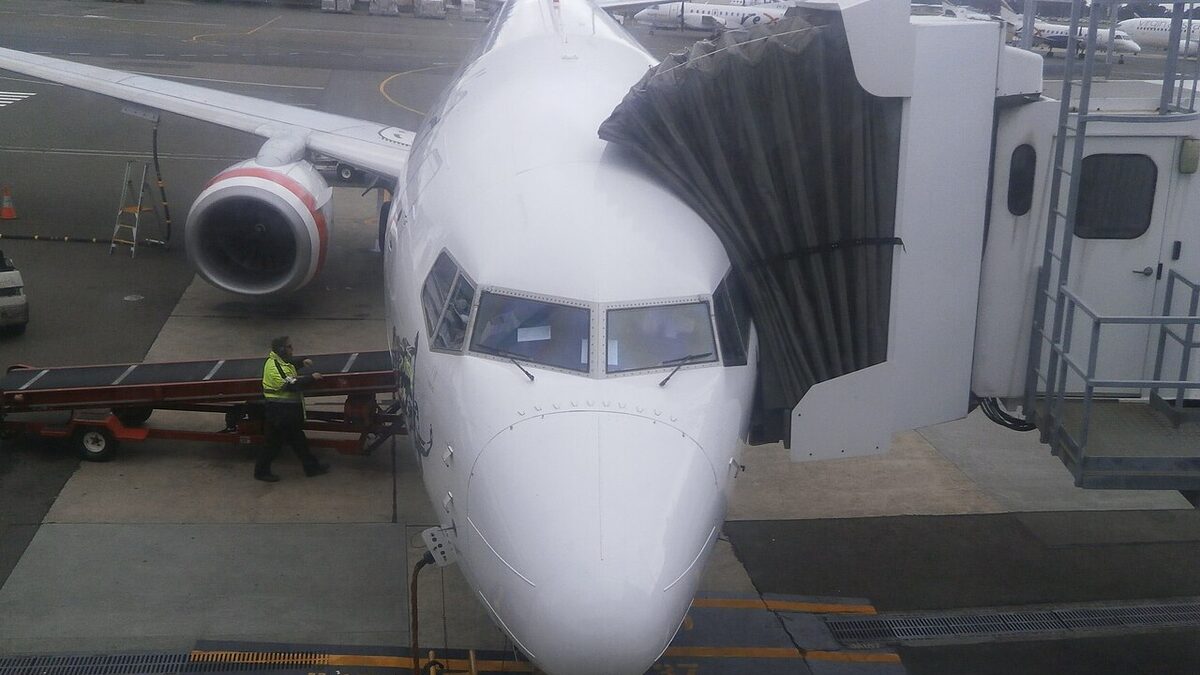
Cover image: A Virgin Australia Boeing 737-800 at a gate at Sydney Airport (file photo) — photo by HutheMeow, CC BY-SA 4.0, via Wikimedia Commons.
Qantas has told Australia's competition regulator that the application to expand the Virgin Australia–Air New Zealand codeshare contains "factual inaccuracies and inconsistencies", and has put numbers on what travellers lose when its own Air New Zealand partnership stops. From early April 2027, Qantas says, Air New Zealand customers lose access to 85 codeshare routes on its network and to 24 Qantas domestic lounges. "Virgin Australia has seven," the letter adds.
The letter is one of eight submissions, seven from organisations, published on the Australian Competition and Consumer Commission (ACCC) register by 3 November 2026. That the Qantas–Air New Zealand codeshare ends on 7 April 2027 has been public since October. In the submissions, New Zealand's airports want conditions, and Australia's travel agents want their pay kept out.
What Did Qantas Tell the ACCC About the Virgin Australia–Air New Zealand Codeshare?
The letter, dated 23 October and signed by Cam Wallace, chief executive of Qantas International and Qantas Freight, says the Qantas Group "does not object", then lists five points it wants tested.
Qantas says it decided to end its own codeshare arrangement "as a consequence" of the proposed alliance. More than 40 per cent of the 85 routes are not served by Virgin Australia, it says.
On market power, Qantas uses the applicants' own tables. Air New Zealand (40 per cent) and Virgin Australia (4 per cent) would hold about 44 per cent of trans-Tasman available seat kilometres against the Qantas Group's 51 per cent.
The airline also asks whether Virgin Australia can ring-fence Qatar Airways, one of the fifth-freedom carriers on the Tasman, from its strategy with Air New Zealand. Qantas objects, too, that a NERA economic report has not been released.
What Conditions Do New Zealand's Airports Want?
Auckland Airport supports the application as "on balance better than the status quo", with three conditions: the Qantas codeshare ends and is not replaced; Air New Zealand's trans-Tasman capacity (excluding Queenstown) stays at or above 3.65 million seats a year, its 2026 level; and the deal never applies where the two airlines compete.
Citing Cirium, the airport says the average one-way trans-Tasman fare was NZ$492 in the year to July 2026, up 72 per cent since 2019.
The NZ Airports Association, which represents 49 airports, wants annual reporting on seats and fares, and limits so that network planning "does not become an agreement on which routes each Applicant will or will not fly". Its Cirium analysis shows the Qantas Group and Air New Zealand scheduled to provide about 91 per cent of trans-Tasman seats in 2026, up from 72 per cent in 2019, when Virgin Australia had 18 per cent.
The association counts 9.47 million seats scheduled for 2026 against 9.95 million on flights operated in 2019. That is 4.8 per cent fewer by our calculation, though scheduled and operated seats are not like-for-like.
Why Are Travel Agents Objecting to Part of the Deal?
The application's scope includes "potential cooperation in relation to pricing for agents in relation to codeshare services, including public and private fares, rebates, incentives and discounts".
The Australian Travel Industry Association (ATIA) calls that wording broad. Its letter of 26 October, signed by chief executive Dean Long, says authorisation "should not extend to coordination of agency remuneration and other commercial arrangements". It notes that the pair's 2024 authorisation did not cover agency arrangements. See how travel agent commission works.
Who Filed, and What Happens Next?
| Party | Date (2026) | Position | Main request or claim |
|---|---|---|---|
| Qantas | 23 October | Does not object; disputes facts | Says 85 codeshare routes and 24 lounges are lost |
| Auckland Airport | 28 October | Supports, with three conditions | Floor of 3.65 million Air New Zealand seats a year |
| NZ Airports Association | 28 October | Supports, with conditions | Annual public reporting on capacity and fares |
| Australian Travel Industry Association | 26 October | Does not oppose the codeshare | Exclude agency remuneration |
| Christchurch Airport | 21 October | Benefits “modest but beneficial” | Calls trans-Tasman competition “poor” |
| Canberra Airport | 21 October (date on register) | Supports | Suggests a three-year term, not five |
| Board of Airline Representatives of Australia | 3 November | Endorses | None |
Every figure above is a party's own claim, not a finding. As of 13 November 2026 the register showed the application, which seeks a five-year term, as "under consideration", with no reply from the applicants published. The ACCC's indicative timetable puts a draft determination in November. A parallel application is before New Zealand's Minister of Transport, the NZ Airports Association's submission says.
Frequently asked questions
When does the Qantas–Air New Zealand codeshare end?
On 7 April 2027, according to submissions to the ACCC from Auckland Airport, Christchurch Airport and the NZ Airports Association. Christchurch Airport says it ends regardless of the regulator's decision on the Virgin Australia deal, and that Qantas can still interline passengers onto Air New Zealand's regional services.
Has the ACCC approved the Virgin Australia–Air New Zealand codeshare?
No. As of 13 November 2026 the ACCC register lists application AA1000742 as under consideration. Its indicative timetable shows a draft determination in November 2026 and a final determination in January or February 2027. A one-way codeshare approved in 2024 remains authorised until 30 June 2029.
Does Qantas oppose the Virgin Australia–Air New Zealand deal?
Not formally. Its letter of 23 October 2026 says the Qantas Group does not object, but asks the ACCC to test what it calls factual inaccuracies and inconsistencies, including the applicants' combined share of trans-Tasman capacity, redacted evidence and Virgin Australia's ties with Qatar Airways.
Would the codeshare cover Queenstown flights?
No. The application excludes routes where the two airlines compete, which today means Virgin Australia's Queenstown services, although frequent-flyer and status benefits would still apply there. Auckland Airport and the NZ Airports Association want that carve-out made a formal condition of any authorisation.
Sources
- ACCC authorisations register, AA1000742
- ACCC, submission by Qantas
- ACCC, submission by Auckland International Airport
- ACCC, submission by NZ Airports Association
- ACCC, submission by Australian Travel Industry Association
- ACCC, submission by Christchurch Airport
- CAPA, Air New Zealand applies for expanded Virgin codeshare