How franchises, management contracts, leases and manchise deals split control, staff, risk and fees, and why Hilton, Marriott, IHG and Hyatt own so few hotels.
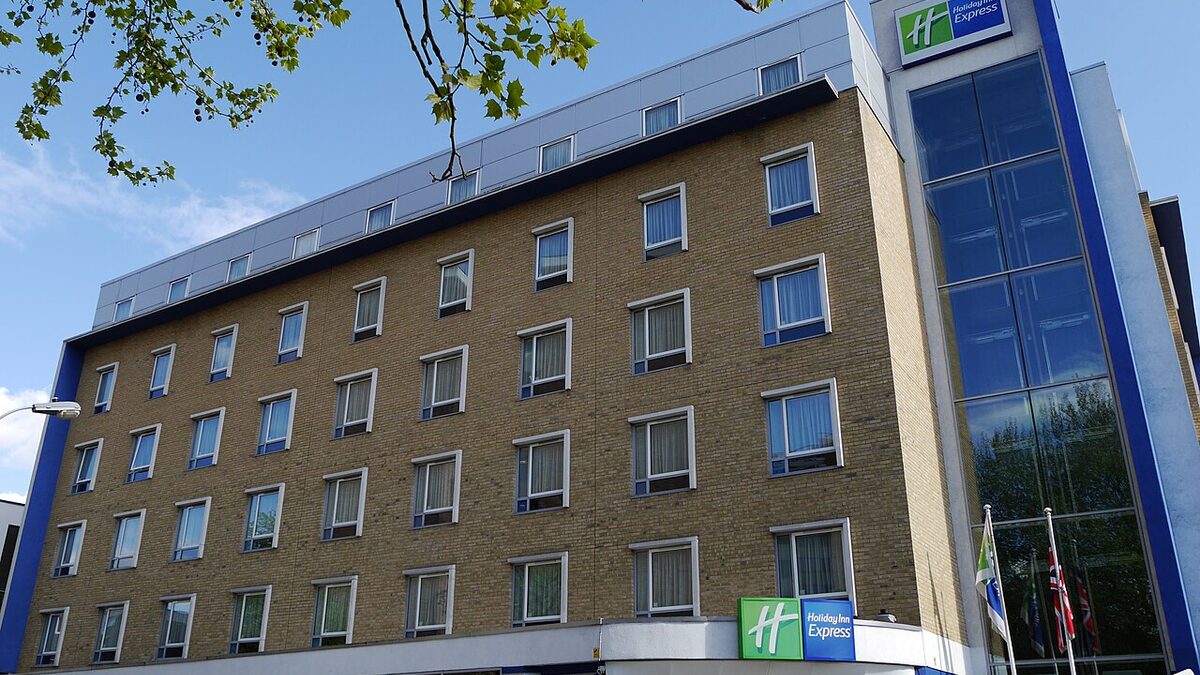
Cover image: A Holiday Inn Express hotel in Fulham, London (2015 file photo) — photo by Edwardx, CC BY-SA 4.0, via Wikimedia Commons.
The hotel franchise vs management contract question comes down to who runs the building. A franchisee licenses a brand's name, standards and booking systems and operates the hotel itself or through an operator it hires. Under a management contract, the brand's own team runs the hotel for the owner. Either way, the owner usually holds the property, pays the operating costs and keeps the profit or loss, while the brand collects fees.
At 31 December 2025, Hilton, Marriott International, IHG Hotels & Resorts and Hyatt each owned or leased 2.5 per cent of their rooms or less, by our analysis of their filings. The type of contract decides who employs the staff, who absorbs a bad year and who signs your rate agreement.
Last checked: 1 November 2026.
Hotel franchise vs management contract: what is the difference?
A franchise is a licence. Hilton's 2025 annual report (Form 10-K) says it does "not own, manage or operate franchised properties" and does not employ their staff. It inspects the hotels and can require a property improvement plan (PIP) to keep them in the system.
A management contract is a service agreement. The owner pays the operating expenses and in return approves the annual operating and capital budgets and, in most cases, certain key appointments, Hilton says.
Both contracts are long. Hilton and Marriott put initial management terms at 20 to 30 years, against 10 to 25 years for Marriott franchises.
Where do leases, third-party operators and manchise deals fit?
In a lease, the operator rents the building, keeps the hotel's revenue and profit and pays the owner rent. Hilton's ownership segment held 46 hotels at the end of 2025, 42 of them leased; 37 of the 46 were in Europe.
A franchised hotel still needs an operator: the owner's own team or an independent (third-party) management company.
A manchise blends the two. Timothy Marvin of JLL Hotels & Hospitality defined it in LODGING Magazine in 2019 as "a brand management contract that can be converted to a franchise agreement". On conversion a third-party manager replaces the brand, which keeps its royalty and distribution fees. Brands offer the option, Marvin wrote, because they find it "increasingly difficult to obtain management contracts".
| Feature | Franchise | Management contract | Lease | Manchise |
|---|---|---|---|---|
| Who runs the hotel | Owner, or an operator it hires | The brand, for the owner | The tenant-operator | Brand, then a third-party operator |
| Who keeps the profit or loss | Owner | Owner, which pays operating costs | Tenant, after rent | Owner |
| How the brand is paid | Royalty on rooms revenue (4–7% at Marriott) plus programme fees | Base fee of 2–4% of total revenue plus incentive fee on profit (HVS) | Keeps hotel profit; pays rent, which can be fixed plus a revenue share (Marriott) | Management fees, then royalty and distribution fees |
| Typical initial term | About 20 years (Hilton new hotels, Hyatt); 10–25 years (Marriott) | 20–30 years (Hilton, Marriott) | Varies (Marriott) | Usually matches the franchise term (LODGING) |
| Share of rooms, end-2025 (our calculation) | Franchised or licensed: Hilton 79%, IHG 73%, Marriott 66%, Hyatt 37% | Hyatt 60%, Marriott 32%, IHG 27%, Hilton 20% | Owned or leased: 0.4% (IHG) to 2.5% (Hyatt) | Not disclosed |
Who employs the staff and who carries the operating risk?
Employment follows the operator, with a twist outside the United States. At managed hotels, Hilton says, "often, particularly in the U.S., we employ the individuals working at these locations". It employed or managed about 182,000 people at leased and managed hotels and offices at the end of 2025; another 328,000 worked at its franchised hotels for third-party owners.
Marriott counted about 266,000 workers "employed by our hotel owners but whose employment is managed by Marriott (which is common outside the U.S.)". IHG typically employs a managed hotel's general manager and sometimes other staff.
The owner carries most of the operating risk under both contracts. Hyatt's 10-K says downturns hit owned and leased hotels harder than managed and franchised ones because of fixed costs and "the greater exposure owners have to the properties' performance".
Brands are not risk-free. Hilton's performance guarantees carried possible cash outlays of $22 million at the end of 2025, and IHG spent $177 million in 2025, net of repayments, on "key money" paid to win contracts.
What fees do hotel owners pay under each model?
Franchise fees fall mainly on rooms revenue. Marriott's royalties "typically range from four to seven percent of room revenues", plus up to 4 per cent of food and beverage revenue for some brands. Hyatt's are typically 2.75 to 5 per cent of gross rooms revenue.
Programme fees for marketing, reservations, technology and loyalty come on top in both models. Including them, the 2025 HVS US franchise fee guide put average total franchise cost at 9.6 per cent of rooms revenue for economy brands and 12.9 per cent for high-end brands, HOTELS magazine reported in August 2026.
Management fees have two tiers. HVS's Marcus Lee wrote in April 2024 that a base fee of 2 to 4 per cent of total operating revenue is typical, 3 per cent being the most common, plus an incentive fee of 10 to 20 per cent of cash flow above an owner return of 8 to 12 per cent on investment.
A worked example shows why the base matters. A hypothetical 200-room hotel at 70 per cent occupancy and a $150 average daily rate sells 51,100 room nights, or $7.665 million of rooms revenue a year. Assume other income lifts total revenue to $10 million.
- Franchise: a 4 to 7 per cent royalty costs $306,600 to $536,550. At HVS's 12.9 per cent high-end average, the brand bill is about $989,000, before the owner pays an operator.
- Management contract: a 3 per cent base fee costs $300,000, due even in a loss-making year. A 10 per cent incentive fee on $1 million of profit above the owner's threshold adds $100,000, plus programme fees.
Why are Hilton, Marriott, IHG and Hyatt asset-light?
Because owners supply the capital. "Under our asset-light business model, we typically franchise, manage, or license hotels and other lodging offerings, rather than own them," Marriott's 10-K says. Hilton grows "with limited or no capital investment" because owners pay to build, renovate and maintain the hotels. IHG calls itself "an asset-light business", and Hyatt chief executive Mark Hoplamazian cited its "asset-light business model" in third-quarter results on 29 October 2026.
Fees are a thin slice of hotel revenue. IHG earned $1.90 billion from its fee business in 2025, while hotels in its system generated $35.2 billion of total gross revenue, nearly all of it belonging to owners.
Hyatt shows the model at work. It bought resort owner Playa Hotels & Resorts in June 2025, then sold all 15 owned resorts and signed long-term management agreements for 13 of them. Its third-quarter 2026 adjusted EBITDA rose 6.2 per cent, or 19 per cent after adjusting for assets sold in 2025, the company said. Our Hilton and Hyatt third-quarter 2026 results report has the detail, and our 2026 hotel industry performance tracker follows the RevPAR trend.
Regional mixes differ sharply. By our calculation, only 9.3 per cent of Hilton's US rooms were managed at the end of 2025, against 45 per cent in Asia Pacific and 81 per cent in the Middle East and Africa. Hyatt managed 91 per cent of its rooms in Asia Pacific outside Greater China.
What does the contract model mean for owners and travel buyers?
Owners trade control for expertise. A franchisee chooses who runs the hotel but funds PIPs and owes liquidated damages if the agreement ends early (at Hilton, on the franchisee's default; at Hyatt, typically for any reason). A managed hotel gets the brand's team for decades; owners can exit some contracts after failed performance tests, though Hilton says it can often cure by paying the shortfall.
For corporate buyers, agents and event planners, the brand over the door does not say who the counterparty is. Hilton says it has no legal responsibility for the liabilities of operating franchised hotels, so check which entity signs a group or negotiated-rate contract. Brand booking channels and loyalty points are available in both models because owners pay for them through programme fees; our hotel loyalty programmes comparison covers the schemes.
Flags change, too. Marriott added roughly 33,400 rooms converted from rival brands in 2025, so multi-year agreements should cover a mid-term change of brand or operator.
Frequently asked questions
Is a hotel franchise cheaper than a management contract?
Not necessarily, as they are not like for like. A franchisee pays a royalty on rooms revenue, typically 4 to 7 per cent at Marriott, plus programme fees, then pays an operator. A managed hotel pays a base fee on total revenue, most commonly 3 per cent according to HVS, plus an incentive fee on profit.
Who employs the staff at a franchised hotel?
The owner, or the management company it hires: Hilton and IHG employ no one at franchised hotels. At managed hotels the brand is often the legal employer in the United States, while elsewhere owners commonly employ staff whose employment the brand manages, as Marriott's 2025 annual report notes.
What is a manchise agreement?
An informal industry term for a brand management contract that the owner can later convert into a franchise. The brand runs the hotel first; on conversion a third-party operator takes over and the brand keeps its royalty and distribution fees, as JLL's Timothy Marvin described it in 2019.
What does asset-light mean for hotel companies?
Earning fees from hotels that other people own. At 31 December 2025 Hilton owned or leased 1.1 per cent of its rooms, Marriott 0.8 per cent, IHG 0.4 per cent and Hyatt 2.5 per cent, by our calculation. Owners fund construction, though brands still spend on key money and guarantees.
Sources
- Hilton, 2025 Form 10-K
- Marriott International, 2025 Form 10-K
- IHG Hotels & Resorts, Annual Report and Form 20-F 2025
- Hyatt, 2025 Form 10-K
- Hyatt, Q3 2026 results release
- HVS, A New Approach to Hotel Management Fees
- HOTELS, Is the hotel franchise agreement still equitable?
- LODGING Magazine, Manchise agreements: what to know