Hidden-city ticketing saves real money and can cost you every mile you own. A $9.4m verdict, a $1,315 bill to an elite flyer, and why airlines now hunt patterns rather than incidents.
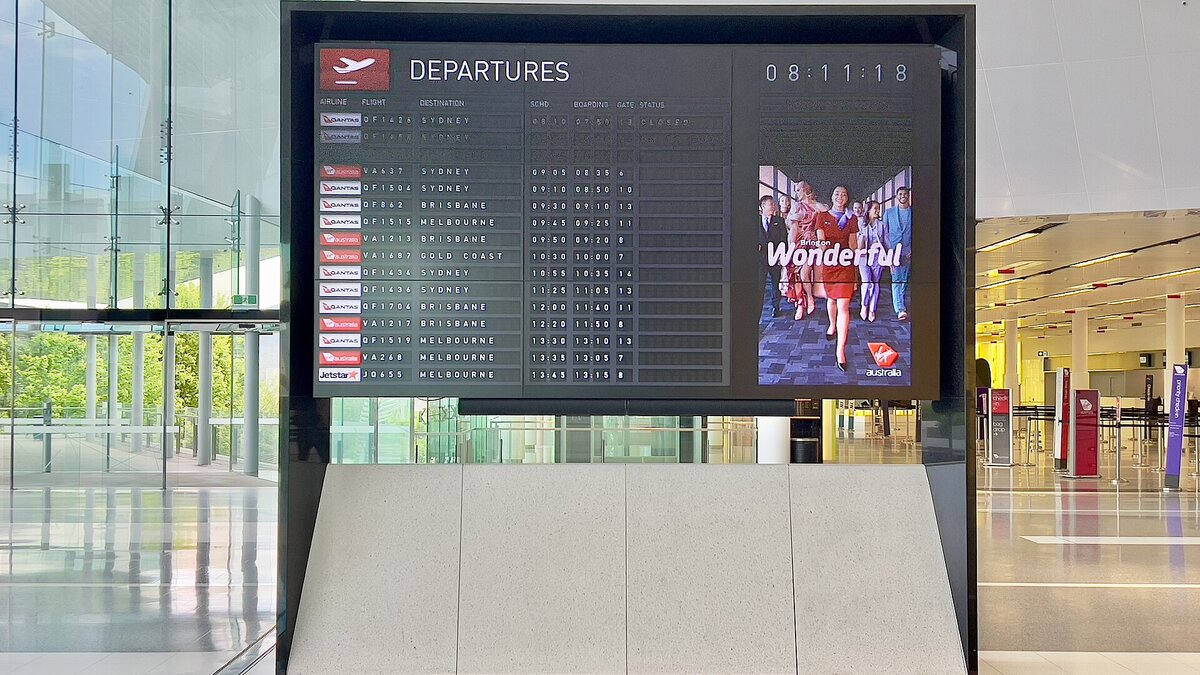
Cover image: An airport flight information display board showing departures, the screen where hidden-city itineraries are built — photo by Kgbo, CC BY-SA 4.0, via Wikimedia Commons.
Skiplagging saves real money and can cost you your entire frequent-flyer account. The trick — buying a connecting ticket and walking out at the layover, because a flight to a hub often costs more than a flight through it — is all over social media as a life hack. What the videos leave out is the enforcement record: a $9.4 million jury verdict, elite flyers billed for years of fare differences, and airlines that now detect the pattern rather than the incident.
What hidden-city ticketing actually is
Say you want to fly to a busy hub city. A direct ticket there is expensive, because the airline dominates that route. But a connecting ticket to a smaller city via that same hub is cheaper, because on that route the airline is competing with others.
So you book the longer, cheaper itinerary and simply do not board the final leg. You have arrived where you wanted for less than the direct fare. The price gap is not a glitch. It is the visible edge of hub-and-spoke revenue management, where fares reflect competition on a route rather than distance flown — the same economics we unpack in how low-cost airlines actually make money.
The $9.4 million verdict
On 15 October 2024, a federal jury in Fort Worth awarded American Airlines $9.4 million against Skiplagged Inc., the booking site built around surfacing these fares.
The award split evenly: $4.7 million in actual damages for copyright infringement and $4.7 million in disgorgement of revenue the jury deemed ill-gotten. Notably, American had asked for $94.4 million — ten times what it got — and the jury awarded nothing on the trademark claims. Both sides appealed to the Fifth Circuit, where briefing was still under way in early 2026.
Read carefully, that verdict is narrower than the headline suggests. American won on copyright and on disgorgement, not on a finding that the practice itself is illegal for passengers.
What happens to passengers, not websites
This is the part the hack videos skip. In 2019 American Airlines emailed an Executive Platinum member — its top published elite tier — alleging 15 instances of hidden-city ticketing across roughly three years.
The airline demanded $1,315 in fare differences, gave one week to pay, and set out what would follow if the passenger did not: forfeiture of all accrued miles, loss of elite status, and a permanent ban from the AAdvantage programme.
That is the asymmetry. The saving is per-trip and modest. The penalty is cumulative and lands on a mileage balance built over years — the sort of balance that takes real effort to accumulate, as anyone working through transferable points and credit-card programmes will recognise.
Detection moved from incidents to patterns
A single missed connection is indistinguishable from a passenger who overslept. That is why enforcement was historically rare.
What changed is analysis. Airlines cross-reference no-show records against frequent-flyer accounts, and repeated no-shows at the same connecting city, tied to one named traveller, stop looking like bad luck. The signal is not the flight you missed; it is the shape of the twentieth one.
This is also why the practice is riskiest for exactly the people best placed to exploit it. An anonymous once-a-year traveller is close to invisible. A frequent flyer with status has a named, permanent record attached to every booking.
The courts have not settled it
Airlines have not had things their own way. In 2018 Lufthansa sued a passenger who had bought a business-class round trip from Oslo to Seattle via Frankfurt, skipped the return leg and flew to Berlin instead.
A Berlin court dismissed the claim in December 2018. Lufthansa appealed — then withdrew the appeal on 2 October 2019 without explanation, which made the dismissal binding. A Spanish court likewise sided with a passenger against Iberia, the judge observing that it is for the passenger to decide what to do with a ticket they have paid for.
But a dismissal is not a licence. Those rulings turned on whether particular contract terms were enforceable in those jurisdictions. Neither established a passenger right to fly segments out of order, and neither stops an airline from closing a loyalty account — a commercial decision, not a legal one.
The practical traps that catch people first
Long before any airline lawyer gets involved, hidden-city itineraries fail for mundane reasons:
- You cannot check a bag. Checked luggage is tagged to the final ticketed destination. Everything must be carry-on, within the limits set out in our guide to baggage rules.
- It only works one way. Skip a leg and the airline cancels every remaining coupon on that ticket, including your return. Hidden-city trips must be booked as one-ways.
- The airline can reroute you. Schedule changes and irregular operations get fixed by putting you on a different connection — through a hub you did not want, defeating the entire plan with no recourse.
- Your loyalty number is the evidence. Omitting it protects you from pattern-matching, but then you earn nothing, which removes much of the reason frequent flyers bother.
- Immigration assumes you are travelling to the ticketed destination. On international itineraries, disembarking early can raise questions you would rather not answer at a border.
So is it worth it?
For an occasional traveller with hand luggage only, no status and no loyalty balance to lose, the arithmetic can work on a one-way domestic hop.
For anyone with meaningful status or a large mileage balance, it is a bad trade. You are risking an asset built over years to save a fraction of one fare, and the detection method is specifically good at catching repeat use — which is the only way the savings ever add up to real money.
The honest summary: it is not illegal, it is a breach of the contract you agreed to, the websites promoting it have lost in court, and the penalty falls on the traveller rather than the tool. If you want reliably cheaper fares to Southeast Asia, routing and timing beat contract-edge tactics — see our cheapest ways to travel Southeast Asia from India.
Frequently asked questions
Is skiplagging illegal?
No. It is not a criminal act. It is a breach of the airline's conditions of carriage, which is a contract matter. Airlines respond commercially — billing fare differences, closing loyalty accounts, forfeiting miles — rather than by pressing criminal charges.
Can an airline take my miles for hidden-city ticketing?
Yes. In 2019 American Airlines told an Executive Platinum member it would forfeit all accrued miles, remove elite status and permanently ban the account over 15 alleged instances, alongside a $1,315 demand for fare differences.
Why did American Airlines win $9.4 million against Skiplagged?
A Fort Worth jury awarded it on 15 October 2024 — $4.7 million for copyright infringement and $4.7 million in disgorgement. American had sought $94.4 million and won nothing on its trademark claims. Both sides appealed to the Fifth Circuit.
Can I check a bag on a hidden-city ticket?
No. Checked bags are tagged through to the ticketed final destination, so they would continue on the leg you intend to skip. Hidden-city itineraries only work with carry-on baggage.
Does skipping a leg cancel my return flight?
Yes. Airlines cancel the remaining coupons on a ticket once a segment is not flown, so the return is void. This is why hidden-city bookings are made as one-way tickets only.
Sources
- American Airlines Inc. v. Skiplagged Inc., jury verdict, US District Court for the Northern District of Texas (Fort Worth), 15 October 2024; appeals pending before the Fifth Circuit
- Reporting on American Airlines' 2019 fare-difference demand to an AAdvantage Executive Platinum member
- Berlin district court dismissal of Lufthansa's claim, December 2018; appeal withdrawn 2 October 2019
- Spanish court ruling in favour of a passenger against Iberia