Korea's transport ministry approved Jin Air's absorption of Air Busan and Air Seoul for a 17 March 2027 launch; shareholder votes have moved to 3 February 2027.
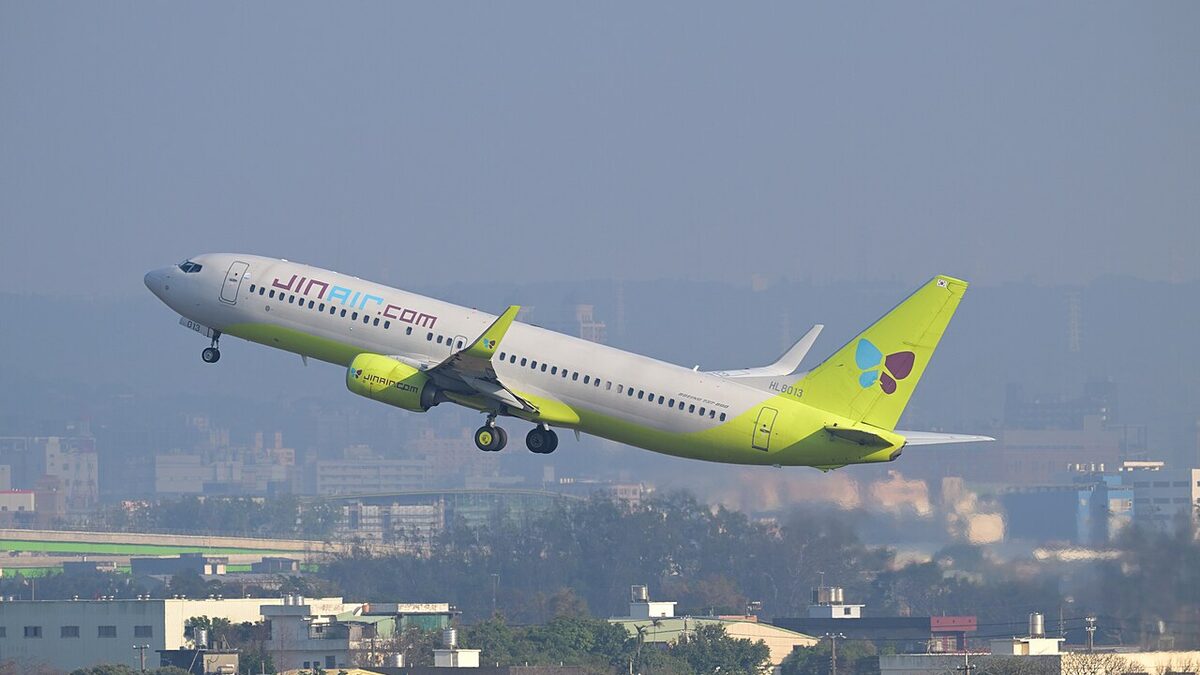
Cover image: A Jin Air Boeing 737-800 departing Taoyuan, February 2026 (file photo) — photo by 4300streetcar, CC BY 4.0, via Wikimedia Commons.
South Korea's transport ministry approved Jin Air's absorption of Air Busan and Air Seoul on Thursday 12 November, clearing the Korean Air group's three low-cost carriers (LCCs) to fly as one airline under the Jin Air name from 17 March 2027. The Ministry of Land, Infrastructure and Transport (MOLIT) attached conditions on safety and consumer protection, and the Fair Trade Commission has cleared the deal.
The Jin Air, Air Busan and Air Seoul merger still needs its shareholders. On Monday 16 November the boards of Jin Air and Air Busan moved the votes from 7 December to 3 February 2027, their filings on Korea's DART disclosure system show. Jin Air says the merger terms are unchanged. It gives no reason for the move.
What conditions did MOLIT attach to the Jin Air, Air Busan and Air Seoul merger?
By launch day the merged carrier must pass a safety-management-system change inspection and secure foreign aviation authorities' approvals. It must also report to MOLIT every month on the plans it submitted, including consumer protection, MOLIT's release says.
All three airlines belong to the Hanjin group, and under Korea's merger guidelines a combination of affiliates is presumed not to restrict competition.
Park Jun-sang, director of MOLIT's aviation industry division, said the ministry would "strictly manage and supervise" both of the group's integrations "so that no safety problems arise and consumer convenience does not decline" (our translation).
What still has to happen before the 17 March 2027 launch?
Each shareholder meeting must approve the merger with two-thirds of the votes present and a third of all issued shares, Jin Air's filing says. The parties can also walk away if dissenting shareholders' buy-back claims exceed KRW 200bn in total.
The exchange ratio is fixed at 0.2862684 new Jin Air shares per Air Busan share and 0.7501939 per Air Seoul share. Asiana Airlines owns 58.40% of Air Busan and all of Air Seoul. Jin Air and Air Busan have called shareholder briefings for 24 November.
| Step | Date | Status |
|---|---|---|
| Boards approve merger; agreement signed | 21 Aug 2026 | Done |
| Vietnam competition approval | 1 Oct 2026 | Done |
| MOLIT approval; FTC clearance announced | 12 Nov 2026 | Done |
| Jin Air and Air Busan shareholder votes | 3 Feb 2027 (was 7 Dec 2026) | Pending |
| Buy-back claims by dissenting Jin Air shareholders | 3–23 Feb 2027 | Pending |
| Safety inspection and foreign aviation approvals | Before launch | Pending |
| Legal merger date | 16 Mar 2027 | Scheduled |
| Combined Jin Air launches | 17 Mar 2027 | Scheduled |
How big will the combined Jin Air be?
As of October the three airlines had 60 aircraft (Jin Air 33, Air Busan 21, Air Seoul six) against 45 at Jeju Air, the current market leader, The Asia Business Daily reported. From January to September they carried 15.64 million passengers, about 54% more than Jeju Air's 10.13 million.
It follows the full-service merger: the integrated Korean Air, fresh from record third-quarter revenue, launches on 17 December, MOLIT said. Korean Air should hold 58.14% of the enlarged Jin Air, up from 54.91% now, the filing estimates.
MOLIT, which says the merged airline will be Korea's largest LCC, will study ways to strengthen other LCCs.
What changes at Busan Gimhae and on routes to Japan and Southeast Asia?
Jin Air's "second hub" plan would take Gimhae's international network from 28 to 33 routes and from 281 to 339 weekly flights (about 21% more, our calculation). It keeps Air Busan's existing infrastructure, develops Gimhae as an independent maintenance base and rules out forced restructuring, MOLIT said.
Busan still wants the headquarters: its Gangseo District has sent Jin Air and Korean Air a formal proposal, The Korea Times reported. "For now, chances appear slim," an industry official told the paper.
For the trade in Japan, Southeast Asia and China, three Korean low-cost brands become one supplier in March. Jin Air's filing says the merger should cut inefficiency on overlapping routes and improve frequencies, slots and price competitiveness on short-haul routes to those markets. Demand is growing: South Korea passed 20 million foreign visitors this year, by the culture ministry's estimate.
Fares matter in a business where, as our guide to how low-cost airlines make money explains, the fare itself often loses money. "A broad-based rise in airfares is unlikely," Lee Yuncheol, vice chairman of the Korea Institute for Industrial Policy Studies, told The Asia Business Daily (as translated by the paper).
Frequently asked questions
When will Jin Air, Air Busan and Air Seoul become one airline?
From 17 March 2027, under the Jin Air name, MOLIT said; the legal merger date is 16 March. Jin Air is the surviving company and takes over the assets, liabilities, employees and legal status of Air Busan and Air Seoul, which will be dissolved.
Is the Jin Air merger final?
Not yet. MOLIT and the Fair Trade Commission have approved it, and Vietnam's competition authority cleared it on 1 October. Jin Air and Air Busan shareholders vote on 3 February 2027, and Jin Air must pass a safety-management-system change inspection and obtain foreign aviation approvals before the launch.
What is the merger ratio for Air Busan and Air Seoul shareholders?
Air Busan shareholders receive 0.2862684 new Jin Air shares per share and Air Seoul shareholders 0.7501939, according to Jin Air's filing. The 16 November timetable change left the ratio, merger values and buy-back prices unchanged, it says.
Will fares go up after the merger?
The Fair Trade Commission presumed no harm to competition because all three airlines are Hanjin affiliates. Experts quoted by The Asia Business Daily said ultra-low-fare competition may diminish somewhat, though one called a broad fare rise unlikely.
Sources
- MOLIT via Korea.kr (Korean), approval release, 12 November
- Jin Air on DART (Korean), amended merger decision report
- Air Busan on DART (Korean), amended meeting notice
- Jin Air on DART (Korean), shareholder briefing notice
- Air Busan on DART (Korean), shareholder briefing notice
- The Korea Times, FTC approves combination of Jin Air, Air Seoul, Air Busan
- The Asia Business Daily, Integrated Jin Air to launch in March 2027