Korean Air's preliminary Q3 revenue hit a record KRW 5.04 trillion, up 26%. Net profit rose tenfold, helped by currency effects, before the 17 December Asiana merger.
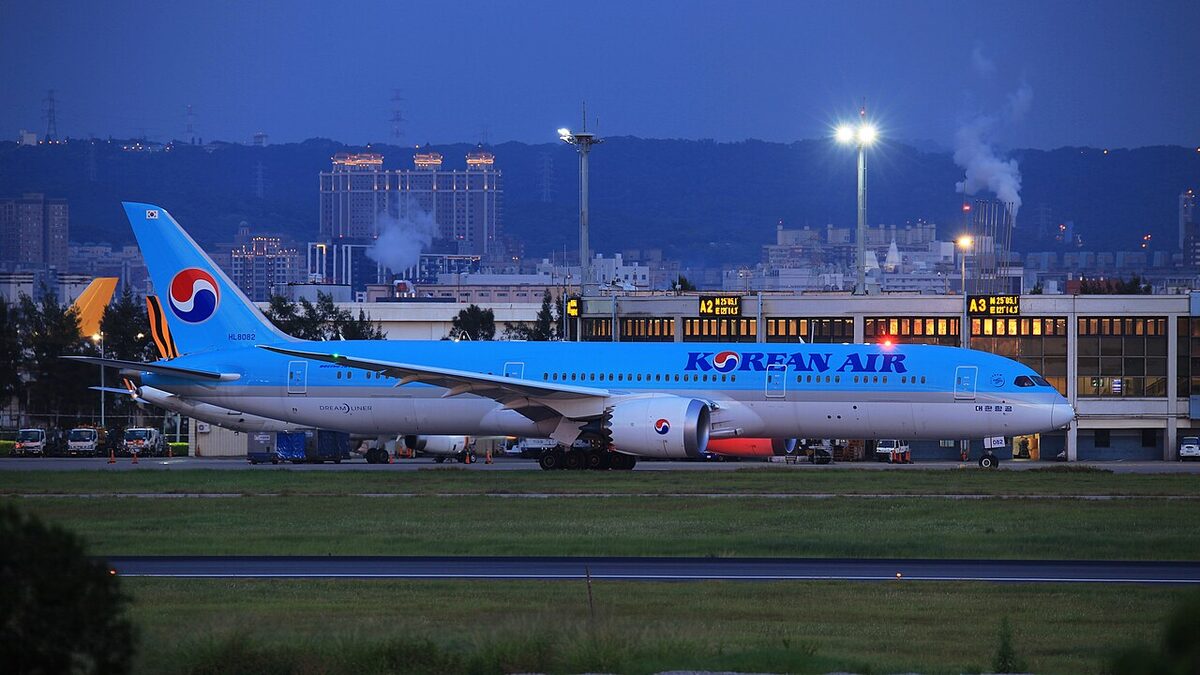
Cover image: A Korean Air Boeing 787-9 at Taiwan Taoyuan International Airport (file photo) — photo by Ltdccba, CC BY-SA 4.0, via Wikimedia Commons.
Korean Air reported record quarterly revenue of KRW 5.0448 trillion for July to September 2026, up 26 per cent year on year, in preliminary results released on Thursday 15 October. Operating profit rose 12 per cent to KRW 421.2 billion. Net profit climbed more than tenfold to KRW 929.7 billion from KRW 91.9 billion, on figures Yonhap describes as non-consolidated.
That last number flatters the quarter. Korean Air said net income was "driven in part by favorable foreign exchange translation effects as the USD/KRW exchange rate declined at the end of the third quarter". The results come two months before Asiana Airlines is integrated into Korean Air on 17 December, which changes alliance, loyalty and branding for travel sellers worldwide.
How much of Korean Air's tenfold profit jump came from currency?
Korean Air's statement gives no figure for the foreign-exchange gain.
The arithmetic is still telling. Net profit rose by KRW 837.8 billion while operating profit rose by KRW 44.9 billion, so, by our calculation, about 95 per cent of the improvement came from items below the operating line, which the airline attributes in part to currency translation. The Korea Herald described net income as "boosted by a lower won-dollar exchange rate at quarter's end". Translation gains come from restating foreign-currency balances in won, not from selling seats or freight space.
On our calculation, operating margin narrowed from about 9.4 per cent to 8.3 per cent. At roughly 1,343 won per US dollar, the rate implied by Yonhap's conversion of net profit to US$692.2 million, revenue equals approximately US$3.76 billion.
What drove passenger and cargo revenue?
Passenger revenue rose by KRW 496.3 billion to KRW 2.9174 trillion, about 20.5 per cent by our calculation. Outbound demand from Korea "softened slightly due to fuel surcharges and a weak Korean Won", the airline said, but "strong inbound traffic and transit demand via Incheon" offset it. Korean Air also added summer capacity to the Americas and Japan.
Cargo grew faster: up KRW 365.6 billion to KRW 1.4323 trillion, about 34 per cent by our calculation, on "steady demand for high-value AI and semiconductor components".
For the first nine months, the Korea Herald reports revenue of KRW 14.58 trillion, up 22 per cent. Compare other carriers in our 2026 airline results roundup.
| Korean Air, Q3 (KRW) | Q3 2026 (preliminary) | Q3 2025* | Change |
|---|---|---|---|
| Revenue | 5,044.8bn | 4,008.5bn | +25.9% |
| Passenger revenue | 2,917.4bn | 2,421.1bn | +20.5% |
| Cargo revenue | 1,432.3bn | 1,066.7bn | +34.3% |
| Operating profit | 421.2bn | 376.3bn | +11.9% |
| Operating margin | 8.3% | 9.4% | down about 1 point |
| Net profit | 929.7bn | 91.9bn | about 10.1 times |
*Prior-year figures and changes computed from Korean Air's reported numbers (via AJOT and Yonhap), except prior-year net profit, which Yonhap reports.
How did fuel costs affect the quarter?
Profits improved "despite fuel costs rising 67% year on year", according to FlightGlobal.
Korean Air expects fuel cost pressure to persist in the fourth quarter "due to the prolonged conflict in the Middle East". High jet-fuel costs are hitting carriers worldwide: Delta cut its profit guidance this month. It will lean on inbound and transit passengers and flex cargo capacity for the year-end peak.
What changes for the trade on 17 December?
Korean Air says it is "aligning its service protocols" ahead of the integration. As of 19 October 2026, the published timeline runs as follows.
Citing dates Star Alliance published on 22 June, Prince of Travel reports that Asiana leaves Star Alliance at 23:59 Korea Standard Time on 16 December, ending Star Gold and Silver benefits on Asiana. On 17 December the Asiana brand is absorbed and the combined airline operates within SkyTeam. Star Alliance plans its own Incheon lounge to fill the gap.
On loyalty, Upgraded Points reports that Asiana Club balances move into SKYPASS accounts that day, kept separately for 10 years. Asiana elites get comparable Korean Air status, and a Morning Calm Select Club tier with SkyTeam Elite Plus benefits launches on 28 October.
The group's low-cost subsidiaries Jin Air, Air Busan and Air Seoul plan to fly as one airline under the Jin Air name from 17 March 2027, subject to December shareholder votes and regulatory approval, The Star reported.
Frequently asked questions
What were Korean Air's third-quarter 2026 results?
In preliminary, non-consolidated figures released on 15 October 2026, Korean Air reported record quarterly revenue of KRW 5.0448 trillion, up 26 per cent. Operating profit rose 12 per cent to KRW 421.2 billion, and net profit reached KRW 929.7 billion against KRW 91.9 billion a year earlier.
Why did Korean Air's net profit rise more than tenfold?
Korean Air says the rise was driven in part by foreign-exchange translation gains as the dollar fell against the won at quarter-end, but it did not quantify them. Operating profit rose only KRW 44.9 billion, so by our calculation about 95 per cent of the net-profit increase came from items below the operating line.
When does Asiana Airlines leave Star Alliance?
According to the Star Alliance timeline reported by Prince of Travel, Asiana exits at 23:59 Korea Standard Time on 16 December 2026, when Star Gold and Silver benefits on Asiana end. The last day to earn Star Alliance miles on Asiana-operated flights was 15 October. From 17 December the combined airline operates within SkyTeam.
What happens to Asiana Club miles after the merger?
On 17 December 2026, Asiana Club balances move into Korean Air SKYPASS accounts as a separate balance usable for 10 years, Upgraded Points reports. Members can convert the whole balance at any time, at 1:1 for flight-earned miles and 1:0.82 for partner-earned miles.
Sources
- AJOT, Korean Air reports tentative Q3 results
- Yonhap, Korean Air's Q3 net profit jumps tenfold
- The Korea Herald, Korean Air posts record quarterly revenue in Q3
- FlightGlobal, Korean Air sees improved profits
- Prince of Travel, Korean Air and Asiana to merge on December 17
- Upgraded Points, What happens to Asiana miles after the merger
- The Star, Korean budget airlines to merge by March 2027