China's three biggest airline groups carried 2.9% fewer passengers in October 2026 as domestic numbers fell and international grew, our analysis of their filings shows.
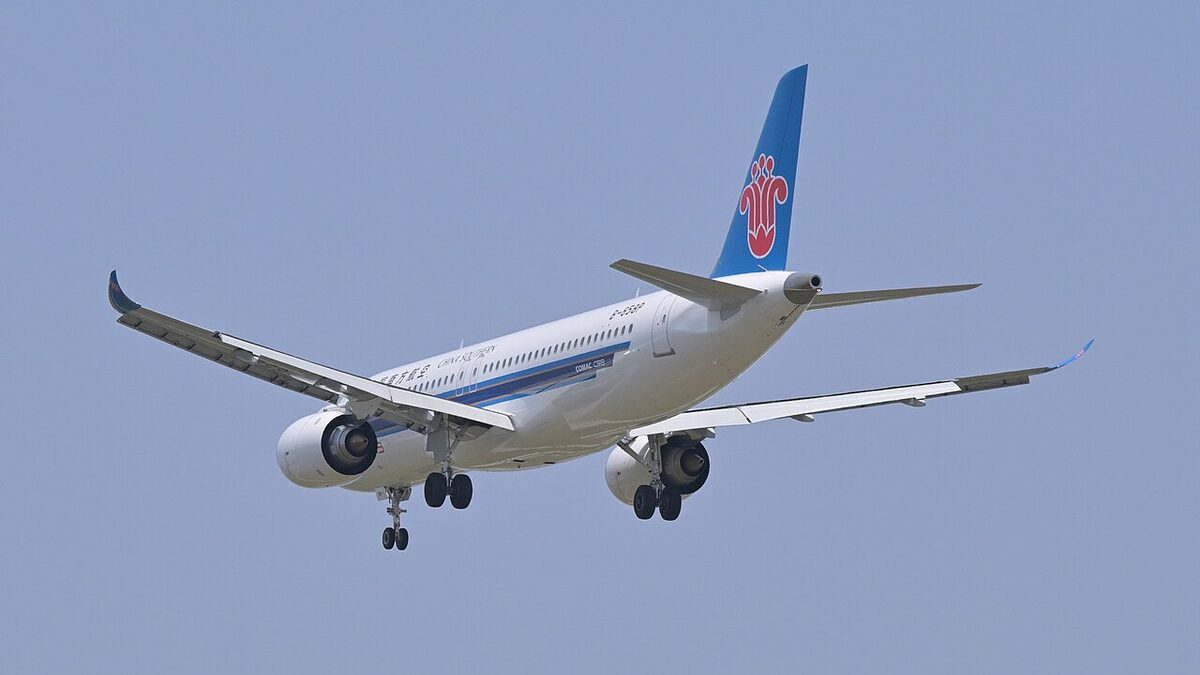
Cover image: A China Southern Airlines COMAC C919 on approach to Shanghai Hongqiao, June 2025 (file photo) — photo by 4300streetcar, CC BY 4.0, via Wikimedia Commons.
China's three biggest airline groups carried 41.95 million passengers in October 2026, 2.9 per cent fewer than a year earlier, as domestic passengers fell 4.2 per cent and international rose 5.6 per cent, according to a Travel Market News analysis of the airlines' Hong Kong stock exchange filings. Air China, China Southern Airlines and China Eastern Airlines filed their October 2026 operating data on 16 November.
The drop is the trio's first year-on-year fall in passengers since June. Together, the three cut domestic seat capacity, measured in available seat kilometres (ASK), by 3.5 per cent and added 9.1 per cent internationally, by our calculation, leaving total capacity almost flat.
How did Air China, China Southern and China Eastern do in October 2026?
Air China made the deepest domestic cut, 7.9 per cent of ASK, and its load factor rose 1.7 points to 87.0 per cent. China Southern's domestic passengers fell 5.52 per cent on 2.45 per cent less capacity, and its load factor slipped 1.09 points to 86.80 per cent.
China Eastern held its domestic flying almost flat, and its 88.74 per cent load factor was the highest.
| Group | Passengers, Oct 2026 | Change | Domestic passengers | International passengers | Domestic ASK | International ASK |
|---|---|---|---|---|---|---|
| Air China | 14.00m | -4.3% | -6.1% | +8.8% | -7.9% | +12.3% |
| China Southern | 14.98m | -3.92% | -5.52% | +6.98% | -2.45% | +8.61% |
| China Eastern | 12.97m | -0.14% | -0.24% | +1.11% | +0.68% | +6.32% |
| Combined (our calculation) | 41.95m | -2.9% | -4.2% | +5.6% | -3.5% | +9.1% |
Year-on-year changes as filed. Domestic is mainland China only; Hong Kong, Macau and Taiwan ("regional") count only in the totals.
Where are the big three moving their seats?
Abroad, and further. Combined international revenue passenger kilometres (RPK) rose 10.6 per cent, so the average international passenger flew about 4,470 km, some 200 km more than a year earlier, our calculation shows.
Air China began Beijing Capital–Copenhagen–Reykjavík three times a week on 26 October, which the Global Times called the first scheduled passenger route by a Chinese mainland-based airline to Iceland. China Southern added Guangzhou–Changsha–Addis Ababa twice weekly.
The Civil Aviation Administration of China (CAAC) said flights to 17 countries, including Kazakhstan, India, Canada and Belgium, would rise more than 40 per cent in the winter-spring season to 27 March 2027, the Global Times reported. Japan is not part of that growth: Narita's winter schedule shows 34 per cent fewer weekly mainland China passenger movements, as we reported on 25 October.
Why is Chinese airlines' domestic traffic declining in 2026?
The filings give numbers, not reasons.
Caixin reported on 15 October that the CAAC plans tighter controls on routes and frequencies from this winter-spring season, including limits on how many carriers serve a domestic route, according to PYMNTS. We have not seen the CAAC's own text. In August, Caixin cited Flight Master data showing flights under 800 km fell from 25.3 per cent of domestic flights in 2019 to 18.1 per cent in 2025 as high-speed rail spread.
Checks cited by Nathan Gee of BofA Global Research suggested domestic fares were rising at double-digit rates year on year after Golden Week as airlines kept a lid on capacity, Reuters reported. The base was also high: in October 2025 the three carried 6.0 per cent more passengers than a year before, and that month's National Day holiday ran eight days against seven this year, as our Golden Week coverage noted.
What does it mean for the airlines' finances and fleets?
Air China's third-quarter net profit fell 92.6 per cent to 270.6 million yuan, China Eastern's 98.2 per cent to 64 million yuan, and China Southern swung to a 609 million yuan loss, Reuters reported on 2 November; all three said rising jet fuel prices hurt results (see our airline results tracker).
The three ended October with 2,791 aircraft. China Southern lists 13 COMAC C919s and 40 C909s, China Eastern 17 and 32; Air China's filing gives no type breakdown.
How did we calculate the combined figures?
We summed each group's passenger, ASK and RPK figures and compared them with its October 2025 filing; the reported percentage changes agree.
All three say the data are internal statistics that may differ from their periodic reports, and Air China's English text is a translation. Other carriers, such as Hainan Airlines, are excluded; we found no CAAC industry-wide October figures as of 17 November.
Frequently asked questions
How many passengers did Air China, China Southern and China Eastern carry in October 2026?
Together they carried 41.95 million, 2.9 per cent fewer than the 43.21 million in their October 2025 filings, by Travel Market News's count. China Southern carried 14.98 million, Air China 14.00 million and China Eastern 12.97 million, their Hong Kong filings show.
Is Chinese airlines' domestic traffic falling in 2026?
At the big three it fell in October, when domestic passengers dropped 4.2 per cent to 35.44 million. Their monthly filings show combined domestic passengers also fell year on year in January, April, May and June, by our count, then grew from July to September.
Why are Chinese airlines adding international flights?
The filings give no reasons. The CAAC has said international passenger flights will increase this winter-spring season, with flights to 17 countries up more than 40 per cent, the Global Times reported. Caixin has reported plans for tighter controls on domestic routes and frequencies from the same season.
How full were the big three's flights in October 2026?
China Eastern reported a passenger load factor of 88.74 per cent, Air China 87.0 per cent and China Southern 86.80 per cent, the only one to fall. Combined, about 87.4 per cent of seat-kilometres were filled, up about 0.6 points, by our calculation.
Sources
- HKEXnews, Air China: key operating data of October 2026
- HKEXnews, China Southern Airlines: key operating data, October 2026
- HKEXnews, China Eastern Airlines: operating data for October 2026
- Global Times via People's Daily Online, China's international air connectivity to improve
- PYMNTS, China tightens airline competition rules
- Caixin Global, China's transport price war
- The Star (Reuters), China's top three airlines head for full-year losses