EU261 pays €250 to €600 when you land three hours late. Distance bands, extraordinary circumstances, how to claim, UK261, US and Canada rules, and the 2027 reform.
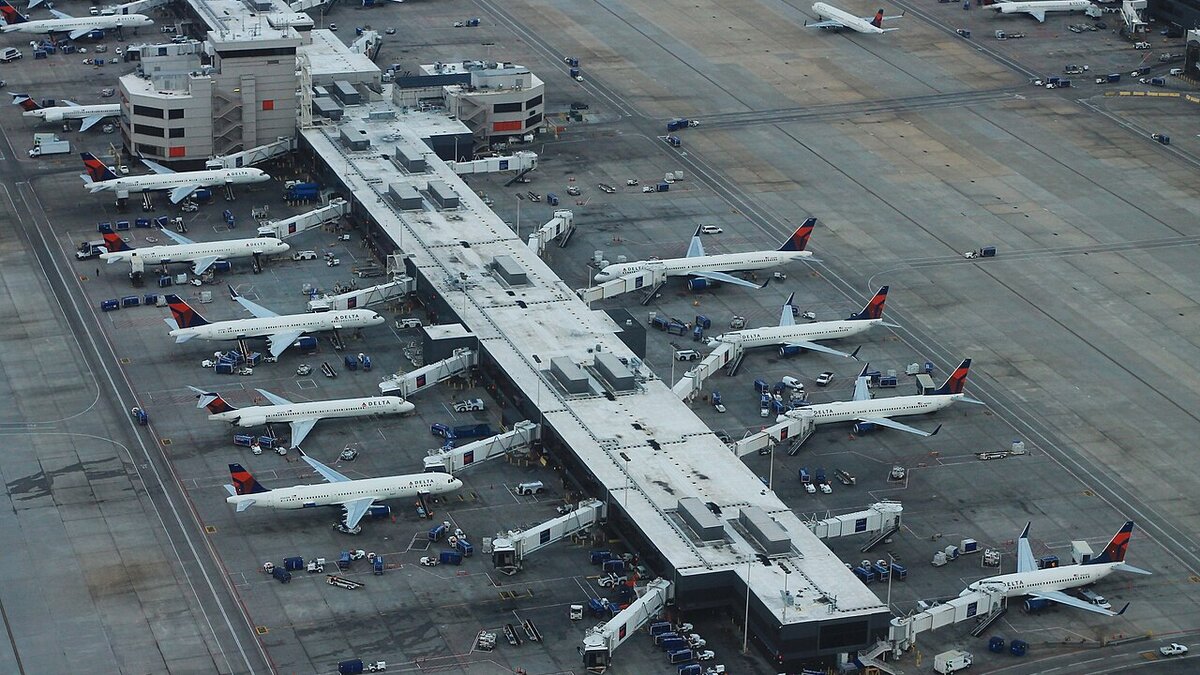
Cover image: airport departures board showing delayed flights — photo by Jun Jie Yam, CC BY 4.0, via Wikimedia Commons.
Under EU Regulation 261/2004, known as EU261 or EC261, passengers who reach their final destination three hours or more late are owed €250, €400 or €600 in cash, set by flight distance rather than fare, unless the airline proves extraordinary circumstances. It covers every flight leaving the EU and EU-airline flights arriving there. The UK's copy, UK261, pays £220 to £520.
The United States pays no delay compensation; its 2024 rule only refunds your fare if you decline a badly delayed flight. Canada's large airlines owe C$400 to C$1,000 for controllable delays. The EU's reform, Regulation (EU) 2026/2202, applies from 23 October 2027 with the same amounts and a three-hour threshold, reworded from "three hours or more" to "exceeding three hours".
Last checked: 25 October 2026.
How much is EU261 and UK261 flight delay compensation?
Compensation is a fixed sum per passenger, set by distance, according to the European Commission's Your Europe guidance and the UK Civil Aviation Authority (CAA). It covers arrival delays of three hours or more, cancellations notified under 14 days before departure and involuntary denied boarding. On journeys over 3,500 km to or from outside the EU, it is halved when the arrival delay is three to four hours.
| Flight distance | EU261 | UK261 | CAA example route |
|---|---|---|---|
| 1,500 km or less | €250 | £220 | Glasgow to Amsterdam |
| Over 1,500 km within the EU, or 1,500 to 3,500 km | €400 | £350 | East Midlands to Marrakesh |
| Over 3,500 km, arriving 3 to 4 hours late | €300 | £260 | London to New York |
| Over 3,500 km, arriving 4 hours or more late | €600 | £520 | London to New York |
The three-hour rule was made by judges. The 2004 regulation did not expressly grant compensation for delays; in Sturgeon v Condor (November 2009) the Court of Justice of the EU (CJEU) held that passengers arriving three hours or more late suffer the same loss of time and must be treated alike.
On a connecting booking the CAA uses the distance between the first and last airports; self-transfer trips on separate tickets carry no compensation for a missed onward flight.
Cash sits on top of the duty of care, which the CAA says applies whatever the cause: meals once the departure delay reaches two to four hours depending on distance, two free calls or emails, and a hotel with transfers for an overnight wait. After five hours passengers may abandon the trip for a refund.
Worked example: who pays on a delayed Frankfurt to New York trip?
Scope turns on where the flight departs and who operates it: any airline leaving the EU, but only EU airlines flying in. The claim goes to the operating airline, not necessarily the seller, which matters on codeshare flights sold under a partner's code. Take a family of four flying Frankfurt to New York, well over 3,500 km, on a US airline. The flight leaves the EU, so EU261 applies.
- A routine technical fault, landing 3 hours 40 minutes late: €300 each, €1,200 in all.
- The same fault, landing 4 hours 10 minutes late: €600 each, €2,400 in all.
- A storm that halts departures: no cash, since adverse weather is extraordinary, but meals after four hours and a hotel overnight.
- The return on the same US airline, six hours late: EU261 does not apply to a non-EU airline flying in. US rules treat six hours as a significant international delay, so the family can decline the flight for a refund; anything more depends on the airline's voluntary policies.
On an EU airline the return would be covered too. The reform keeps this arithmetic: the 2026 text again lets airlines halve the €600 band when the arrival delay does not exceed four hours.
What counts as extraordinary circumstances?
Airlines escape cash compensation, never the duty of care, only by proving the event was extraordinary and unavoidable even with all reasonable measures. The CJEU's test, applied since Wallentin-Hermann in 2008, has two parts: the event must not be inherent in normal airline operations, and it must be beyond the airline's actual control. The Court reads the exemption strictly.
- Usually extraordinary: air traffic management decisions, political instability, adverse weather and security risks (Your Europe's examples), plus strikes by outsiders such as air traffic controllers or airport staff.
- Usually not extraordinary: most technical problems found during maintenance or caused by failure to maintain an aircraft, a collision between boarding stairs and the aircraft, and strikes by the airline's own staff.
The staff-strike line was drawn in Airhelp v SAS (March 2021): a lawful, union-called pilots' strike over pay was inherent in running an airline. A staff strike can still qualify if it stems from demands that only public authorities can satisfy, which is why strike-hit passengers' rights depend on whose staff walk out.
After the UK system failure that grounded hundreds of flights in September 2026, the CAA said the disruption was "likely to be considered" extraordinary, so passengers were unlikely to be owed compensation but were still owed care. Ground-handling strikes are a grey zone. From 23 October 2027 the EU's new list names strikes at "groundhandling service providers which air carriers do not effectively choose"; on our reading, a strike at a handler an airline contracts itself, as in the Groundforce walkout at Barcelona in August 2026, may not qualify, though courts will decide.
How do I claim flight delay compensation?
Compensation is not paid automatically; the CAA says passengers must claim from the airline first. A practical sequence:
- Keep boarding passes and delay messages, plus itemised receipts for expenses, which the CAA says airlines will require.
- Claim from the operating airline in writing, citing EU261 or UK261.
- Escalate if refused. In the EU, if the airline refuses or has not replied within two months, complain to the national enforcement body where the incident happened; dispute resolution schemes are open to EU residents. In the UK, after a final refusal or eight weeks without one, go to the airline's ADR provider or, if it has none, the CAA's complaints team.
- Go to court as a last resort, including via the European Small Claims procedure. Time limits are set by national law, so they differ by country.
What changes under the EU261 reform, and when?
Proposed in 2013, the overhaul stalled for a decade. According to the European Parliament's Legislative Observatory, it went to conciliation after the Council rejected Parliament's second-reading amendments on 24 March 2026; a joint text was agreed on 15 June and adopted by Parliament on 7 July and the Council on 13 July. Published in the Official Journal on 2 October 2026 as Regulation (EU) 2026/2202, it applies from 23 October 2027; until then today's rules govern every flight. Under the regulation:
- The amounts stay at €250, €400 or €600, for arrival delays "exceeding three hours".
- Claims must be made within nine months of the ticketed departure date; airlines must pay or justify a refusal within 30 calendar days, and may ask a claims agency for proof of mandate.
- Airlines must tell eligible passengers within 96 hours of the journey's end how to claim.
- A non-exhaustive annex lists extraordinary circumstances, including hidden manufacturing or design defects.
- Refunds become automatic within seven days of the passenger's choice, and after a two-hour tarmac delay at an EU airport the aircraft must normally return to let passengers off.
- A personal item flies at no extra cost; a piece of hand baggage is allowed "subject to the capacity of the aircraft cabin", and fares including it must be shown by default.
UK261 is untouched by the EU reform.
What do US rules owe passengers for a delayed flight?
No federal rule pays cash for a delay. The Department of Transportation (DOT) refund rule, finalised in April 2024 as 14 CFR Part 260, covers flights to, from or within the US. If a flight is cancelled or significantly delayed and you decline the alternative, the seller that took your payment (the merchant of record) must refund the fare, taxes and fees in the original form of payment, automatically if that seller is the airline: within seven business days for credit cards, 20 calendar days otherwise.
- A significant delay is arrival three hours or more late on a domestic itinerary, six hours on an international one; a new airport, an extra connection or a downgrade also counts.
- Checked-bag fees come back when a bag is 12 hours late on domestic trips, or 15 or 30 hours on international ones, depending on the non-stop segment's length.
In December 2024 DOT sought comment on requiring cash compensation, rebooking, meals and hotels for major disruptions. It withdrew that notice on 17 November 2025, concluding that its statute does not authorise compensation mandates, and pointed to voluntary pledges: four of the largest US airlines offer credits, vouchers or miles for controllable cancellations and long delays.
Being bumped from an oversold flight carries separate cash rules; see our guide to overbooking and denied boarding rights. For hotel nights or tours lost to a delay, consider travel insurance with delay cover.
How do Canada, India and other regimes compare?
| Regime | Cash for a delay? | Amounts | Who owes it | Main exemption |
|---|---|---|---|---|
| EU261 | Arrival 3+ hours late | €250 / €400 / €600 | Operating airline | Extraordinary circumstances |
| UK261 | Arrival more than 3 hours late | £220 / £350 / £520 | The airline | Extraordinary circumstances |
| United States | No; refund if you decline a flight 3 hours (domestic) or 6 hours (international) late | Fare, taxes and fees | Seller that took payment | Not applicable |
| Canada (APPR) | Arrival 3+ hours late, if within airline control | Large carriers C$400 / C$700 / C$1,000; small C$125 / C$250 / C$500 | Operating carrier | Outside airline control, or safety |
| India (DGCA) | No; cash for cancellations notified under 24 hours ahead | Up to ₹5,000 / ₹7,500 / ₹10,000 by block time | Operating airline | Extraordinary circumstances, incl. ATC and weather |
Canada's Air Passenger Protection Regulations (APPR) define a large carrier as one carrying two million or more passengers in each of the two previous calendar years; its tiers apply at three, six and nine hours of arrival delay. Passengers must claim within a year, and airlines must pay or explain within 30 days. The official text, current to 30 September 2026, was last amended in September 2022.
India's Directorate General of Civil Aviation (DGCA) rules, in their current form since 15 February 2023, require meals once a delay reaches two to four hours, depending on block time, and on domestic flights delayed more than six hours an alternative flight or a full refund. Cash is reserved for late-notice cancellations and denied boarding.
Frequently asked questions
If your flight is delayed, are you entitled to compensation?
In the EU and the UK, yes, if you reach your final destination three hours or more late and the cause was not extraordinary: €250 to €600, or £220 to £520. Canada's large airlines owe C$400 to C$1,000 for controllable delays. The United States and India pay no cash for delays, though a refund, meals or a hotel may be due.
Does EU261 apply to non-EU airlines?
Yes, on any flight departing an EU airport, whatever the airline's nationality. Flights into the EU are covered only when an EU airline operates them, so a US airline's Frankfurt to New York service is covered but its return is not. The rules also extend to flights to and from Iceland, Norway and Switzerland.
Do I get compensation if my EU flight is cancelled?
Usually: €250 to €600 by distance if you were told under 14 days before departure and the cause was not extraordinary. Nothing is due if, told 7 to 14 days ahead, you are rerouted to leave at most two hours early and arrive under four hours late; with under 7 days' notice, the limits are one hour and two hours.
Is a technical fault an extraordinary circumstance?
Usually not. In Sturgeon (2009) the Court of Justice held that a technical problem is not extraordinary unless it stems from events not inherent in running an airline and beyond its control. The Commission treats most faults found in maintenance, or caused by poor maintenance, as the airline's responsibility. From 23 October 2027 the EU's annex adds hidden manufacturing or design defects revealed by the manufacturer or an authority.
When do the new EU261 rules start?
Regulation (EU) 2026/2202 was published in the Official Journal on 2 October 2026, entered into force on 22 October 2026 and applies from 23 October 2027. Until then today's rules govern every claim. The €250, €400 and €600 amounts survive and the threshold stays at three hours, though now worded "exceeding three hours" rather than "three hours or more"; a nine-month claim deadline is new.
Sources
- European Union, Your Europe: Air passenger rights
- UK Civil Aviation Authority, Delays
- UK Civil Aviation Authority, statement on the 8 September 2026 NATS disruption
- CJEU, Sturgeon judgment press release (2009)
- CJEU, Airhelp v SAS press release (2021)
- Official Journal of the EU, Regulation (EU) 2026/2202
- European Parliament Legislative Observatory, procedure 2013/0072(COD)
- eCFR, 14 CFR Part 260 (refunds)
- Federal Register, Airline Passenger Rights; Withdrawal (17 November 2025)
- Justice Laws, Air Passenger Protection Regulations
- DGCA India, CAR Section 3, Series M, Part IV