Airlines deliberately sell more seats than they have because a slice of passengers never shows up. Here is how often bumping actually happens, what US DOT and EU rules pay, and how to turn a voluntary bump into real money.
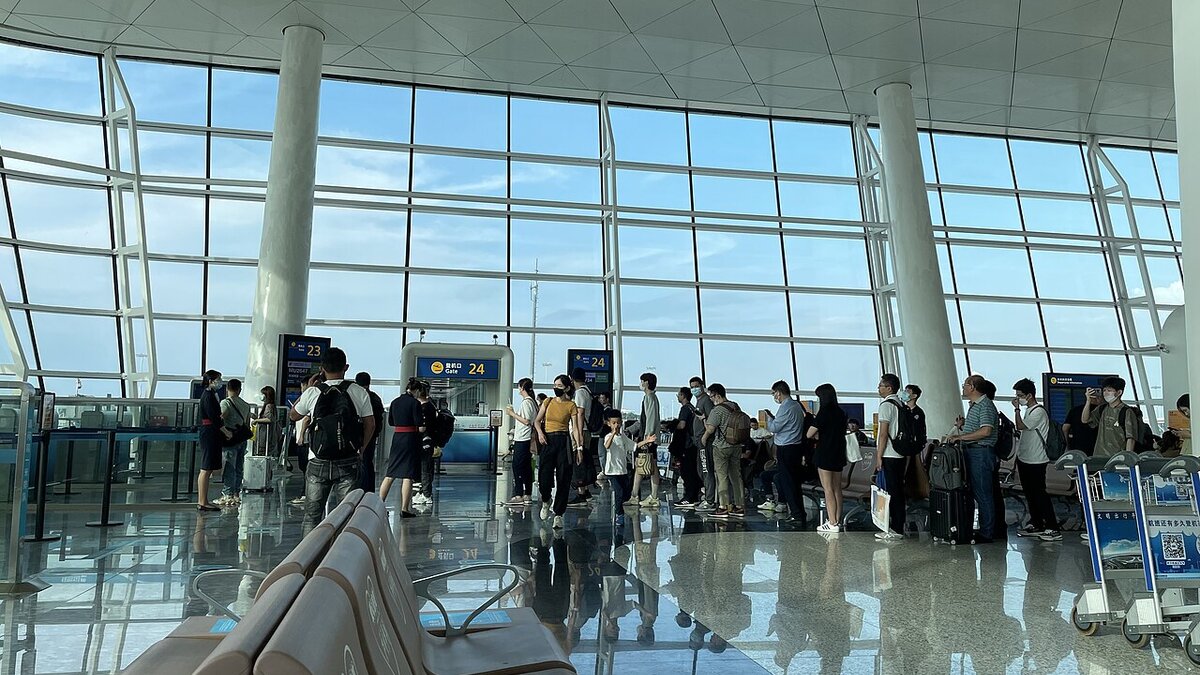
Cover image: full boarding queue at an airport departure gate — photo by Zheng Zhou, CC BY-SA 4.0, via Wikimedia Commons.
Airlines overbook because a predictable share of ticketed passengers never turns up, and an empty seat on a departed flight is revenue lost forever. Industry analyses put no-show rates at roughly 5 to 15 per cent depending on route, season and fare type, so revenue-management systems deliberately sell a few more tickets than the aircraft holds. When the forecast misses and more people show up than there are seats, someone gets bumped. It is rarer than assumed: the US Department of Transportation (DOT) reported an involuntary denied-boarding rate of just 0.33 per 10,000 passengers for the ten largest US marketing carriers in the second quarter of 2024, and volunteers outnumber involuntary bumps by roughly ten to one. If you are bumped against your will in the United States, DOT rules require cash compensation of 200 to 400 per cent of your one-way fare, capped at US$1,075 or US$2,150 depending on the delay, under limits raised on 22 January 2025. In the European Union, Regulation 261/2004 pays a flat €250 to €600 by flight distance, plus care and rerouting.
Why do airlines overbook flights in the first place?
Overbooking is a legal, decades-old revenue-management practice. Flexible fares, corporate bookings and misconnecting passengers all create no-shows, and carriers model that behaviour route by route. Selling to a forecast rather than to the seat count keeps load factors high in an industry where, as our report on airline profitability in 2026 shows, net margins remain wafer-thin.
The DOT's own oversales data shows the overwhelming majority of oversold situations are resolved with volunteers at the gate, not forced removals. The reputational cost of getting it wrong is severe: after a passenger was forcibly dragged off United Express Flight 3411 in April 2017, United Airlines raised the ceiling its agents can offer volunteers to US$10,000, and rivals followed.
How often do passengers actually get bumped?
Involuntary bumping is a statistical edge case, but it clusters when travellers can least absorb it: peak periods when flights leave full, such as the record July 4 travel wave the US just processed. Carrier behaviour also varies enormously. DOT figures show Delta Air Lines posting zero or near-zero involuntary bumps in recent reporting periods, largely because it empowers agents to bid aggressively for volunteers, while some low-cost and network carriers post rates many times the industry average.
Two categories matter, and they drive your rights:
- Voluntary denied boarding: you accept the airline's offer (vouchers, cash, miles, upgrades) to take a later flight. Whatever you negotiate is the deal; no regulation sets a minimum.
- Involuntary denied boarding: the airline refuses you a seat despite a confirmed reservation and on-time check-in. Statutory compensation rules now apply.
What does US DOT denied boarding compensation pay?
Under 14 CFR Part 250, a US airline that bumps you involuntarily must pay compensation based on how late the substitute transport gets you to your destination compared with your original arrival time. The caps were inflation-adjusted by a DOT final rule effective 22 January 2025. Crucially, you can insist on a cheque or cash rather than a voucher, and accepting the airline's first voucher offer usually waives your right to the cash amount.
| Arrival delay at destination | US domestic flights | International flights from the US |
|---|---|---|
| 0–1 hour | No compensation | No compensation |
| 1–2 hours (domestic) / 1–4 hours (international) | 200% of one-way fare, up to $1,075 | 200% of one-way fare, up to $1,075 |
| Over 2 hours (domestic) / over 4 hours (international), or no rebooking | 400% of one-way fare, up to $2,150 | 400% of one-way fare, up to $2,150 |
The rules apply to flights departing the US on aircraft with more than 30 seats, and only if you met the airline's check-in deadline. Miss the cut-off and your denied-boarding rights largely evaporate.
How do EU denied boarding rules compare?
EU Regulation 261/2004 covers any flight departing an EU airport, plus EU-carrier flights into the bloc. Airlines must first call for volunteers; anyone then bumped involuntarily is owed immediate flat-rate compensation of €250 (flights up to 1,500 km), €400 (1,500–3,500 km) or €600 (longer flights), alongside a choice of refund or rerouting, plus meals, communications and a hotel if an overnight stay is needed. The payout can be halved if the rerouting lands close to the original schedule. The UK retained a mirror-image scheme after Brexit, paying £220, £350 or £520 across the same distance bands.
The same regulation governs long delays and cancellations, where the money is identical but the trigger conditions differ. Our companion guide to flight delay compensation and passenger rights walks through those scenarios, including the extraordinary-circumstances defence airlines lean on.
How do you maximise a voluntary bump payout?
When a gate agent announces an oversale, the offer is a negotiation, not a fixed price. Treat the involuntary entitlement as your floor: if the airline would owe you $2,150 in cash for bumping you anyway, a $300 voucher is a poor trade.
- Volunteer early, settle late. Get on the volunteer list first, then negotiate as departure nears and the agent's authority to bid higher kicks in.
- Ask for cash or a cheque instead of a travel credit, or at least check the voucher's expiry date, transferability and blackout rules before accepting.
- Confirm the rebooking first. Never surrender a boarding pass until you hold a confirmed seat, not a standby listing, on a specific later flight.
- Stack the extras. Meal vouchers, hotel, lounge access and seat upgrades on the later flight are all routinely granted on request.
- Know the bump order. Airlines typically bump last those with elite status, higher fares and earlier check-in, so checking in early is itself protection.
Frequently asked questions
Is overbooking flights actually legal?
Yes. Overbooking is lawful in the United States, the EU and most jurisdictions. What regulators police is the aftermath: airlines must ask for volunteers, follow published boarding-priority rules and pay prescribed compensation to anyone denied boarding involuntarily.
Can the airline pay me with a voucher instead of cash?
For an involuntary bump in the US, no: DOT rules entitle you to payment by cheque or cash, and airlines may only offer a voucher as an alternative you may refuse. In the EU, compensation is payable in money unless you agree in writing to vouchers.
What if I miss a connection because I was bumped?
Compensation is measured against your arrival time at your final destination, not the bumped segment. The airline must also rebook you; if the delay pushes past the two-hour (US domestic) or four-hour (international) mark, you move into the higher 400 per cent tier.
Do these rules apply if my aircraft was swapped for a smaller one?
Partially. In the US, downgauging to a smaller aircraft is an exception where compensation may not be owed, though you are still entitled to rebooking or a refund. In the EU, a downgauge is treated like any other denied boarding and compensation applies.
Sources
- US Department of Transportation — Bumping & Oversales consumer guide
- Federal Register — Periodic Revisions to Denied Boarding Compensation (effective 22 January 2025)
- EUR-Lex — Regulation (EC) No 261/2004 on denied boarding, cancellation and long delay
- Cornell LII — 14 CFR § 250.5, denied boarding compensation amounts