Alaska drew about 1.7 million cruise passengers in 2025, most booked to see tidewater glaciers that new satellite data shows are melting faster. With Tracy Arm off major 2026 itineraries and Glacier Bay capped at two ships a day, the industry's star attraction is literally receding.
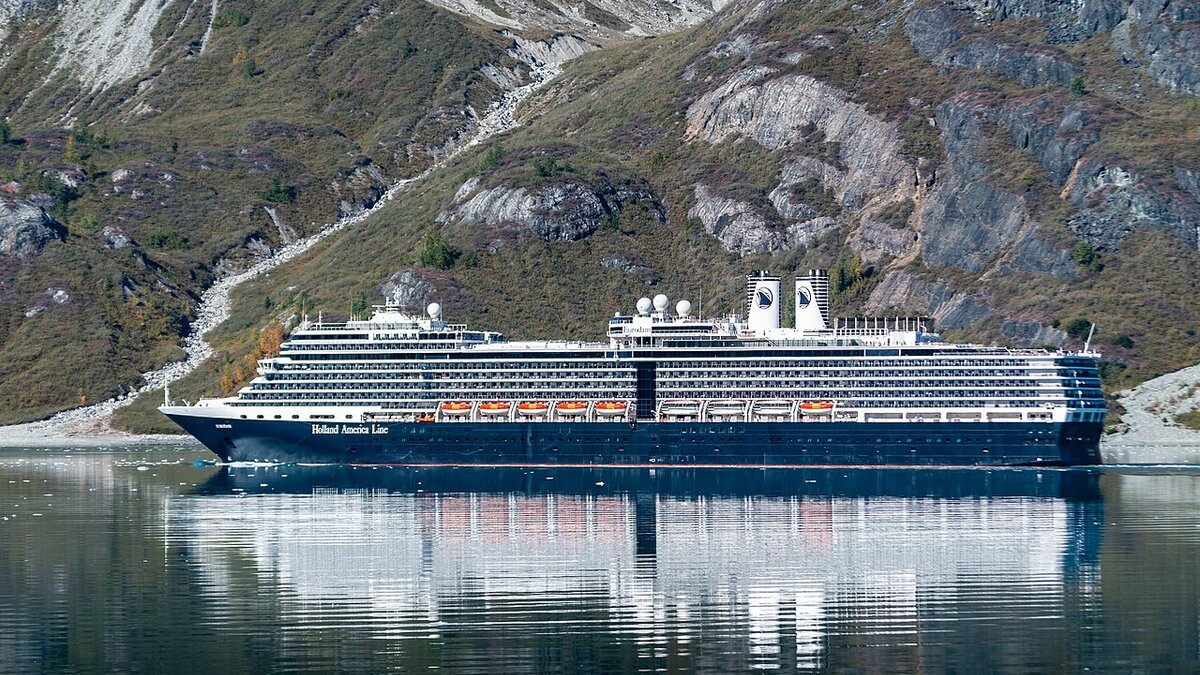
Cover image: Cruise ship sailing near a tidewater glacier in Glacier Bay, Alaska — photo by Gordon Leggett, CC BY-SA 4.0, via Wikimedia Commons.
The glaciers that anchor Alaska's cruise product are receding measurably, and the industry is already redrawing itineraries around them. Alaska drew about 1.7 million cruise passengers in 2025, per travel reporting published 4 August 2026, most of them booked at least partly to see tidewater ice from the deck. A February 2026 analysis of satellite radar data covering more than 3,000 glaciers found Alaska's melt season now runs roughly three weeks longer for every 1C of summer warming — and that a single heat wave can strip up to 28 per cent more of a glacier's snow cover than an ordinary summer.
The changes are no longer abstract. Tracy Arm, home of the twin Sawyer glaciers, is off virtually every major 2026 itinerary after an August 2025 landslide near South Sawyer Glacier sent a wave nearly 1,600 feet up the fjord walls, pushing Holland America Line and Carnival to reroute scenic cruising to Endicott Arm. For sellers of Alaska, the product brief has quietly changed.
Which glaciers do Alaska cruises actually visit?
The core glacier stops are Glacier Bay National Park (Margerie and Grand Pacific at the head of Tarr Inlet), Hubbard Glacier in Disenchantment Bay, and the fjords south of Juneau — Tracy Arm's Sawyer glaciers and Endicott Arm's Dawes Glacier — plus Mendenhall, a Juneau shore excursion rather than a ship stop.
Their trajectories differ sharply. The US National Park Service describes Margerie Glacier as relatively stable, though its northern third has been slowly receding since about 1998; the classic photo stop is roughly 0.85 miles wide with a 200-foot face above the waterline, flowing three to seven feet a day. Grand Pacific Glacier, by contrast, is grounded at the head of Tarr Inlet with no dramatic ice front, per the NPS, having last joined Margerie in 1992. Hubbard is the outlier — NASA notes it has been thickening and steadily advancing since measurements began in 1895.
| Glacier | Where ships see it | Status (NPS / NASA / USGS) |
|---|---|---|
| Margerie | Glacier Bay (Tarr Inlet) | Relatively stable; northern third receding since ~1998 |
| Grand Pacific | Glacier Bay (Tarr Inlet) | Grounded; no longer joined to Margerie since 1992 |
| Johns Hopkins | Glacier Bay (restricted inlet) | Advancing — the bay's rare exception |
| South Sawyer | Tracy Arm | Off major 2026 itineraries after landslide-tsunami |
| Dawes | Endicott Arm | Actively calving; now the default fjord stop |
| Hubbard | Disenchantment Bay | Advancing and thickening since 1895 |
| Mendenhall | Juneau shore excursion | Retreated ~1 mile 1986–2024; up to 2,000 ft thinner in places |
How fast are Alaska's cruise glaciers retreating?
The headline figures are stark but need context. The NPS says Glacier Bay holds 11 per cent less glacial ice than in the 1950s, and that 95 per cent of Alaska's 100,000-plus glaciers are thinning, stagnating or retreating. The bay's ice has pulled back some 65 miles since Captain George Vancouver charted it in 1794 — what the park service calls the most dramatic documented glacial retreat in the world — though much of that was natural rebound from the Little Ice Age maximum of about 1750.
The recent acceleration is the human-driven part. NASA satellite records cited in the same reporting show Mendenhall Glacier retreated roughly a mile between 1986 and 2024 and lost as much as 2,000 feet of thickness in places, while the Juneau Icefield above it shed 63 of its roughly 1,050 glaciers — about a tenth of its ice — in the 14 years to 2019. Park rangers who board ships in Glacier Bay now narrate the change in real time.
Why are cruise ships skipping Tracy Arm in 2026?
On 10 August 2025 a slope above the toe of South Sawyer Glacier failed into Tracy Arm, the US Geological Survey recorded, generating a tsunami whose runup later scientific reporting put at nearly 1,600 feet on the far wall of the fjord. Researchers link such failures to slopes destabilised as the ice that buttressed them melts. No injuries were reported, but the event reset risk calculations across the industry.
Holland America acted first, pulling Tracy Arm from its 2026 programme on 16 March. Carnival followed for all 2026 Alaska sailings of Carnival Spirit, Carnival Luminosa and Carnival Miracle between late April and mid-September, describing the swap to guests as "turning right, instead of left, upon entering the fjords". The beneficiary is Endicott Arm and Dawes Glacier, a wider fjord where guests still get deep blue ice and intense calving; what they lose is the tighter, more theatrical approach that made Tracy Arm a brochure staple.
How does the Glacier Bay cruise permit system work?
Glacier Bay was rationed long before the retreat made headlines. The NPS caps entry at two cruise ships per day, year-round, with 153 use days in the June–August prime season and 92 across the May and September shoulders. Six lines hold the concession contracts required to enter: Princess, Holland America, Norwegian, Seabourn, Cunard and Viking.
That scarcity is now a commercial asset. As capacity grows — the industry is heading for another record passenger year in 2026 — a Glacier Bay day becomes a differentiator lines without contracts cannot buy, and one agents should verify on any "glacier cruise" itinerary.
Is Alaska glacier cruising becoming last-chance tourism?
There is an uncomfortable loop, and the industry increasingly acknowledges it: ships carry 1.7 million people a year to view ice that fossil-fuel emissions are helping to melt. Marketing rarely says "last-chance tourism", but the melt data and ranger-narrated retreat do that work on their own — and demand for cold-climate scenery is rising, as the coolcations boom in Scandinavia shows.
The honest framing for sellers is neither doom nor denial. Alaska's glaciers are not vanishing on a booking horizon — Hubbard and Johns Hopkins are advancing, Margerie remains a reliable spectacle — but specific experiences are already gone or altered: Muir Glacier left tidewater in 1993, Grand Pacific no longer reaches the bay's edge, Tracy Arm is off major schedules this season. Clients who care can be steered to practical ways to cut a trip's footprint, and first-timers will find the trade-offs in our first-time cruise guide.
Frequently asked questions
Can you still see glaciers on an Alaska cruise in 2026?
Yes. Margerie, Hubbard and Dawes glaciers all remain on 2026 itineraries, and the NPS describes Margerie as relatively stable. The change is Tracy Arm, which major lines removed after the August 2025 landslide-tsunami.
Which Alaska glaciers are actually growing?
NASA says Hubbard Glacier has been thickening and advancing since measurements began in 1895, and the NPS lists Johns Hopkins as advancing. They are exceptions: 95 per cent of Alaska's glaciers are thinning, stagnating or retreating.
Why is Glacier Bay limited to two cruise ships a day?
The NPS caps entry at two cruise ships daily under a concession system, with 153 prime-season use days in June–August. Only Princess, Holland America, Norwegian, Seabourn, Cunard and Viking hold contracts, so not every Alaska cruise includes Glacier Bay.
Will Tracy Arm reopen to cruise ships?
No line has published a return date. Carnival and Holland America removed it for the whole 2026 season, citing waterways "not suitable for cruise ship navigation", and the USGS continues to study the slopes. Endicott Arm's Dawes Glacier is the substitute meanwhile.
Sources
- FoodDrinkLife via Fox21 — The Alaska cruise view is changing fast
- NPS — Overview of selected glaciers in Glacier Bay
- NPS — Glacier Bay: Glaciers
- NPS — Glacier Bay concession contracts and vessel quotas
- USGS — 2025 Tracy Arm landslide-generated tsunami
- Cruise Hive — Carnival changes Alaska cruises as Tracy Arm deemed too risky
- NASA Earth Observatory — The advance of Hubbard Glacier