What fifth freedom flights are, ICAO's nine freedoms of the air in plain words, cabotage rules, and 11 fifth-freedom services we confirmed operating in late October 2026.
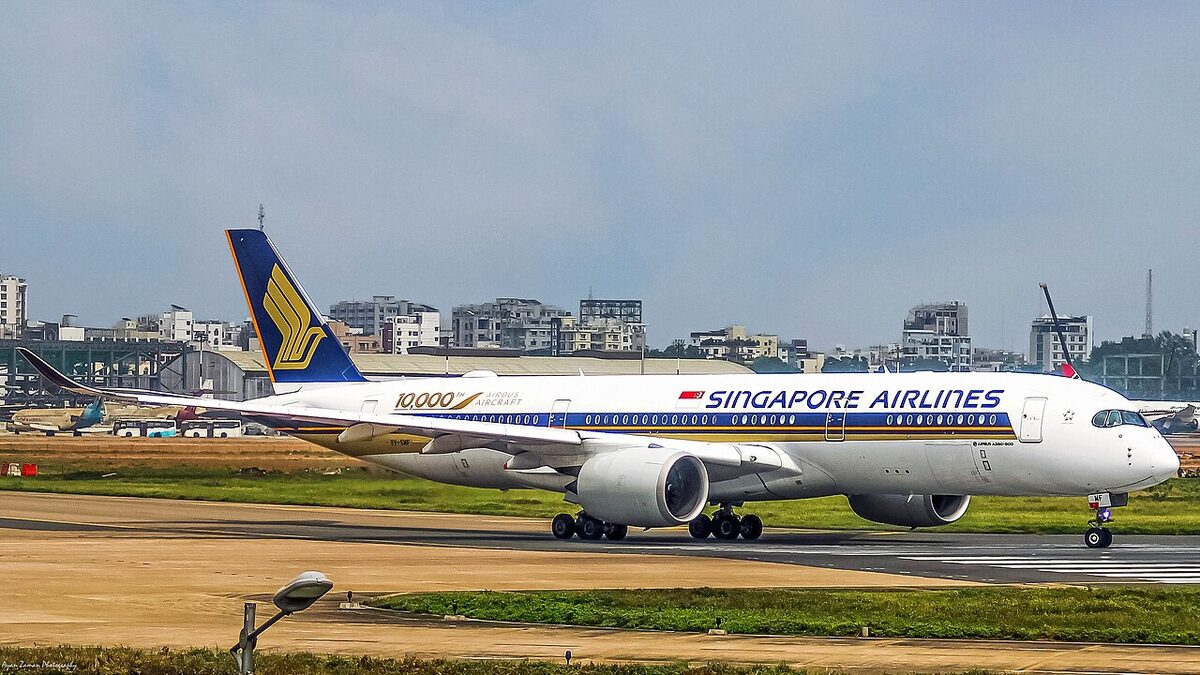
Cover image: A Singapore Airlines Airbus A350-900 (2022 file photo) — photo by Md Shaifuzzaman Ayon, CC BY-SA 4.0, via Wikimedia Commons.
Fifth freedom flights are services on which an airline carries paying passengers between two foreign countries, as part of a route that starts or ends in its home country. Emirates' EK205 is the textbook case: it flies from Dubai to Milan, then takes on passengers in Milan who are flying only to New York JFK.
The legal basis is the fifth of nine "freedoms of the air" defined by the International Civil Aviation Organization (ICAO): the right to put down and take on, in another state, traffic coming from or going to a third state. These rights decide which airlines may compete on a city pair, and they move networks. Turkish Airlines moved the stop on its Istanbul–Sydney service from Kuala Lumpur to Singapore in late October 2026: the first flight left Istanbul on 26 October and reached Sydney on 27 October, FlightAware shows. It holds fifth-freedom rights between Singapore and Sydney but held none between Kuala Lumpur and Sydney, according to Mainly Miles.
Last checked: 1 November 2026.
What are the nine freedoms of the air?
ICAO's definitions, from its Manual on the Regulation of International Air Transport (Doc 9626), in plain words. "Home" is the airline's own country.
- First freedom: fly across a foreign country without landing.
- Second: land in a foreign country for non-traffic purposes, without picking up or setting down passengers.
- Third: set down, in a foreign country, passengers coming from home.
- Fourth: pick up, in a foreign country, passengers bound for home.
- Fifth: set down and pick up, in a foreign country, passengers coming from or going to a third country.
- Sixth: carry passengers between two other countries via home, the model behind hub connections.
- Seventh: fly between a foreign country and a third country, with no link to home at all.
- Eighth: carry domestic passengers inside a foreign country on a service that starts or ends at home ("consecutive cabotage").
- Ninth: fly a domestic route entirely inside a foreign country ("stand-alone cabotage").
ICAO calls every freedom beyond the fifth "so-called", because only the first five have been officially recognised as such by international treaty. It also notes that the sixth is not written into widely recognised agreements such as the "Five Freedoms Agreement".
These rights are granted by governments, unlike commercial deals such as a codeshare on a partner's flight or membership of the three global airline alliances.
How does a fifth-freedom route like Dubai–Milan–New York work?
Take EK205. FlightAware's logs show it leaving Dubai every day from 27 October to 1 November 2026 as an Airbus A380, taking about six hours to Milan Malpensa and a further eight hours or so to New York JFK.
Two kinds of passenger share the Milan–New York cabin:
- Through passengers from Dubai. Emirates carries them on third-freedom rights: traffic from the UAE set down in the United States.
- Passengers who boarded in Milan. This is fifth-freedom traffic: picked up in Italy, set down in the United States, by a UAE airline.
The second group needs two governments on side. Article 6 of the Chicago Convention says no scheduled international air service may operate over or into a state's territory without that state's permission. So Italy must let Emirates take on passengers in Milan bound for the United States, and the United States must let it set them down in New York.
The return, EK206, runs New York–Milan–Dubai on the same pattern.
Which fifth freedom flights are operating in November 2026?
Each service below appears in FlightAware's logs as operating in the week to 1 November 2026. The fifth-freedom status of each sector comes from One Mile at a Time's (OMAAT) guide dated 23 August 2026 or Mainly Miles' report of 6 August 2026. Outbound flight numbers are shown.
| Airline and flight | Full routing | Fifth-freedom sector | Aircraft seen | Rights reported by |
|---|---|---|---|---|
| Emirates EK205 | Dubai–Milan Malpensa–New York JFK | Milan–New York | Airbus A380 | OMAAT |
| Emirates EK209 | Dubai–Athens–Newark | Athens–Newark | Boeing 777-300ER | OMAAT |
| Emirates EK213 | Dubai–Miami–Bogotá | Miami–Bogotá | Boeing 777-200LR | OMAAT |
| Emirates EK255 | Dubai–Barcelona–Mexico City | Barcelona–Mexico City | Boeing 777-200LR | OMAAT |
| Emirates EK384 | Dubai–Bangkok–Hong Kong | Bangkok–Hong Kong | Airbus A380 | OMAAT |
| Singapore Airlines SQ26 | Singapore–Frankfurt–New York JFK | Frankfurt–New York | Boeing 777-300ER | OMAAT |
| Singapore Airlines SQ12 | Singapore–Tokyo Narita–Los Angeles | Tokyo–Los Angeles | Boeing 777-300ER | OMAAT |
| Qantas QF3 | Sydney–Auckland–New York JFK | Auckland–New York | Boeing 787-9 | OMAAT |
| Ethiopian Airlines ET514 | Addis Ababa–Lomé–Newark | Lomé–Newark | Boeing 787-8 | OMAAT |
| British Airways BA15 | London Heathrow–Singapore–Sydney | Singapore–Sydney | Boeing 777-300ER | Mainly Miles |
| Turkish Airlines TK22 | Istanbul–Singapore–Sydney | Singapore–Sydney | Airbus A350-900 | Mainly Miles |
Turkish Airlines is the newest entrant. Mainly Miles reported that TK22/23 would fly the route five times a week with two-class Airbus A350-900s, replacing the Kuala Lumpur routing used since 2024, with Singapore–Sydney tickets on sale in both directions.
Why do governments grant or refuse fifth-freedom rights?
Countries that open up point to the results. The European Commission says the EU's single aviation market, created in the 1990s, removed all commercial restrictions on routes, frequencies and fares for airlines flying within the EU, and that prices "have fallen dramatically" while new business models appeared.
South-east Asia has written fifth freedoms into a multilateral treaty. A protocol to ASEAN's 2010 Multilateral Agreement on the Full Liberalisation of Passenger Air Services grants unlimited fifth-freedom traffic rights between any ASEAN cities. ASEAN's status table dated 17 July 2026 lists it as in force since 1 July 2011 and ratified by all 11 members, most recently Timor-Leste on 24 November 2025.
Restrictions are often political. One Mile at a Time notes that Gulf carriers' fifth-freedom flights have been "especially controversial, given accusations of government subsidies". In May 2018 the United States and the UAE set out an "understanding on Open Skies". The UAE's General Civil Aviation Authority also sent the US State Department a side letter saying UAE carriers had "no current plans to adjust the Fifth Freedom services" they operate, according to the UAE Embassy in Washington.
The embassy says the letter describes the airlines' intentions and specifies that nothing in it amends the 2002 UAE–US agreement or any rights under it.
Approval can also be slow. One Mile at a Time says Emirates needed "a couple of years" to win Mexican government approval for its Barcelona–Mexico City flight.
What is cabotage, and who allows it?
Cabotage is the right to carry domestic passengers inside a foreign country: ICAO's eighth and ninth freedoms. Article 7 of the Chicago Convention, signed on 7 December 1944, gives every state the right to refuse foreign aircraft permission to take on passengers, mail and cargo for another point within its territory.
The same article adds a twist: each state undertakes not to grant cabotage "on an exclusive basis" to another state or its airline, nor to obtain such a privilege itself.
The European Union works differently. Under Regulation 1008/2008, "all EU airlines may operate air services on any route within the EU", the Commission says. That covers seventh-freedom flying between two other member states and cabotage on domestic routes inside another member state.
What do fifth-freedom flights mean for passengers and competing airlines?
For passengers, the case is price and product. OMAAT says fifth-freedom flights are often "more reasonably priced", or carry far more award availability, and can offer a better experience because long-haul aircraft operate them. Emirates puts an A380 on Bangkok–Hong Kong, where FlightAware logged durations of between 2 hours 12 minutes and 2 hours 21 minutes from 30 October to 1 November 2026.
For rival airlines, the entrant adds seats on their route. On Singapore–Sydney, Turkish Airlines joins Singapore Airlines, Qantas, Scoot and British Airways, according to Mainly Miles, which notes that BA also operates the sector on longstanding fifth-freedom rights.
For agents, the check is which leg of a multi-stop flight is sold on its own. Without fifth-freedom rights, as on Turkish's old Kuala Lumpur–Sydney leg, only through passengers can fill the seats.
Frequently asked questions
What is a fifth freedom flight?
It is a flight on which an airline carries paying passengers between two foreign countries, on a service that starts or ends in its home country. Singapore Airlines' SQ26 flies Singapore–Frankfurt–New York and sells Frankfurt–New York seats. ICAO defines the right as putting down and taking on, in another state, traffic from or to a third state.
Can you book just the fifth-freedom leg of a flight?
Yes, where the airline holds the rights and chooses to sell the sector. Emirates sells Bangkok–Hong Kong and Turkish Airlines sells Singapore–Sydney as trips in their own right. Where an airline holds no fifth-freedom rights, as Turkish had none between Kuala Lumpur and Sydney, only passengers travelling through can fill those seats.
What is the difference between fifth and seventh freedom flights?
A fifth-freedom service is tied to the airline's home country: the foreign sector extends a flight to or from home. A seventh-freedom service has no such link; the airline simply flies between two foreign countries. ICAO notes that only the first five freedoms are recognised by treaty. Inside the EU, any EU airline may fly any route within the bloc.
Can a foreign airline fly domestic routes in another country?
Only where that country allows it. Article 7 of the 1944 Chicago Convention lets every state refuse foreign aircraft the right to carry passengers, mail and cargo between two points in its territory, and bars granting that privilege on an exclusive basis. The European Union is one exception: all EU airlines may fly any route within the EU.
Sources
- ICAO, Freedoms of the Air (archived April 2026)
- UN Treaty Series, Convention on International Civil Aviation (1944)
- European Commission, Air transport: the internal market
- ASEAN, Ratification status of air transport agreements, 17 July 2026
- UAE Embassy in Washington, Record of Discussion on civil aviation (2018)
- One Mile at a Time, Fifth freedom flights explained
- Mainly Miles, Turkish Airlines launching Singapore–Sydney flights
- FlightAware, flight histories (EK205 and others)