How airport slots work: Level 1, 2 and 3 airports, the 80/20 use-it-or-lose-it rule, new-entrant rules, Heathrow slot prices and EU and UK rules in 2026.
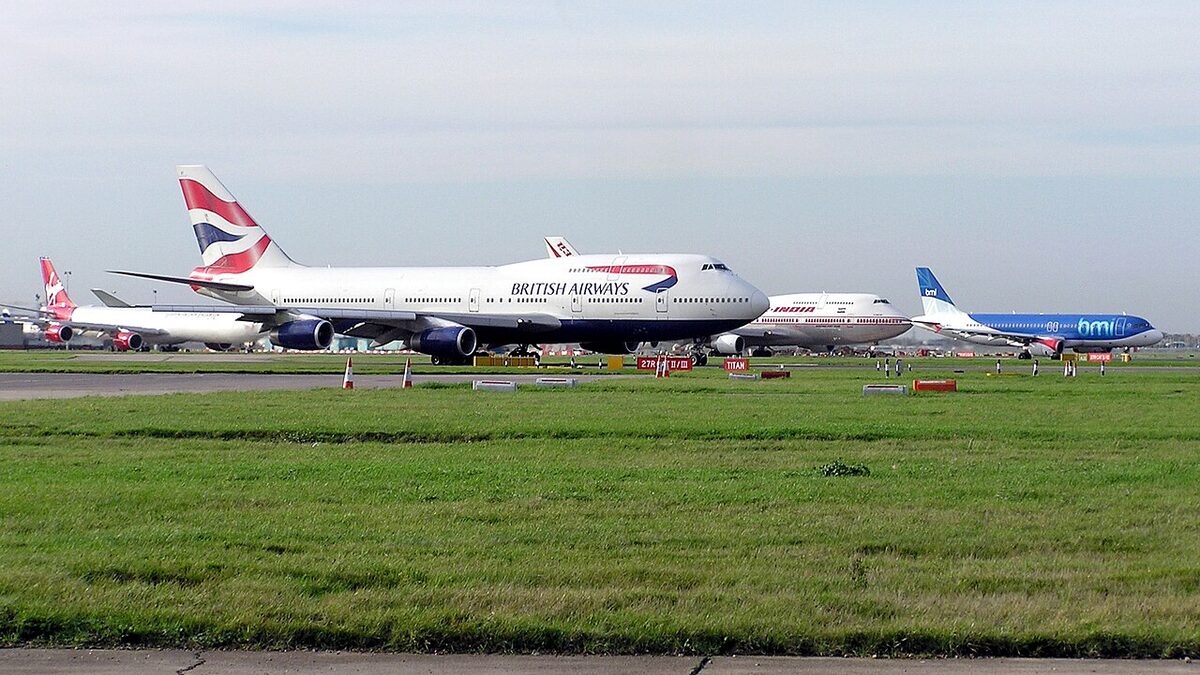
Cover image: Aircraft queuing for take-off at London Heathrow (2005 file photo) — photo by Adrian Pingstone., Public domain, via Wikimedia Commons.
Airport slots explained in one line: a slot is a coordinator's permission for an airline to use a congested airport's runway, terminal and stands to land or take off on a specific date at a specific time. IATA counts 395 airports under some form of coordination in 2026, 216 of them fully slot-coordinated, and says around 43 per cent of passengers depart from a slot-coordinated airport.
The rules come from the Worldwide Airport Slot Guidelines (WASG), published by IATA, Airports Council International (ACI) and the Worldwide Airport Coordinators Group (WWACG), now in Edition 4, plus national law such as the EU's Regulation 95/93 and US Federal Aviation Administration (FAA) orders. The deadline for initial summer 2027 allocations is 5 November 2026.
Last checked: 1 November 2026.
Airport slots explained: what are Level 1, 2 and 3 airports?
The WASG sorts airports by congestion. At a Level 1 airport capacity is generally adequate, and airlines just notify the airport and their handling agent. At Level 2, congestion is possible at some periods, so an independent facilitator agrees schedule changes with airlines. No slots are allocated and historic rights do not apply.
At Level 3, demand cannot be met. Every airline needs a slot from an independent coordinator before operating, and slot times are gate times (on-block and off-block), not runway times. Government authorities set the level after a capacity analysis.
| Airport | Level, summer 2027 | Who allocates | What to know |
|---|---|---|---|
| London Heathrow (LHR) | 3 | Airport Coordination Limited (ACL) | Runway limits unchanged from 2026: 686 arrivals, 702 departures, 05:00–22:00 UTC |
| Tokyo Haneda (HND) | 3 | Japan Schedule Coordination (JSC) | US airlines' access set by the 2010 US–Japan agreement, as amended: 17 daytime pairs, one night pair |
| New York JFK | 3 | FAA | Capped at 81 scheduled operations an hour; order runs to 28 October 2028 |
| New York LaGuardia (LGA) | FAA order (not on IATA's list) | FAA | 71 scheduled operations an hour; order runs to 28 October 2028 |
| Singapore Changi (SIN), Delhi (DEL), Bangkok Suvarnabhumi (BKK) | 3 | Local coordinators | Level 3 in both 2026 seasons and summer 2027 |
| Doha (DOH), Jakarta Soekarno-Hatta (CGK) | 2 | Schedules facilitators | Schedules adjusted by agreement; no slots or historic rights |
| Chicago O'Hare (ORD), Los Angeles (LAX), San Francisco (SFO) | 2 | FAA | FAA-facilitated; gates coordinated separately |
Sources: IATA WASG Annex 12.7 (22 September 2026), ACL, FAA, US DOT.
How does the 80/20 use-it-or-lose-it rule work?
Slots are allocated as a series: at least five slots at the same time on the same day of the week across a season. An airline that operates a series at least 80 per cent of the time keeps it for the next equivalent season. That entitlement, historic precedence or grandfather rights, takes first priority in the next allocation, and the WASG forbids confiscating historic slots except for proven intentional misuse.
The test is anchored to the Historics Baseline Date (23:59 UTC on 31 January for summer, 31 August for winter). Cancellations filed before it generally fall outside the calculation; later ones count as non-use unless justified, for example by an airspace closure or severe weather.
Worked example. Summer 2027 runs from 28 March to 30 October 2027, 31 weeks, so a Monday departure series holds 31 slots. With nothing cancelled before the baseline date, the airline must operate at least 25 of them (80.6 per cent). Fly 24 (77.4 per cent) and the series goes back to the pool. A daily return flight needs 14 such series, seven arrivals and seven departures, or 434 individual slots over the season.
From summer 2027, Edition 4 requires at least seven slots for a Northern Summer series; winter stays at five.
How do new entrants get slots at congested airports?
After historic slots are allocated, the coordinator forms a pool from returned and new slots. Under both the WASG and the EU regulation, half the pool goes to new entrants unless they request less. Definitions differ. The WASG treats an airline as a new entrant if accepting its request would leave it with fewer than seven slots that day, enough for three daily rotations. Regulation 95/93, as amended in 2004, draws the line at fewer than five and excludes any carrier holding more than 5 per cent of the airport's slots that day.
Newly won slots cannot be flipped: both texts lock them for two equivalent seasons.
At Heathrow the pool is tiny. IATA says the airport runs at around 99 per cent of declared capacity, and over 99 per cent of summer 2022 weekly slots were historic, according to Department for Transport figures cited by IAG, British Airways' parent, in a May 2026 paper submitted to the Civil Aviation Authority. So entrants lease. Alaska Airlines launched Seattle–Heathrow in summer 2026 on a daily slot pair leased from its oneworld alliance partner American Airlines, valid from 22 May to 24 October 2026, ch-aviation and CAPA reported.
Can airlines buy and sell slots, and what are Heathrow slots worth?
The WASG allows transfers and swaps where national law permits; coordinators publish the airlines, times and period of any paid deal. The UK permits secondary trading. At Frankfurt, Paris CDG, Madrid, Amsterdam, Munich and Rome, airlines swap slots but do not trade them for cash, IAG says. The EU regulation itself provides only for transfers within groups or takeovers and one-for-one exchanges.
Published prices are rare. Oman Air paid a reported $75 million for a Heathrow slot pair, including an early-morning arrival, in February 2016, a record at the time, TTG reported. Evidence before the High Court in July 2026 put a seasonal slot (one weekly slot for a season) at £812,000; IAG says that average came from a thin sample of deals up to 2017. Slots are also collateral: in November 2025 Apollo-managed funds provided $745 million of senior secured financing against Virgin Atlantic's Heathrow slots, Apollo said.
What is the status of the EU slot regulation in 2026?
Regulation 95/93 still governs EU airports; its last Covid-era relief, Regulation (EU) 2022/2038, applied until 28 October 2023. The Commission's 2011 recast proposal has awaited the Council's first-reading position since Parliament's vote in December 2012, Parliament's Legislative Observatory shows. A Commission fitness check of the slot, ground-handling and airport-charges rules closed its consultation on 28 October 2025; as of 1 November 2026 no conclusions were posted on the Commission's portal.
The 2026 Middle East conflict showed how far the UK and EU have diverged. Commission guidance of 8 May 2026 said airlines may be exempt from slot obligations because of fuel supply issues at airports. The UK went further: its Airports Slot Allocation (Alleviation of Usage Requirements) Regulations 2026 let airlines hand back up to 10 per cent of slots at English coordinated airports in 2026-27 without losing future allocations. The High Court dismissed Gatwick Airport's challenge on 9 July 2026.
Take-up was small. ACL figures as at 15 October show Heathrow airlines returned 4,694 of 290,677 summer 2026 slots (1.6 per cent), and 0.8 per cent across England's nine coordinated airports.
How do slots shape new routes at Heathrow, Haneda and JFK?
At Haneda, access is partly political. The WASG keeps slots separate from traffic rights, yet US carriers' daytime access is set by a 2010 US–Japan memorandum, and the US Department of Transportation (DOT) divides the pairs among airlines. When Delta returned an unused Portland–Haneda pair in September 2023, DOT tentatively gave it to American for JFK–Haneda in January 2024, over United.
Citing 57 per cent controller staffing at its New York approach facility, the FAA lets carriers return up to 10 per cent of JFK and LaGuardia slots without penalty through 30 October 2027. Slots can also spark trade disputes: the DOT lifted its freeze on Mexican airlines' new Mexico City–US routes in October 2026 after Mexico returned many seized slots, adopted the 80/20 standard and named an independent slot coordinator.
For the trade, a route announced into a Level 3 airport is only as firm as its slots. Ask whether the airline holds historic slots, a lease or only a request. Summer 2027 series can still be handed back until 15 December 2026, so check launches against our route tracker before contracting seats.
Frequently asked questions
What is the 80/20 rule for airport slots?
It is the use-it-or-lose-it test. An airline that operates a series of slots at least 80 per cent of the time keeps it for the next equivalent season. Below that, the series returns to the coordinator's pool unless the shortfall is justified, for example by an airspace closure or severe weather. EU, UK and FAA rules all use 80 per cent.
Can airlines sell or lease airport slots?
Yes, where national law allows it. The UK permits secondary trading, and Heathrow slot pairs have changed hands for tens of millions of dollars. The WASG bars transferring newly allocated slots until they have been operated for two equivalent seasons. At JFK, the FAA allows trades and leases of slots with its approval.
Who allocates slots at Heathrow?
Airport Coordination Limited (ACL), an independent coordinator. ACL allocates slots at all nine coordinated airports in England, including Heathrow, Gatwick, Manchester and Stansted, under the UK's assimilated version of Regulation 95/93. It also coordinates Dubai International and says it works with 80 airports worldwide.
When are summer 2027 slots allocated?
Initial requests were due by 8 October 2026 and initial allocations by 5 November, according to IATA's coordination calendar. The IATA Slot Conference follows on 17 to 19 November, series can be returned until 15 December 2026 (a trial deadline), and the Historics Baseline Date is 31 January 2027. The season starts on 28 March 2027.
Sources
- IATA, Airport slots fact sheet (June 2026)
- ACI, IATA, WWACG, Worldwide Airport Slot Guidelines, Edition 4
- EU, Regulation (EC) No 793/2004 amending slot regulation 95/93
- European Parliament, slot recast procedure 2011/0391(COD)
- ACL, UK alleviation slot returns, summer 2026
- High Court, Gatwick v Secretary of State for Transport (9 July 2026)
- FAA, JFK operating limits extended to 2028
- US DOT, Order 2024-1-18, US–Haneda slot pair
- FAA, New York slot-usage relief to October 2027
- European Commission, Middle East crisis guidance (8 May 2026)
- IATA, Calendar of Coordination Activities