NDC is IATA's XML and API standard for airline offers and orders. How it differs from EDIFACT GDS booking, what airlines charge, and 2026 adoption.
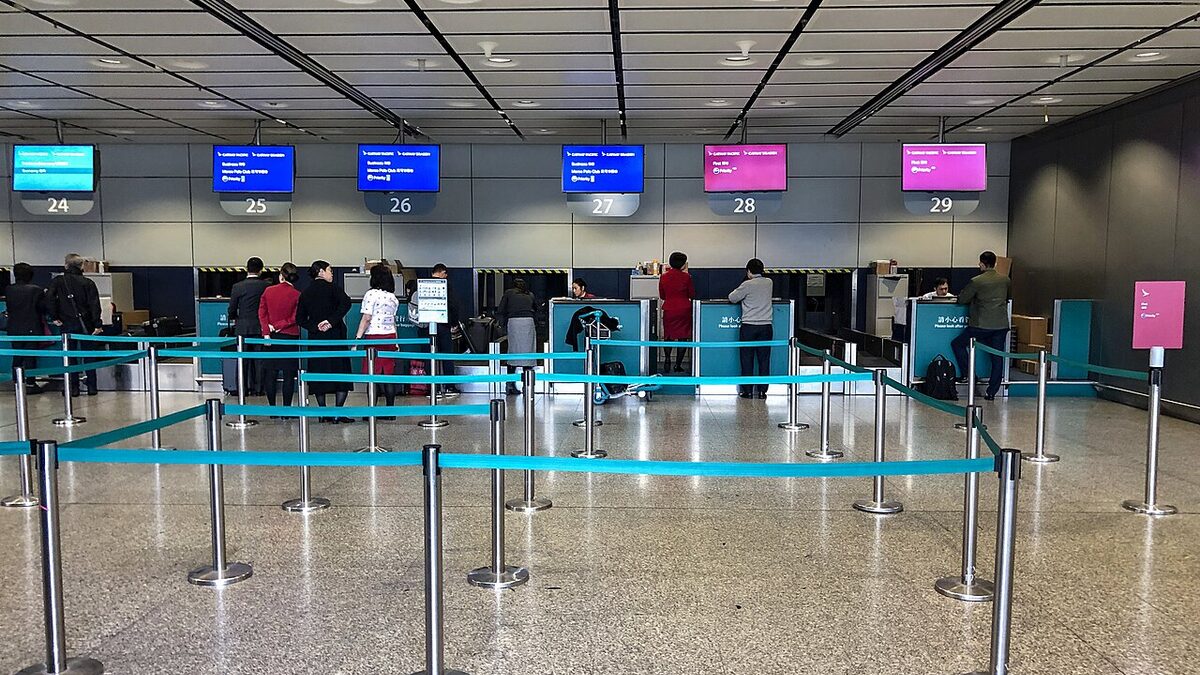
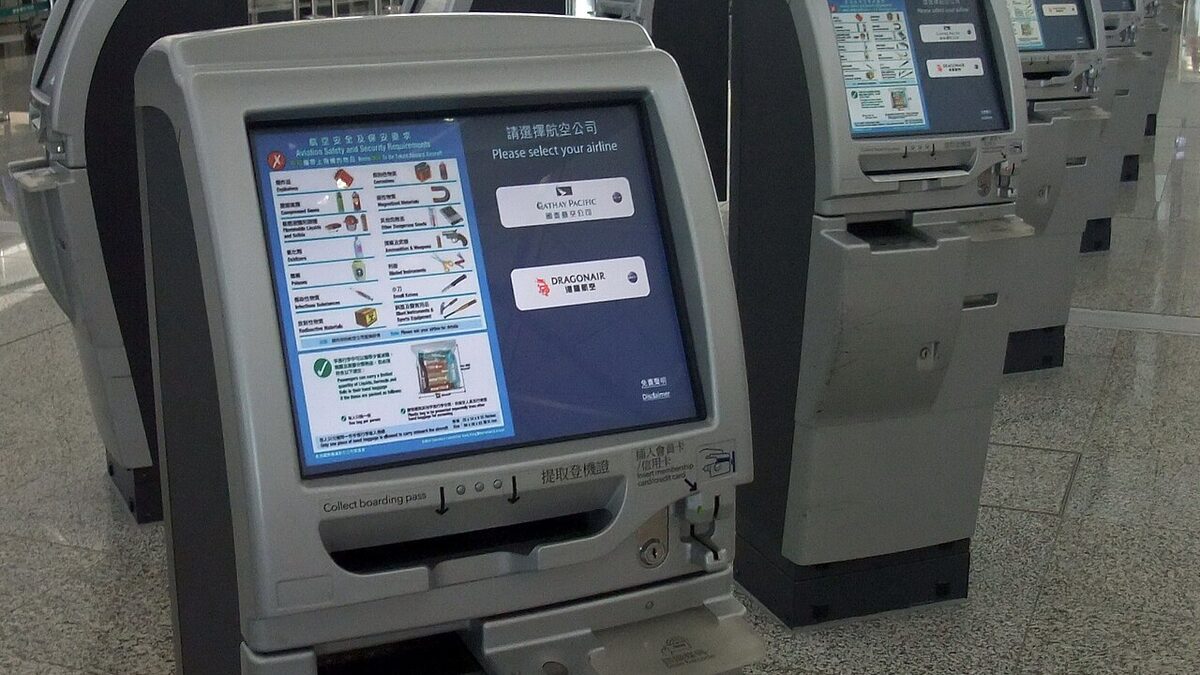
Cover image: Self check-in kiosks at Hong Kong International Airport (2011 file photo) — photo by Mk2010, CC BY-SA 3.0, via Wikimedia Commons.
What is NDC? It is IATA's New Distribution Capability, an XML-based standard, used through an API, that lets an airline build its own offer, send it to travel agencies and other sellers, and hold the sale as an order. The older route works the other way round: the airline files fares in advance and a global distribution system (GDS) such as Amadeus, Sabre or Travelport prices the trip over EDIFACT messages.
The difference now shows up on the invoice. Under its guideline valid from 5 May 2026, and its NDC overview updated on 8 October, Lufthansa Group charges €19 to €23 per ticket issued through a classic GDS connection, against €8 or nothing over NDC. In the US, NDC made up 21.2 per cent of agency transactions settled by ARC in September 2026.
Last checked: 1 November 2026.
What is NDC, technically?
IATA describes NDC as "a data communication standard via an API" that lets sellers "shop, order, pay, and service" airline products under its Offer and Order standards. That covers four exchanges: shopping and the offers returned, creating the order, changing or cancelling it, and payments and refunds. IATA Resolution 787, adopted in October 2012, underpins the programme.
The airline's own system answers each shopping request. It can return a fare bundled with bags or seats, a promotional price or a price point that was never filed, which is how continuous pricing reaches agencies. IATA says the standard is open to "any third party, intermediary, IT provider or non-IATA member".
The schemas come in generations: IATA enhanced the 21.3 schemas in 2024 and calls 24.1 the start of a new generation. Adoption is voluntary, and IATA says it "will not prescribe a specific course of action".
How is NDC different from EDIFACT and GDS booking?
EDIFACT stands for Electronic Data Interchange for Administration, Commerce and Transport. Lufthansa's guideline calls it a 1980s standard that "has reached its limitation". Our guide to how ticket stock, GDSs and BSP settlement work covers the classic plumbing. The table sets out what changes.
| Feature | Classic GDS (EDIFACT) | NDC |
|---|---|---|
| Message format | EDIFACT, a data standard established in the 1980s | IATA XML schemas used through an API; current generations 21.3 and 24.1 |
| Who builds the price | Airline files fares and rules; the GDS prices the itinerary | Airline's own system returns an offer for each request |
| Content | Filed fares; some carriers keep their best fares off this channel | Full range, including ancillaries and promotional fares (IATA) |
| How the seller connects | GDS terminal or GDS-linked booking tool | Direct airline API, a GDS or other NDC aggregator, or an airline agency portal |
| Lufthansa Group charge (EUR, from 5 May 2026) | €19 (Amadeus), €22.50 (Sabre), €23 (Travelport) per ticket, as YR | €8 via GDS NDC aggregators (OB-T); none under a bilateral agreement |
| Finnair charge (per its agent page) | €15 per direction, as YQ | Avoided via direct NDC, approved aggregators or Finnair's FAST tool |
| Records and settlement | PNR, e-ticket and EMD; settled through BSP or ARC | Airline order reference, usually still backed by a PNR and e-ticket in 2026; settled through BSP or ARC |
An NDC sale in 2026 usually still ends in an e-ticket, which is why Lufthansa levies its NDC charge per ticket.
Why do airlines charge more for GDS bookings?
The first reason is in the name of Lufthansa's levy, the Distribution Cost Charge. GDSs earn booking fees on EDIFACT sales, and Sabre chief executive Kurt Ekert told analysts on 6 August 2026 that NDC hits Sabre's revenue hardest in Europe, "where prevailing EDIFACT booking fees are nearly double what they are in the balance of the world".
Control of the product is the other. Lufthansa Group says NDC bookings carry on average three times the ancillary attachment rate, according to Travel Weekly (Australia). "If we develop a new feature on NDC today, we're reaching more agents than if we developed it in the EDIFACT environment," Brendan Shashoua, its head of regional sales for South-East Asia, told an industry briefing in Sydney on 11 June.
Lufthansa Group's Distribution Cost Charge covers Austrian Airlines, Brussels Airlines, Lufthansa, SWISS and Air Dolomiti. It is a fixed amount per ticket, collected as a YR tax, that varies by GDS: €19 for Amadeus, €22.50 for Sabre and €23 for Travelport (US$22 to US$27 for journeys starting in the US, ¥3,500 to ¥4,300 from Japan). Through a GDS NDC aggregator under its NDC Public Model, where that model is live, sellers get the "Base Offer" for €8 (US$9.50, ¥1,500), collected as an OB-T fee. NDC bookings under its bilateral model, which unlock the "Smart Offer", and its own sales channels carry no charge.
Exemptions are narrow. Journeys starting in Hong Kong, Iran, Libya or Yemen are excluded, and the May 2026 version removed the exceptions for New Zealand and China.
Finnair's agent page states that it has collected an EDIFACT surcharge since 2022, €15 per direction at first issuance, filed as YQ, and that "our best offering for our travel agent partners is always found via NDC distribution."
Worked example. A Sabre-connected agency issuing 1,000 Lufthansa Group tickets a year for journeys starting in Germany collects €22,500 in DCC over EDIFACT (1,000 × €22.50). Through a GDS NDC aggregator the charge falls to €8,000 (1,000 × €8), or €14,500 less, and under a bilateral NDC agreement to nothing. On Finnair, an EDIFACT return ticket with a Finnair-marketed flight in each direction carries €30 (2 × €15).
How widely is NDC used in 2026?
The 2026 figures measure different things.
ARC, which settles US agency sales, said NDC accounted for 21.2 per cent of its settled transactions in September 2026, with 1,264 agencies reporting NDC sales. Sabre put NDC at about 5 per cent of its own distribution volumes on its 6 August call. Ekert said it was "growing very steadily", partly through "reintermediation": NDC volume that used to flow through direct airline connections now coming through Sabre.
Lufthansa's own figure runs higher. According to Travel Weekly, Shashoua said 50 per cent of Lufthansa Group's indirect bookings went through NDC, against "one out of five tickets" sold indirectly worldwide; the same report put 77.5 per cent of the group's bookings, including direct sales, outside EDIFACT.
What changes for travel agents and TMCs?
The connection now decides the price and the content. Under Lufthansa's rules a Public Model seller pays €8 for the Base Offer, while a bilateral agreement brings the Smart Offer free of charge.
Servicing is where agencies feel the change most. Changes, cancellations and refunds run as messages to the airline's order system, so capability depends on each carrier's build. According to Travel Weekly's report of the June briefing, Lufthansa's early NDC work went into servicing and closing functionality gaps against EDIFACT systems. Group bookings are still unavailable in its Public Model.
Refunds need care. Lufthansa's charge is non-refundable except on involuntary refunds of completely unused tickets. EDIFACT agencies using semi-automated tools must strip the YR from voluntary refunds by hand, while a refundable NDC OB-T fee goes back manually through the BSP Refund Application. A missing or wrongly refunded charge triggers an agency debit memo (ADM).
For corporate programmes, IATA's pitch is that NDC makes all airline product information available to buyers, "reducing the need for out-of-policy bookings".
What is ONE Order, and what comes after NDC?
NDC modernises the offer. ONE Order targets what happens after the sale, merging the PNR, e-ticket and EMD into a single record, the Order. IATA says agents would then follow "an identical process" for every airline, where ticketless and ticketed carriers now need different ones, and accounting would shift from tickets and EMDs to payment for services ordered.
IATA told its World Passenger Symposium in Macao on 28 October 2026 that seven airlines were live or implementing Orders, more than 20 were expected to follow from 2027, and IT providers had committed more than US$1.7 billion to Offers and Orders.
There is no industry deadline. IATA leaves the timeline to each airline.
Frequently asked questions
What does NDC stand for in airline booking?
NDC stands for New Distribution Capability, an IATA programme and XML-based standard. Through an API, a seller asks the airline for offers, books one as an order, pays, and later changes or cancels it. The airline builds each offer itself, so it can include bundles and prices not filed for classic GDS distribution. Any third party can implement it.
Is NDC replacing the GDS?
Not in 2026. Amadeus, Sabre and Travelport also act as NDC aggregators, and Lufthansa Group sells its NDC Public Model only through such aggregators. What airlines are retreating from is classic EDIFACT content: Finnair says its journey towards "ending all Edifact distribution is progressing well". Even so, Sabre said in August 2026 that NDC was only about 5 per cent of its distribution volumes.
Do NDC bookings still produce an e-ticket?
Usually, yes. Lufthansa Group levies its NDC charge per ticket and excludes EMDs, and ARC counts NDC sales among the agency transactions it settles. Under IATA's ONE Order standard, the PNR, e-ticket and EMD would merge into a single order record, but IATA leaves the timing to each airline, and only seven airlines were live or implementing Orders in October 2026.
How can an agency avoid airline GDS surcharges?
Book through the airline's NDC connection or its own channels, and check each carrier's current guideline before quoting. Lufthansa Group charges €19 to €23 per EDIFACT ticket, €8 through a GDS NDC aggregator and nothing under a bilateral NDC agreement. Finnair's agent page states a €15 charge per direction on EDIFACT tickets. Lufthansa audits collection and issues an ADM for any missing charge.
Sources
- IATA, Distribution with Offers and Orders (NDC) fact sheet, June 2026
- IATA, NDC programme page
- IATA, Fulfilling with Orders: ONE Order fact sheet, June 2026
- IATA, WFS-WPS 2026 opening speech, 28 October 2026
- Lufthansa Group, DCC Guideline version 7.0, valid from 5 May 2026
- Lufthansa Group, NDC model overview, updated 8 October 2026
- Finnair, Fares and rules for travel agents
- ARC, U.S. travel agency air ticket sales, September 2026
- The Motley Fool, Sabre Q2 2026 earnings call transcript
- Travel Weekly (Australia), Lufthansa Group closes in on all-NDC future