Wizz Air's half-year net profit fell 66.6% to €108.1m on a 33.7% higher fuel bill, but second-quarter profit rose and October unit revenue was up about 5%.
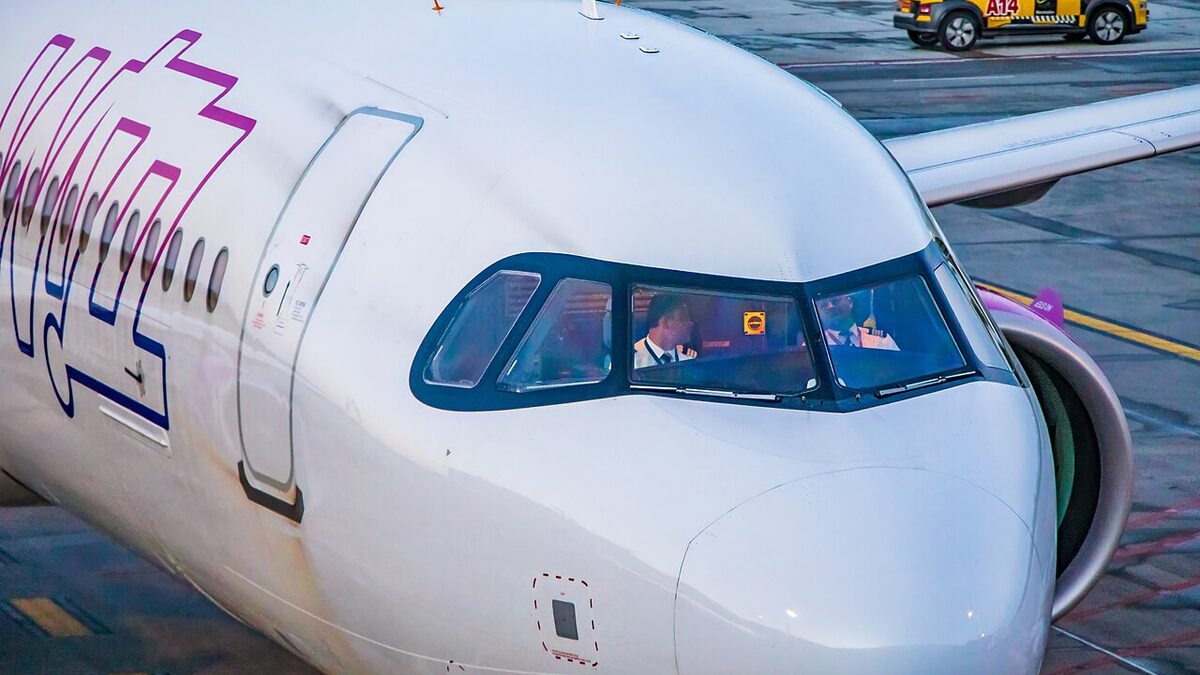
Cover image: The nose of a Wizz Air Airbus A321neo (file photo) — photo by DavidivardiIL, CC BY 4.0, via Wikimedia Commons.
Wizz Air's H1 F27 results, published on Thursday 12 November, show that adding a quarter more seats did not protect earnings from dearer fuel. Net profit for the six months to 30 September 2026 fell 66.6 per cent to €108.1 million, from €323.5 million a year earlier, even though passenger numbers rose 26.2 per cent to 46.1 million and revenue 13.8 per cent to €3,801.8 million.
The damage was done between April and June. The July to September quarter beat last year's, and the airline says winter fares are rising while it keeps adding capacity. The release contains no full-year profit guidance.
What do Wizz Air's H1 F27 results show?
Two different quarters. Half-year operating profit fell 39.8 per cent to €264.5 million. In the second quarter alone, though, Wizz Air made an operating profit of €447.8 million, up 8.8 per cent, and a net profit of €306.3 million, up 7.4 per cent, despite fuel costs 28.7 per cent higher, the results release says.
Subtracting those figures from the half-year totals leaves a first-quarter operating loss of about €183 million and a net loss of about €198 million. That is our arithmetic; the release blames Middle East disruption. Revenue per available seat kilometre (RASK) fell 8.1 per cent in the first quarter and rose 0.5 per cent in the second.
Currency widened the gap at the net level: a €32.5 million foreign exchange loss replaced a €176.0 million gain a year earlier.
| Six months to 30 September | 2026 | 2025 | Change |
|---|---|---|---|
| Passengers (million) | 46.1 | 36.5 | +26.2% |
| Revenue (€ million) | 3,801.8 | 3,342.1 | +13.8% |
| Fuel expenses (€ million) | 1,241.4 | 928.3 | +33.7% |
| Operating profit (€ million) | 264.5 | 439.2 | −39.8% |
| Net profit (€ million) | 108.1 | 323.5 | −66.6% |
| RASK (euro cents) | 4.84 | 4.98 | −2.9% |
| Fuel cost per ASK (euro cents) | 1.58 | 1.38 | +14.5% |
How hard did fuel hit, and how much is hedged?
Fuel expenses rose 33.7 per cent to €1,241.4 million on 17.1 per cent more available seat kilometres. Wizz Air said its average fuel price, after hedges, was $176 a tonne higher than a year earlier. Unit costs excluding fuel were flat.
As of 6 November it had hedged 82 per cent of its fuel for the six months to March 2027 with a ceiling of $860 a tonne, and 41 per cent of the following financial year at $1,009. "Fuel remains the main headwind," chief executive József Váradi said.
Emirates reported a 68 per cent fall in half-year pre-tax profit a week earlier (see our report on Emirates' hedging gains), and we reported in October on the wider jet fuel squeeze on airline fares.
Are Wizz Air fares going up this winter?
On the airline's own numbers, yes. October RASK was up around 5 per cent year on year and ticket revenue per passenger rose 7 per cent, Váradi said. About 70 per cent of November seats and 40 per cent of December seats were sold, and unit revenue on hand was in line with a year earlier on roughly 18 per cent more capacity, with "higher average fares offset by lower load factors". October traffic showed the same trade-off: 7.62 million passengers, up 19.8 per cent, at a load factor of 91.2 per cent, 1.7 points lower. Third-quarter RASK is guided up by a low single-digit percentage.
The first half went the other way. Average revenue per passenger fell 9.9 per cent to €82.5, of which €35.3 was ancillary revenue. The network also got shorter: the average flight shrank 7.1 per cent to 1,576km as Wizz Air refocused on flying within Europe.
Where is Wizz Air adding and cutting capacity?
Growth is going into Europe. The release lists Spanish bases at Valencia, Madrid and Santiago de Compostela this winter, plus Pristina in Kosovo and Brasov in Romania from November and December.
The Gulf is on hold. Flights to Abu Dhabi and Dubai remain postponed because airspace restrictions lengthen the routings. Our analysis of UK regulator data on Gulf flights found Wizz Air UK operated no Gatwick flights to Jeddah or Medina in July or August.
Wizz Air had 22 aircraft parked for Pratt & Whitney GTF inspections on 30 September, down from 35 a year earlier, and expects none by the end of 2027.
Net debt stood at 4.1 times EBITDA, against 3.7 times a year earlier. The shares closed at 1,131p in London on results day, down 1.4 per cent, FT markets data show, after an early dip to 1,097p reported by AskTraders.
Frequently asked questions
What were Wizz Air's H1 F27 results?
For the six months to 30 September 2026, Wizz Air reported revenue of €3,801.8 million, up 13.8 per cent, and net profit of €108.1 million, down 66.6 per cent. Operating profit fell 39.8 per cent to €264.5 million.
Why did Wizz Air's profit fall when passenger numbers rose 26 per cent?
Costs grew faster than revenue. Fuel expenses rose 33.7 per cent and total operating expenses 21.9 per cent, against revenue growth of 13.8 per cent. First-quarter unit revenue fell 8.1 per cent, and a €32.5 million foreign exchange loss replaced a €176.0 million gain.
How much of Wizz Air's fuel is hedged?
As of 6 November 2026, Wizz Air had hedged 82 per cent of its jet fuel for the six months to 31 March 2027, with a weighted average ceiling of $860 a tonne. For the following financial year the cover was 41 per cent at $1,009.
Is Wizz Air flying to Abu Dhabi and Dubai again?
No. Wizz Air said it has postponed restarting flights to Abu Dhabi and Dubai because regional airspace restrictions require significantly longer routings. The results release gives no restart date. Tel Aviv flights resumed in late May 2026.
Sources
- Wizz Air Holdings (RNS via Investegate), Half Year Results for the six months to 30 September 2026
- AskTraders, Wizz Air Profit Falls 67% on Fuel
- Wizz Air Holdings (RNS via Investegate), October 2026 traffic statistics
- Financial Times markets data, Wizz Air Holdings share price, 12 November 2026 close