Travel agents sell other firms' trips for commission; tour operators build packages and answer for them. Where DMCs, OTAs, bed banks and consolidators fit, and the rules.
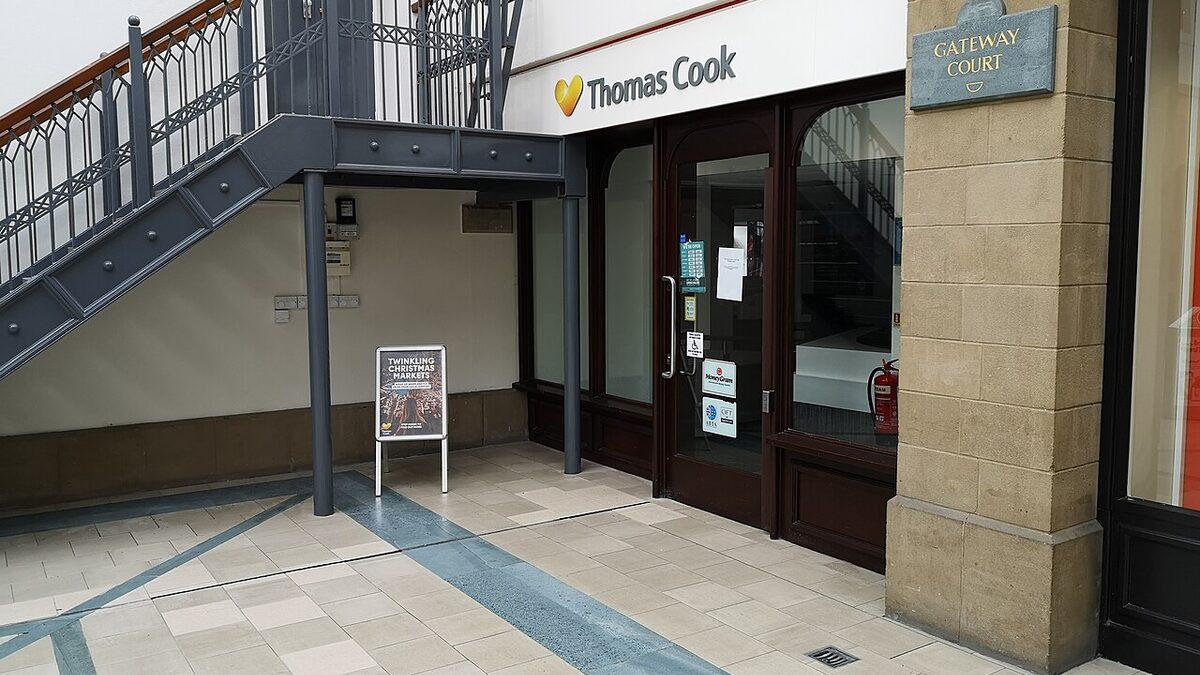
Cover image: A high-street travel shop in Kendal, England (2019 file photo) — photo by Lewis Clarke, CC BY-SA 2.0, via Wikimedia Commons.
A travel agent sells trips that other companies put together and is usually paid a commission by the supplier. A tour operator contracts the flights, hotels and ground services itself, sells them as its own package at its own price, and answers for every part. That is the tour operator vs travel agent distinction, and EU law draws the line in the same place: the organiser of a package is responsible for every service in it, “irrespective of whether those services are to be performed by the organiser or by other travel service providers” (Article 13 of the Package Travel Directive).
Four more trade players sit between supplier and traveller: destination management companies (DMCs) and inbound operators, online travel agencies (OTAs), bed banks and air consolidators. The role a business plays decides who holds the customer’s money, who needs a licence and who pays when something fails.
Last checked: 1 November 2026.
Tour operator vs travel agent: what is the legal difference?
Directive (EU) 2015/2302 defines the “organiser” as the trader who “combines and sells or offers for sale packages”, and the “retailer” as a trader who sells packages an organiser has combined. The retailer is the travel agent. It is not automatically liable for how the trip is delivered, though each member state may make it so.
The trap is the package definition. Two or more types of travel service for one trip become a package when one trader combines them, “including at the request of or in accordance with the selection of the traveller”. An agent that tailor-makes a flight-and-hotel trip is, for that booking, the organiser.
The shopfront label does not decide it. The booking does.
Where do DMCs, inbound operators, OTAs, bed banks and consolidators fit?
An outbound tour operator sells holidays abroad to travellers in its home market. An inbound, or receptive, operator sits in the destination and sells ground arrangements to those operators and to foreign agents. A DMC does that with a wider brief: ADMEI, a global DMC association, requires members to provide tours and transportation plus at least two of event management, activities and programme logistics. Our guide to what a DMC does and how DMCs price covers the business in depth.
OTAs are agents that sell online, and Booking Holdings and Expedia act as merchants too, taking the payment and paying the supplier later. Booking Holdings’ merchant revenues rose to $17.8 billion in 2025 from $14.1 billion, while its agency revenues fell to $8.0 billion from $8.5 billion, its results show. Our explainer on how online travel agencies work sets out both models.
Bed banks are hotel wholesalers: they contract rooms at net rates and resell them business to business. WebBeds, the bed bank of Australian-listed Web Travel Group, handled A$5.8 billion of total transaction value (TTV) in the year to 31 March 2026.
Consolidators do the same with airline fares, reselling them to agents. The settlement plumbing behind that is in our guide to airline ticketing, GDSs and IATA settlement.
| Role | Sells to | Contracts suppliers? | Main risk and protection | How it earns |
|---|---|---|---|---|
| Travel agent (retailer) | Travellers and companies | No | Its own booking errors; package liability only if national law adds it | Supplier commission plus client fees |
| Outbound tour operator (organiser) | Travellers, direct or through agents | Yes: flights, hotels, ground services | Every service sold; EU insolvency security; UK ATOL for flight packages | Margin over net cost |
| Inbound operator or DMC | Foreign operators, agents, event planners | Yes, locally | Delivery on the ground, under contract to its client | Mark-up on local net costs |
| Online travel agency (OTA) | Travellers online | Yes, mainly hotels | Holds the payment in the merchant model; organiser when it sells packages | Commission, merchant margin, advertising |
| Bed bank or wholesaler | Agents, tour operators, OTAs | Yes: net hotel rates | Package duties sit with whoever sells to the traveller | Margin (WebBeds: 6.8% of TTV, FY26) |
| Air consolidator | Travel agents | Yes: airline fares | UK: Trade ATOL for sales only to other ATOL holders | Margin on net fares |
Who carries the risk if a trip goes wrong or a company fails?
In the EU, the organiser carries it. Article 17 requires organisers to provide security for “the refund of all payments made by or on behalf of travellers” if their insolvency stops the services, plus repatriation when transport is included. Organisers based outside the EU that sell into a member state must provide that security under its law. If the organiser is outside the European Economic Area, the EU retailer takes on its duties unless it can show the organiser complies (Article 20).
For an Asian or American operator selling direct to European travellers, those are the clauses to read. Agents still answer for errors caused by technical defects in their own booking systems (Article 21).
The rules are changing. Directive (EU) 2026/1024, in force since 28 May 2026, must be applied from 29 March 2029. It scraps “linked travel arrangements”, lets member states require retailers to hold insolvency protection too, and catches the unflagged upsell: if a trader, before the traveller pays for a first service, invites them to add another type of service without warning that the combination will not be a package, and the traveller buys it at the same point of sale within 24 hours of paying for the first, the trader is deemed the organiser.
In the UK, the Civil Aviation Authority’s ATOL rules let only an airline, an ATOL holder or an exempt business sell flight-inclusive packages to UK consumers, wherever the seller is based and “irrespective of the departure point of the flight”. A Standard ATOL needs a bond of 15 per cent of licensable revenue (minimum £50,000). Sellers can instead join an accredited body and trade under its licence.
DMCs and inbound operators sell to the organiser, so their exposure is mainly contractual: the directive lets an organiser that pays compensation seek redress from any third party that contributed. ADMEI asks member DMCs to carry at least $1 million of general liability insurance, or explain why they do not.
Do travel agents and tour operators need a licence?
In the US, registration is a state matter. California requires every seller of travel to register with the Attorney General before trading, at $100 a year per business location. Sellers it requires to keep a trust account must pay “consolidators, wholesalers, airline companies” from it before withdrawing their commissions. Florida requires annual registration, a $300 fee and a bond of up to $25,000. Washington licenses sellers of travel too.
Singapore licenses the activity, not the job title. Under the Travel Agents Act 1975, a business in Singapore that sells travel, packages or tours, or engages in “purchasing or reserving for resale” a right to travel, needs a Singapore Tourism Board licence. A General Licence requires S$100,000 of paid-up capital and net value.
A business that only supplies services to a licensee for the licensee’s tour, such as a tourist guide, needs no travel agent licence of its own, though guides need a separate tourist guide licence.
How does each one make money: commission or margin?
Agents earn commission and client fees. Hilton pays up to 10 per cent on commissionable rates (10 per cent of room revenue in the US, Mexico and Canada), only to agencies registered with bodies such as IATA, ARC or CLIA, and deducts a 3 per cent processing fee.
Operators, bed banks and merchant OTAs earn a margin: their selling price minus the net price they pay. UK tax works the same way, with HMRC’s Tour Operators’ Margin Scheme charging VAT only on that difference for businesses reselling travel in their own name. WebBeds’ revenue was 6.8 per cent of TTV in its 2026 financial year; Booking’s was 14.5 per cent of its $186.1 billion of 2025 gross bookings, by our calculation.
Worked example (illustrative): a $2,000 hotel stay, three routes.
- An agent books a commissionable Hilton rate in the US, all of it room revenue: $200 commission, less a $6 processing fee, leaves $194.
- A bed bank earning WebBeds’ 6.8 per cent average keeps $136.
- An OTA at Booking’s blended 14.5 per cent keeps about $290.
Two of those are company-wide averages, not rate cards. The structure is the point: commission is a share of someone else’s price, while margin is your own price minus your cost.
Frequently asked questions
Is a DMC the same as an inbound tour operator?
The terms overlap. Both are based in the destination and sell ground services to trade clients abroad, not to travellers. The DMC label signals a wider brief: ADMEI requires member DMCs to provide tours and transportation plus at least two of event management, activities and programme logistics.
Can a travel agent become a tour operator without meaning to?
Yes, under EU package rules. An agent that combines two or more types of travel service for the same trip, such as a flight and a hotel, before one contract is concluded is the organiser of that package. It then answers for every service in it and needs insolvency protection.
Is an OTA a travel agent or a tour operator?
It can be either, booking by booking. Selling a stand-alone room on commission, it is an agent. Taking the payment and reselling at its own price, it earns a merchant margin. Selling a flight and a hotel together from one point of sale, chosen before payment, it is a package organiser under EU law.
What is the difference between a bed bank and a consolidator?
A bed bank is a hotel wholesaler: it contracts rooms at net rates and resells them business to business, to agents, tour operators and OTAs. A consolidator does the same job with airline fares. Neither is normally the seller to the traveller, so package-law duties fall on whoever is.
Sources
- EUR-Lex, Directive (EU) 2015/2302 on package travel
- EUR-Lex, Directive (EU) 2026/1024 amending the Package Travel Directive
- UK Civil Aviation Authority, Types of ATOL
- California Attorney General, Seller of Travel FAQs for registrants
- Singapore Tourism Board, Travel Agent Licence
- Hilton, Transient commissions for travel agents
- Web Travel Group, FY26 results
- Booking Holdings, full-year 2025 results