Do you need to tip in Singapore, Malaysia, the Philippines, Cambodia, the Maldives, Dubai or Hong Kong? A country-by-country guide to service charges, customary amounts and which currency to use.
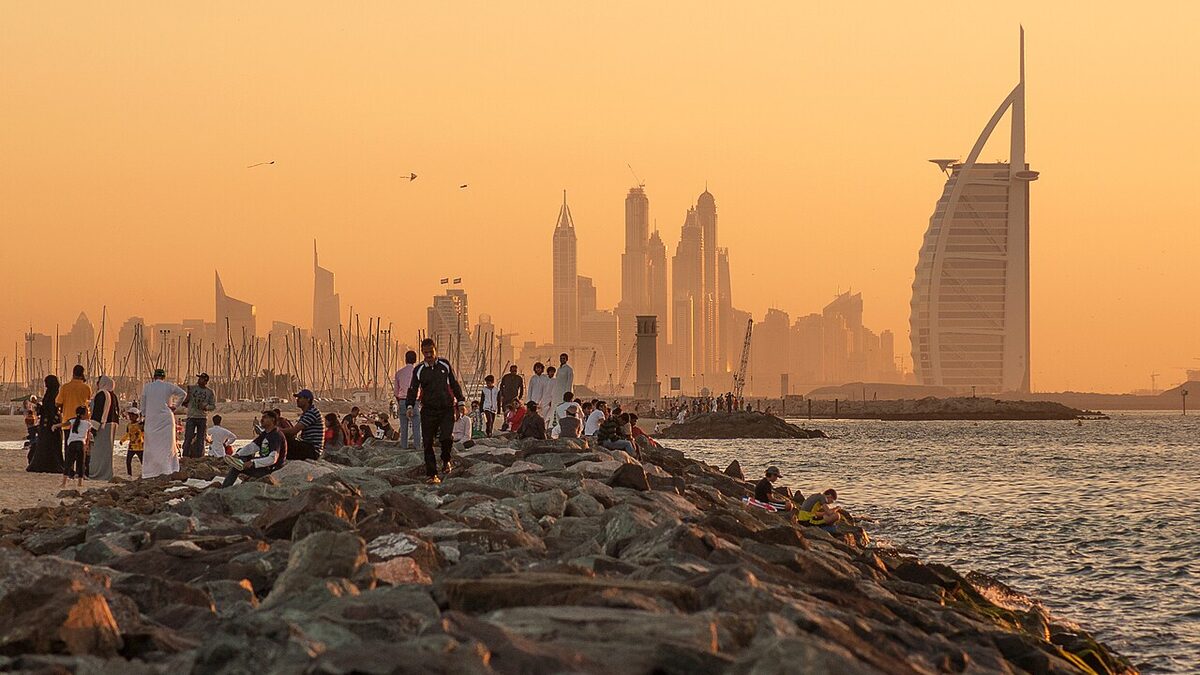
Cover image: the Dubai skyline and Burj Al Arab at sunset — photo by Phil6007, CC BY-SA 4.0, via Wikimedia Commons.
In most of these destinations you do not have to tip. Singapore, Malaysia and Hong Kong have no tipping expectation, and mid-range and upscale restaurants there usually add a 10% service charge that settles the matter. In the Maldives, resort bills carry a 10% service charge plus 16% GST, so extras are optional. The Philippines, Cambodia and Dubai are where small tips are most common: never compulsory, but appreciated for good service, particularly in tourist areas. The rule that works everywhere is the same: read the bill first, and do not add a tip on top of a service charge unless service stood out. Tip in cash and in local currency (or US dollars in Cambodia and at Maldives resorts), never in rupees.
| Country | Tipping expected? | Restaurants | Hotels/porters | Taxis | Currency note |
|---|---|---|---|---|---|
| Philippines | Not mandatory, appreciated | 5–10% if no service charge; nothing extra if 10% charge added | PHP 20–50 per night or per bag | Not required; round up PHP 20–50 | Pesos in cash; card tips often go to the house |
| Singapore | No | 10% service charge + 9% GST on the bill; no tip | Not required; SGD 2–5 housekeeping optional | No tip; rounding up optional | Cards and SG QR almost everywhere |
| Malaysia | No | 10% service charge + service tax at mid-range and upscale places | A few ringgit for bellhop or valet, optional | No tip; round up the fare | RM1 ≈ INR 23.4 (September 2026) |
| Cambodia | No, but welcome in tourist areas | 5–10% cash in tourist restaurants with no service charge | $1 per night or per bag in tourist hotels | Tuk-tuk: round up; $2–3 after a full temple day | US dollars and riel both circulate |
| Maldives | No; extras welcome | 10% service charge + 16% GST at resorts | A few dollars for room attendants | Round up the fare | US dollars at resorts; rufiyaa on local islands |
| Dubai | Optional but common | Check for a service charge; a modest extra if none | A few dirhams per bag or per day | Round up the metered fare | Dirhams in cash or a card addition |
| Hong Kong | No | 10% service charge often compulsory at mid-to-upmarket places | HK$10–20 per bag or service | Round up to the nearest dollar | Hong Kong dollars in cash; card tips may not reach staff |
Philippines
Tipping in the Philippines is not mandatory, but it is appreciated, especially in Manila, Cebu, Boracay and Palawan. Many mid-range and upscale places add a 10% service charge; when it is there, no extra tip is needed, though PHP 20–50 or rounding up is fine if service stood out. Where there is no service charge, leave 5–10% in cash (PHP 40–80 on a PHP 800 bill). Street food, jeepneys and small carinderias never expect a tip.
- Hotels: PHP 20–50 per night for housekeeping; PHP 20–50 per bag for porters.
- Guides: PHP 100–200 for a half-day group tour, PHP 300–500 for a full-day private guide.
- Drivers: PHP 100–300 for a half day, up to PHP 500 for long transfers.
- Spa: PHP 50–100 for a 60–90 minute session if no service charge is included.
- Taxis and Grab: no tip required; round up PHP 20–50 for good service, or tip in the Grab app.
Carry PHP 20, 50 and 100 notes: tips added to cards often go to the house, not the server. A budget of PHP 200–400 a day covers tips if you use guides and eat out twice.
Singapore
Tipping is not expected in Singapore. Restaurants add a 10% service charge plus 9% GST (GST has been 9% since 1 January 2024), and that is treated as the tip. GST is charged on the menu price plus service, so a SGD 100 bill becomes SGD 119.90. Menus marked "++" add both; menus marked "nett" already include them, so you pay the listed price. Do not add a tip line on the card slip.
Hawker centres and food courts have no service charge and no tipping; the etiquette that matters is returning your tray. Taxis and ride-hailing apps (Grab, Gojek, Tada) are metered or app-priced with no tip; rounding up SGD 1–2 for help with luggage is polite but optional. In hotels, the service charge covers service; SGD 2–5 a night for housekeeping is a kind extra, never required. For a full-day private guide, SGD 5–10 per person is a generous thank-you; group tours expect nothing. Contactless cards, NETS and SG QR work almost everywhere, so keep only SGD 10–20 in cash for cash-only hawker stalls.
Malaysia
Tipping is not the norm in Malaysia and is not expected for any service. What matters is the bill. Mid-range and upscale restaurants usually add a 10% service charge, which goes to the house rather than the waiter, and the government's service tax, a single-digit levy, goes on top. A RM100 dinner for two therefore comes to roughly RM116–118; at September 2026 rates (RM1 ≈ INR 23.4) that is about INR 2,700–2,760. Where there is no service charge, 5–10% in cash for very good service is generous.
Hawker stalls, kopitiams, mamak stalls and food courts add nothing; rounding RM13.50 up to RM14 is appreciated but never expected. In taxis, Grab and airport limos no tip is expected; riders usually round up, for example paying RM20 on a RM17.40 fare. For a full-day private driver or guide, RM20–30 is a generous thank-you. Valet attendants generally get about RM5. At independent massage shops with no charge on the receipt, regulars often add 10%. RM50–100 in small notes covers a week's tipping.
Cambodia
Tipping is not part of Cambodian culture, but it is becoming more common in tourist areas and is always appreciated. Street stalls, noodle shops and markets expect nothing. In tourist-district restaurants in Siem Reap and Phnom Penh, 5–10% in cash for good service is generous. Upscale hotel restaurants sometimes print a service charge; when they do, anything extra is voluntary.
- Tuk-tuks: agree the fare first. Round a $1.50 ride up to $2, add $2–3 after a full-day temple circuit ($15–20 for the vehicle), and about $5 at the end of a multi-day hire.
- Angkor guides: $5 for a half-day or full-day private guide; $1–2 per person into a pooled tip on group tours.
- Hotels: $1 per night for housekeeping or per bag for porters in tourist hotels.
US dollars are accepted everywhere in tourist zones, and riel covers amounts under a dollar (about 4,000 riel to the dollar). Carry $1 bills. At September 2026 rates a dollar is about INR 94.5, so a $5 guide tip is roughly INR 470. Pagoda donations go in the box, not into a monk's hands.
Maldives
You do not need to tip in the Maldives, but small extras are welcome. At resorts, nearly every bill (restaurants, bars, spa, diving, room service) carries a 10% service charge plus 16% GST, and the service charge is pooled and distributed to staff. Menu and rate-card prices usually exclude both, so check the line items before adding anything; the commonest mistake is tipping a percentage on top.
For standout service, guests hand a cash extra directly to the staff member: a few dollars for a waiter or room attendant, more for a private dive guide or a butler after a long stay. On local islands, guesthouses and cafés usually add no service charge; round up or leave small change, and tip a helpful host or boat crew in cash. Malé's hotel restaurants often add the service charge and tax; local teashops and hedika joints expect nothing. Taxis: round up. Seaplane and speedboat transfers are prepaid and not tipped.
Tip in US dollars at resorts, where extras are quoted in dollars, and in rufiyaa or dollars on local islands. Do not tip in rupees: staff cannot easily use or exchange them.
Dubai
Tipping in Dubai is optional but common. There is no Gulf tipping tradition, but the service economy is staffed largely by workers from tipping cultures, so small extras for good service are the norm. Higher-end restaurants and hotels often add a service charge automatically; tipping on top of it means paying twice. Where nothing is added, a modest extra for good service is the custom. Cafeterias, food courts and shawarma counters expect nothing beyond small change, and delivery riders get small cash tips as standard.
In hotels, porters get a few dirhams per bag, housekeeping a small daily amount, and valet attendants a couple of dirhams. Concierges who secure hard bookings get a larger thank-you. Taxi drivers do not expect a percentage: round up the metered fare, and ride-hailing apps let you tip after the trip. Tour and desert-safari guides appreciate a per-person cash extra after a full day. Abra rides, the metro and attraction tickets need nothing. Upscale hotel spas usually add a service charge; at standalone salons a small cash extra is at your discretion. Tip in dirhams or as a card addition, not rupees, and keep it discreet.
Hong Kong
Tipping is not customary in Hong Kong, and locals usually leave nothing. Mid-range and upmarket restaurants very often add a compulsory 10% service charge; menu prices exclude it, and where it applies you owe nothing more, though a little cash for exemplary service is fine. In cheap restaurants and cooked-food centres tipping is not expected, and it is unusual not to take all your change. Mid-range Chinese restaurants often add a small "cha-sui money" charge for tea, peanuts and a hot towel, which is accepted practice unless it looks excessive.
Hotels are the one place cash tips are genuinely expected: HK$10–20 (roughly Rs 120–240) per bag or per room-service delivery. Taxi drivers do not expect tips; passengers round the fare up to the nearest dollar, though during typhoons a tip or surcharge may be requested. Tip in cash, because owners commonly keep some or all of card-added tips. Break HK$500 and HK$1,000 notes early; a HK$10 note covers most situations. Never offer money to a government employee or police officer: that reads as bribery and is illegal.
Tipping elsewhere in Asia
For other destinations, see our guides to tipping in Thailand, Bali, Vietnam and Japan.
Frequently asked questions
Is tipping mandatory in Singapore, Malaysia or Hong Kong?
No. None of the three has a tipping expectation. Mid-range and upscale restaurants usually add a 10% service charge (plus 9% GST in Singapore and service tax in Malaysia), and where it appears you owe nothing more.
What currency should Indian travellers tip in?
Local currency in cash: pesos in the Philippines, dirhams in Dubai, Hong Kong dollars in Hong Kong. In Cambodia US dollars and riel both work, and at Maldives resorts extras are paid in US dollars. Do not tip in rupees; staff cannot easily use them.
Should I add a tip if the bill already has a service charge?
Not usually. Across all seven destinations the service charge replaces the tip, and adding a percentage on top means paying twice. A small cash extra is only for service that stood out.
Do you tip taxi drivers in these countries?
No percentage is expected anywhere in this guide. Rounding up the fare is the custom, and Grab in the Philippines and ride-hailing apps in Dubai let you add a tip after the trip. In Hong Kong, a tip or surcharge may be requested during typhoons.
Sources
- Wikipedia — Culture of the Philippines
- Department of Tourism Philippines — Visitor information
- Lonely Planet — Philippines
- Wikipedia — Goods and Services Tax (Singapore)
- Visit Singapore — Tipping guide
- Wikipedia — List of tipping customs by country
- ExchangeRate-API — INR reference rates
- Tourism Malaysia — Visitor information
- Intrepid Travel — Tipping in Cambodia
- Tourism Cambodia — Visitor information
- Wikivoyage — Hong Kong