Europe's 2026 drought has pushed the Rhine to a record-low 6 cm at the Kaub gauge and the lower Danube to 30-year lows, forcing river cruise lines into ship swaps, coach transfers and reversed itineraries at peak season.
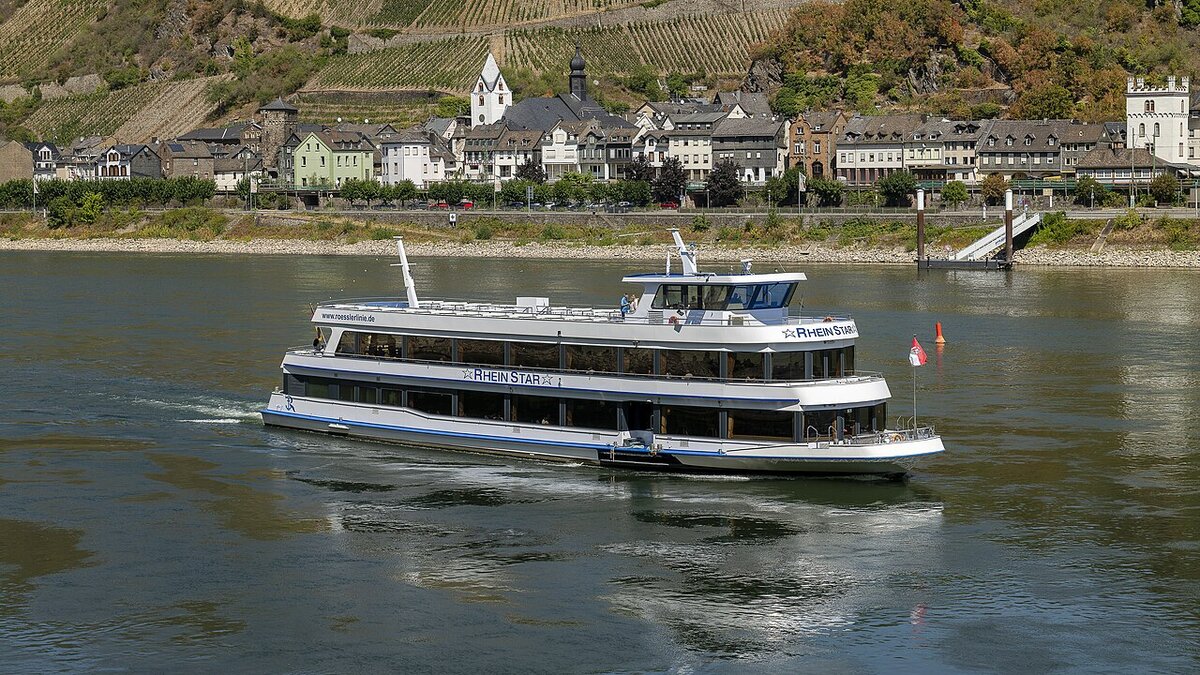
Cover image: River excursion vessel passing Kaub on Middle Rhine, exposed gravel banks — photo by Rolf Kranz, CC BY-SA 4.0, via Wikimedia Commons.
Rhine water levels have collapsed to the lowest point ever recorded, and river cruise operators are scrambling to keep Europe's peak-season sailings moving. In mid-August the reference gauge at Kaub, the shallowest chokepoint on the Middle Rhine, fell to a single-digit reading of 6 centimetres — the lowest since measurements began in 1880 and well under the 25 cm record set in the October 2018 drought, per German waterway gauge data reported by Bloomberg and the trade press. On the other side of the continent, the lower Danube in Romania has dropped to its lowest level since 1996, with flow at roughly 1,500 cubic metres per second in early August — about a third of a typical July average, per EU Copernicus monitoring data.
The result, at the busiest point of the European season, is a wave of ship swaps, reversed itineraries, coach transfers, unplanned hotel nights and — in a minority of cases — outright cancellations across the Rhine and Danube, the two rivers that anchor the European river cruise market.
How low is the Rhine right now?
The Kaub gauge is not a measure of actual water depth — ships still have more than a metre beneath them — but it is the industry's reference point for the Middle Rhine gorge between Koblenz and Rüdesheim, the castle-lined stretch most itineraries are sold on. Germany's equivalent low-water reference (GlW) is 77 cm; below that, cargo barges sail part-loaded or stop, and cruise lines begin adapting. At 6 cm, parts of the gorge and the Maxau area farther upstream are effectively closed to full-draught passenger vessels.
Forecasters quoted by Bloomberg say it would take weeks of sustained rain to restore normal levels, meaning disruption could run into October — historically the tail end of the season and, as our first-time cruise guide notes, a popular window for value-seeking bookers.
Which river cruise routes are affected?
Both flagship rivers have problem stretches, and the Danube's troubles extend far beyond the classic Vienna–Budapest run. Serbia, Croatia and Hungary are all reporting some of their lowest readings in decades, and Cruise Critic reported that a Viking vessel ran aground on the Danube in Bulgaria on 28 July; no guests or crew were injured and passengers continued by land.
| River stretch | Status (mid-August 2026) |
|---|---|
| Rhine: Koblenz–Rüdesheim (Middle Rhine gorge) | Record low at Kaub; ship swaps and coach bridging |
| Rhine: Maxau area | Sections unsuitable for full-draught navigation |
| Danube: Regensburg–Passau | Reduced levels; itinerary changes and transfers |
| Danube: Vienna–Budapest (incl. Dürnstein, Melk) | Low levels; reroutes and reversed itineraries |
| Lower Danube: Serbia–Romania | ~30-year lows; groundings reported, some cancellations |
The scale is striking: Viking has said low water affected more than half of its European river-cruise operating days this summer, according to River Cruise Advisor.
What happens to my river cruise if water is too low?
Cancellation remains the exception. The standard playbook, refined since 2018 and 2022, looks like this:
- Sister-ship swaps: two identical vessels work the same river from opposite ends of an impassable stretch; guests coach across during a scheduled excursion and find their luggage in the matching cabin.
- Reversed or rerouted itineraries, with extra time in cities that remain reachable.
- Coach transfers and hotel nights to bridge closed sections — sometimes several hours of motorway in place of scenic sailing.
- Lightening ships (fewer stores, less fuel and water) to reduce draught on marginal stretches.
AmaWaterways told Forbes on 11 August that it has adjusted sailings on the Danube, Rhine and Main but has not cancelled a single departure because of this summer's conditions. Affected AmaWaterways guests have been offered a choice: sail the adjusted itinerary with a 40% future cruise credit, move to a late-2026 European departure at no extra cruise fare, or cancel for a 100% future cruise credit valid on 2027 sailings.
Will I get compensation for a changed river cruise?
Usually not in cash — and this is the point booked passengers most often misunderstand. A ship swap or coach-assisted itinerary is a modification, not a cancellation, so standard cancellation refunds generally do not apply as long as the line delivers you from embarkation to disembarkation port. Goodwill offers — onboard credit, future cruise credits, free rebooking — vary sharply by line, so check the low-water policy in your cruise contract before assuming anything.
Travel insurance is equally nuanced: most policies treat low water as an operational issue for the cruise line rather than an insurable event, though trip-interruption cover may respond if the line formally cancels. Our travel insurance guide explains the distinction — and as with this summer's Greek wildfire disruption, your strongest rights usually flow from the operator's own terms, not your insurer.
Is low water the new normal for river cruising?
The structural question is harder than the operational one. Record or near-record lows in 2018, 2022 and now 2026 suggest low-water summers are becoming routine rather than exceptional, just as the sector enjoys a sustained booking boom and dozens of new vessels enter service. Lines are already responding with shallower-draught newbuilds, paired sister ships positioned for swaps, and itineraries weighted toward spring and autumn. For travellers, the practical hedge is timing: July and August on the Middle Rhine and lower Danube now carry the highest disruption risk, while April–June and late autumn sailings are statistically safer bets.
Frequently asked questions
Which months are riskiest for low water on the Rhine and Danube?
Late July through September carries the highest risk, when Alpine meltwater is exhausted and summer heat peaks. In 2026 the record Kaub low of 6 cm came in mid-August. Spring departures, fed by snowmelt, are the safest; note that early spring carries a smaller, opposite risk of high-water flooding.
Can I cancel my river cruise because of low water and get a refund?
Not usually. Unless the line itself cancels the departure, low-water changes are itinerary modifications and standard refund rights don't apply. Some lines offer voluntary options — AmaWaterways is offering affected guests future cruise credits or free rebooking — but these are goodwill policies, not entitlements.
What is a sister-ship swap?
Two identical vessels operate the same itinerary from opposite ends of an impassable stretch. Guests transfer between them by coach, usually during a planned excursion, and luggage is moved to the corresponding cabin on the other ship. It preserves the cruise but can add hours of road travel.
Does travel insurance cover river cruise low-water disruption?
Rarely for itinerary changes, since the cruise still operates. Trip-interruption or cancellation cover may respond if the line formally cancels the departure, and some premium policies cover missed independent arrangements. Read the policy wording for 'itinerary change' exclusions before relying on it.
Sources
- Bloomberg — Rhine River Shipping Stalls as Water Level Hits Record Low
- Forbes — Low Water Levels Are Still Disrupting European River Cruises, From Ship Swaps To Evacuation
- Cruise Critic — European River Cruises Hit by Low Water Levels
- River Cruise Advisor — Viking Says Low Water Affected More Than Half Of Its European River-Cruise Days
- Travel Weekly — Low water levels in Europe are disrupting river cruises