Lunar New Year 2027 falls on 6 February (7 February in Korea). Official holiday dates for seven Asian markets, our estimate of the Chunyun window and what it means for the trade.
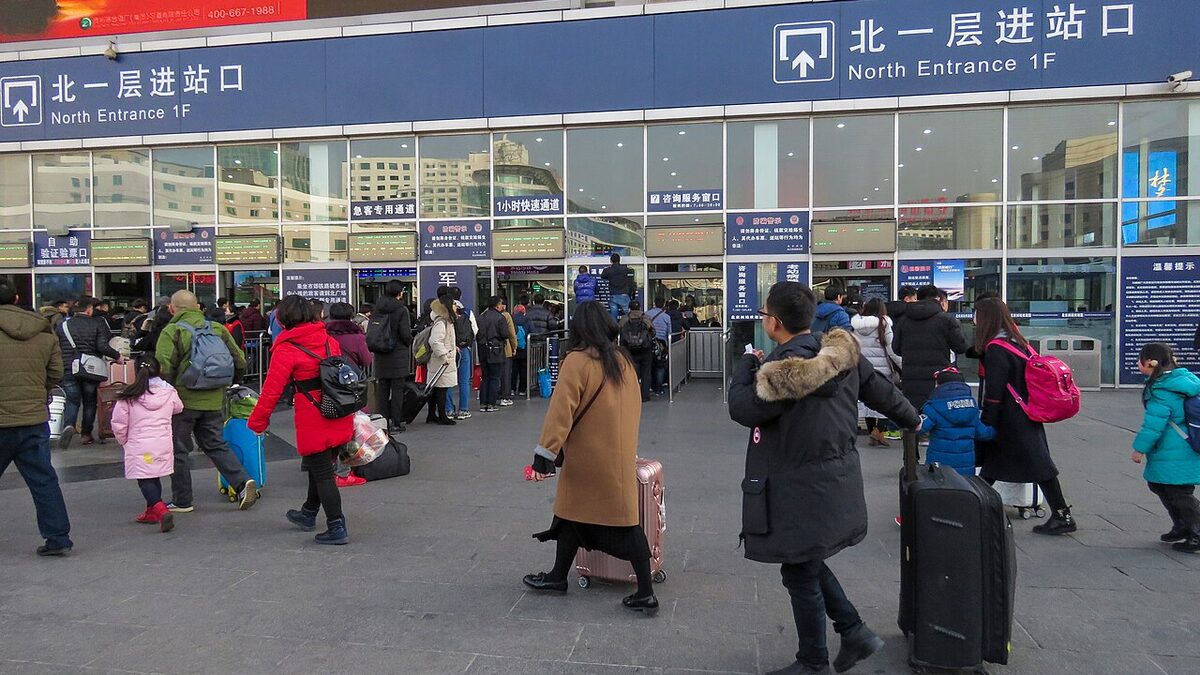
Cover image: Travellers at the north entrance of Beijing West Railway Station in February 2018, during that year's Spring Festival travel rush (file photo) — photo by N509FZ, CC BY-SA 4.0, via Wikimedia Commons.
Chinese New Year 2027, or Lunar New Year, falls on Saturday 6 February 2027, the first day of the Year of the Goat, in mainland China, Hong Kong, Taiwan, Vietnam, Singapore and Malaysia. South Korea celebrates Seollal a day later, on Sunday 7 February, because its calendar runs on Seoul time. Mainland China's official holiday lasts nine days, from 5 to 13 February, under a State Council notice published on 5 November 2026.
Government staff in Vietnam and Taiwan get seven days off (4 to 10 February) and Korea four (6 to 9 February). The dates of Chunyun, China's 40-day Spring Festival travel rush, had not been announced as of 29 November 2026; on the formula used in 2026, our estimate is 22 January to 2 March 2027.
Last checked: 29 November 2026.
When is Chinese New Year 2027, and why is Korea a day later?
The Hong Kong Observatory's calendar table puts the first day of the first lunar month on 6 February 2027 and names the year Ding-wei, the Year of the Goat. Vietnam's Ministry of Home Affairs uses the same date for Tết Nguyên Đán, the start of the year Đinh Mùi.
Korea is the exception. A lunar month starts on the day of the new moon, and the February 2027 new moon arrives at 15:56 Universal Time on 6 February, according to NASA's moon-phase tables. That is 23:56 in Beijing and 22:56 in Hanoi, still the 6th, but 00:56 on 7 February in Seoul. The Korea AeroSpace Administration (KASA), which publishes Korea's official calendar, lists Seollal as Sunday 7 February 2027.
Any booking engine, rate calendar or group itinerary keyed to one pan-Asian date will be a day out for Korea.
What are the official Lunar New Year 2027 holidays in each market?
All seven governments had published their 2027 calendars as of 29 November 2026. The table shows public-sector or general holidays; private employers in some markets set their own schedules within the law.
| Market | Lunar New Year's Day | Official 2027 holiday | Days off in a row | Notes | Official source |
|---|---|---|---|---|---|
| Mainland China | Sat 6 Feb | Fri 5 Feb to Sat 13 Feb | 9 | Make-up working days on Sun 31 Jan and Sun 14 Feb | State Council notice, 5 Nov 2026 |
| Hong Kong | Sat 6 Feb | General holidays on 6, 8 and 9 Feb (7 Feb is a Sunday) | 4 (6 to 9 Feb) | 9 Feb is a substitute because the second day falls on a Sunday | GovHK gazetted list |
| Taiwan | Sat 6 Feb | Thu 4 Feb to Wed 10 Feb | 7 | 9 and 10 Feb make up for the weekend; private firms follow labour rules | DGPA government calendar |
| South Korea | Sun 7 Feb | Sat 6 Feb to Tue 9 Feb | 4 | 9 Feb is a substitute holiday because Seollal falls on a Sunday | KASA calendar, 29 Jun 2026 |
| Vietnam | Sat 6 Feb | Thu 4 Feb to Wed 10 Feb (public sector) | 7 | Five Tết days plus two replacement days; private employers pick one of three five-day patterns | MOHA Notice 11483/TB-BNV, 9 Oct 2026 |
| Singapore | Sat 6 Feb | Sat 6 Feb and Sun 7 Feb | 2 or 3 | Mon 8 Feb is a public holiday for workers whose rest day falls on 7 Feb | Ministry of Manpower |
| Malaysia | Sat 6 Feb | Sat 6 Feb and Sun 7 Feb | 2 or 3 | Second day is a state, not federal, holiday in Kelantan and Terengganu. No replacement day is listed, but the Holidays Act 1951 makes Mon 8 Feb a holiday where Sunday is the weekly holiday, unless a state gazettes otherwise | Prime Minister's Department list |
Return dates do not line up. Singapore staff are back on 8 or 9 February. In Malaysia, where the Monday replacement rule applies, offices reopen on Tuesday 9 February. Hong Kong and Korea return on Wednesday 10 February, Taiwan's government offices and Vietnam's public sector on Thursday 11 February, and mainland China on Sunday 14 February, a make-up working day.
China's 2027 break is the same length as its 2026 one, which ran from 15 to 23 February.
When is Chunyun 2027, the Chinese New Year travel period?
Chunyun is the 40-day transport season China runs around Spring Festival. In 2026 it ran from 2 February to 13 March, 15 days before the festival and 25 after, as the Beijing News reported when ticket sales opened. China had not published the 2027 window as of 29 November 2026. If the same formula is used, the Chinese New Year 2027 travel period would run from Friday 22 January to Tuesday 2 March 2027 (our estimate).
Rail tickets go on sale 15 days ahead. In 2026, tickets for the first day of Chunyun went on sale on 19 January; under the same rule, departures on 22 January 2027 would open on 8 January (our estimate).
Chunyun 2026 logged a record 9.41 billion cross-regional trips over its 40 days, according to People's Daily, just short of the 9.5 billion that the National Development and Reform Commission (NDRC) forecast in January. The NDRC expected about 80 per cent of journeys to be by car, with railways carrying 540 million passengers and airlines 95 million.
In 2026, pre-holiday travel peaked on 13 February at 288 million trips, the transport ministry said, two days before the break began. People's Daily reported a single-day record of more than 380 million trips on the sixth day of the new year, which in 2027 is Thursday 11 February.
How busy are China's borders at Lunar New Year, and where is demand going?
China's National Immigration Administration (NIA) cleared 17.80 million crossings during the nine-day holiday from 15 to 23 February, an average of 1.98 million a day and 10.1 per cent more per day than in the 2025 holiday. Crossings peaked at 2.26 million on 21 February, the fifth day of the new year, which in 2027 is Wednesday 10 February.
Mainland residents made 9.51 million of the trips and foreign nationals 1.31 million, with foreigners' daily average up 21.8 per cent. Some 460,000 foreigners entered without a visa, a 28.5 per cent rise in the daily average. Inbound operators selling February departures should check which passports qualify for China's visa-free entry: for most covered countries the 30-day exemption ends on 31 December 2026, and no extension had been announced as of 29 November.
Japan is the market to watch. The Japan National Tourism Organization (JNTO) estimated 379,500 mainland Chinese visitors in October 2026, down 47.0 per cent, and 3.72 million for January to October, down 54.7 per cent. JNTO points to repeated Chinese government advice since November 2025 to avoid travel to Japan, and to flight cuts.
South Korea was Japan's largest source market in October, with 1,035,800 visitors, up 19.4 per cent, as our report on Japan's October arrivals details. Korea's Seollal break, 6 to 9 February, overlaps China's.
What should airlines, hotels, agents and DMCs plan for?
Supplier closures differ by market. In mainland China, the official holiday runs from 5 to 13 February, and Sundays 31 January and 14 February are working days. Paperwork that depends on Chinese offices is best cleared by 4 February.
Vietnam is less predictable. The Ministry of Home Affairs lets private employers choose one of three five-day Tết patterns (one day before the new year and four after, two and three, or three and two) and requires them to tell staff at least 30 days ahead. Most suppliers' closure dates should therefore be known by early January.
In Malaysia, Ramadan follows almost at once. The Prime Minister's Department lists Awal Ramadan, the start of the fasting month, as a state holiday on Monday 8 February in Johor and Kedah, and Hari Raya Puasa on 10 and 11 March, all subject to change. Groups arriving after the new year will travel during the fasting month.
For group space on peak dates, contract early. Our guide to what fare data says about booking holiday flights covers timing, and our explainer on how to vet a destination management company covers what to check before handing a local partner a Lunar New Year programme.
Frequently asked questions
When is Tết 2027 in Vietnam?
Tết Nguyên Đán 2027 falls on Saturday 6 February 2027, the first day of the year Đinh Mùi. Under a Ministry of Home Affairs notice of 9 October 2026, public-sector staff are off for seven days, from Thursday 4 February to Wednesday 10 February. Private employers choose one of three five-day patterns and must tell staff at least 30 days in advance.
What are the Chunyun 2027 dates?
China had not published the 2027 Chunyun window as of 29 November 2026. The rush normally lasts 40 days, 15 before Spring Festival and 25 after; in 2026 it ran from 2 February to 13 March. Applied to 2027, that formula gives Friday 22 January to Tuesday 2 March 2027, an estimate until the authorities confirm it.
Are businesses in China closed during Chinese New Year 2027?
The State Council's official holiday runs from Friday 5 February to Saturday 13 February 2027, nine days in all, and government offices and employers following it close for that period. Sunday 31 January and Sunday 14 February are working days to make up for the break. Airlines, railways and hotels keep running, but suppliers' offices may shut, so confirm cut-off dates with Chinese partners well before 5 February.
What is the Chinese zodiac animal for 2027?
2027 is the Year of the Goat, also translated as Sheep. The Hong Kong Observatory gives its name in the sexagenary cycle as Ding-wei, and Vietnam calls it Đinh Mùi. It begins on Saturday 6 February 2027 in China, Hong Kong, Taiwan, Vietnam, Singapore and Malaysia, and on Sunday 7 February in South Korea, whose calendar follows Seoul time.
Sources
- Gov.cn, State Council General Office notice on 2027 holidays
- Hong Kong Observatory, 2027 lunar calendar table
- Korea.kr, KASA publishes the 2027 calendar
- Ha Tinh provincial government, Tết 2027 holiday notice
- Holidays Act 1951 (Malaysia), section 3
- Beijing News, 2026 Chunyun dates and ticket sales
- People's Daily, Chunyun 2026 ends with 9.41 billion trips
- NIA, 17.80 million Spring Festival crossings
- JNTO, October 2026 visitor arrivals