Children under 18 don't need ID for US domestic flights, but do need their own passport abroad. Lap-infant proof of age, consent letters and unaccompanied-minor paperwork explained.
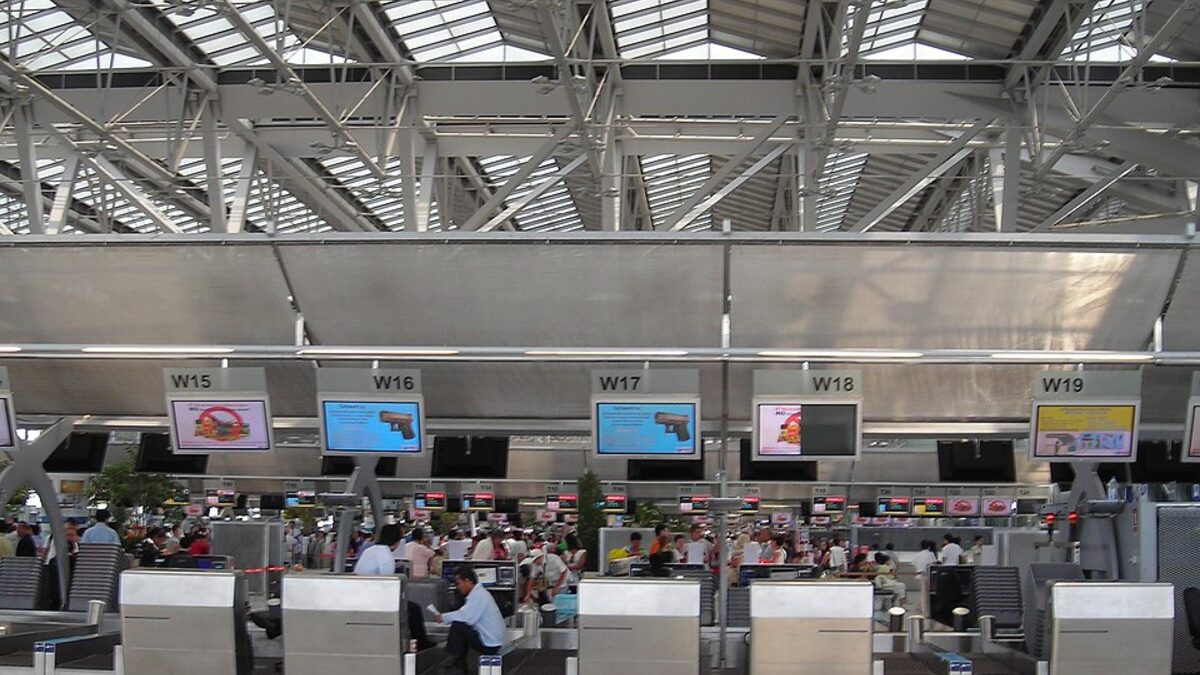
Cover image: Check-in counters at Suvarnabhumi International Airport, Bangkok — photo by User:Mattes, CC BY-SA 3.0, via Wikimedia Commons.
Children under 18 do not need any ID to fly domestically within the United States, according to the TSA, but they do need their own passport for any international flight, and a few situations (lap infants, kids flying alone, one-parent travel abroad) require extra paperwork. Here is exactly which documents cover which scenario, so nothing gets caught at the checkpoint or the gate.
Last checked: 20 November 2026.
The short version by scenario:
- Domestic US flight, child with an adult: no ID needed for the child; the accompanying adult needs a REAL ID-compliant license or an accepted alternative.
- Lap infant (under 2): no ticketed seat, but airlines ask for proof of age, so bring a birth certificate.
- International flight: every child, including newborns, needs their own passport (plus a visa or electronic travel authorisation where required).
- Child flying alone: the airline's unaccompanied-minor form, plus proof of age and ID for whoever picks them up.
- Travelling without both parents abroad: a consent letter, preferably in English and notarised.
Do children need ID for domestic flights in the US?
No. The TSA is explicit: "Children under 18 do not need ID for domestic flights." The agency screens everyone, but a minor is not required to present identification at the checkpoint. There are two caveats worth knowing. First, if a child is flying alone and uses TSA PreCheck, they will need an acceptable ID to receive that screening lane. Second, the airline's rules are separate from the TSA's: carriers set their own requirements for unaccompanied minors, and some ask for proof of age (American says it may for any child under 18), so always check with the carrier directly.
The adult travelling with the child is the one who needs paperwork. Passengers 18 and older must show valid identification at the checkpoint, and since the REAL ID deadline passed on 7 May 2025, a state-issued REAL ID-compliant driver's license or ID card is the standard. Alternatives the TSA accepts include a US passport or passport card, Global Entry/NEXUS/SENTRI cards, a permanent resident card, a foreign government-issued passport, and a Department of Defense ID. Note that a temporary driver's license is explicitly not acceptable. Since 1 February 2026, an adult with no acceptable ID can pay $45 for TSA ConfirmID, a non-refundable identity check that TSA says is not guaranteed to succeed.
What documents does a lap infant need to fly?
Children under 2 can typically fly free on an adult's lap on US domestic flights, and while the TSA will not ask the baby for ID, the airline usually will ask you for proof the child really is under 2; a birth certificate is the document of record. Travel writers who fly frequently with infants report being asked for it at check-in even for obviously young babies, and recommend carrying a certified copy or a clear photo of it on your phone. For international flights the exemption disappears: lap infants still need their own passport, and usually pay a percentage of the adult fare plus taxes.
What documents do children need for international flights?
Every US citizen child flying internationally needs a US passport; there is no age exemption. Under-16s must apply in person, with both parents (or guardians) signing the application, or one parent bringing the other's notarised consent or evidence of sole custody; their passports last five years and cannot be renewed. Depending on the destination, the child may also need a visa or an electronic travel authorisation. For entry into the United States, the rule is the same in reverse: all children, including infants, must have their own passport or visa.
The one big exception is land and sea travel to Canada, Mexico and the Caribbean. Children under 16 crossing by land or sea can present a passport or an original or certified copy of their birth certificate, a Certificate of Naturalization, or a Consular Report of Birth Abroad; CBP extends this to under-19s travelling with a school, religious or youth group. Outside such groups, the concession ends at 16: CBP then expects a passport, passport card, Enhanced Driver's License or Trusted Traveler card. Flying to those same countries requires a passport, for children and adults alike, although USAGov says US children flying to Canada or Mexico may use a Trusted Traveler Program card instead.
Do children need an ESTA, UK ETA or ETIAS?
Yes, wherever an adult of the same nationality needs one: authorisations are per person, babies included.
- US ESTA: every Visa Waiver Program visitor, infants included, needs their own; the fee rose to $40.62 on 16 October 2026 (see our ESTA guide).
- UK ETA: GOV.UK says each person needs one, "including babies and children", at £20 each. British and Irish citizens are exempt (see our UK ETA explainer).
- EU ETIAS: not yet operating, and no start date had been announced as of 20 November 2026. Under EU rules, under-18s will be exempt from the €20 fee.
- EU Entry/Exit System (EES): fully operational at Schengen-area external borders since 10 April 2026; it registers non-EU children too, but under-12s are not fingerprinted.
Do you need a consent letter to travel with a child alone?
If a child is leaving the country with only one parent, with a guardian, or alone, border authorities in many countries want evidence the trip is agreed by both parents, a measure aimed at international child abduction. USAGov advises a letter of consent, preferably written in English and notarised. If one custodial parent is travelling, the letter should come from the other parent; if the child is with a guardian or travelling alone, both parents should sign, and a parent with sole custody should carry a copy of the custody document. The recommended wording is simple: "I acknowledge that my child is traveling outside the country with [the name of the adult] with my permission." Requirements differ by country, so contact the destination's embassy or consulate before you fly.
Other governments publish their own rules. The UK requires permission from everyone with parental responsibility for a child, or from a court, before the child is taken abroad; GOV.UK says a letter is usually enough, and that it helps to carry evidence of your relationship, such as a birth or adoption certificate, plus a marriage or divorce certificate if you are a single parent with a different family name from the child. Canada recommends a consent letter, ideally notarised, for any child under 19 travelling abroad without both parents. Brazil requires Brazilian minors leaving without both parents to carry a notary-certified authorisation.
What do unaccompanied minors need to fly alone?
Most major US airlines run a fee-based unaccompanied-minor programme, generally mandatory for ages 5 to 14 and optional for older teens, with specifics varying by carrier. American Airlines and Delta, for example, require it from 5 to 14 and charge $150 each way (plus tax at American). Expect to provide the airline's unaccompanied-minor form, proof of age (birth certificate or passport) at check-in, and ID for the adult authorised to meet the child at the destination. The child keeps any customs and immigration documents with them throughout the journey. Book the service in advance: airlines cap the number of unaccompanied minors per flight (JetBlue allows three), and connections are often restricted.
Children's travel documents by scenario
| Scenario | Child's documents | Adult's documents |
|---|---|---|
| Domestic US flight, with adult | None (TSA); birth certificate if under 2 on lap | REAL ID-compliant license or accepted alternative |
| Lap infant under 2, domestic | Proof of age: birth certificate | As above |
| International flight | Own passport (+ visa/eTA if required) | Passport; consent letter if other parent absent |
| Canada/Mexico by land or sea, under 16 | Passport or certified birth certificate / naturalization certificate | Passport or accepted WHTI document |
| Flying alone (unaccompanied minor) | UM form, proof of age, customs docs for international | Photo ID for drop-off and pickup adults |
| Non-US citizen child entering the US | Own passport and visa/authorisation, including infants | Standard entry documents |
Practical checklist before you fly with kids
- Check passport validity: many countries require six months beyond your dates, and US passports issued to children under 16 last five years (not ten).
- Carry the birth certificate even for domestic trips if your child is close to the two-year mark.
- Prepare the consent letter early enough to get it notarised.
- Arrive with buffer time: our guide to how early to get to the airport covers the timing, and families clearing border formalities in Europe should also read up on the EES entry/exit system, which biometrically enrols non-EU nationals, children included.
- If your child is a frequent traveller, keep an eye on digital travel credentials; pilot programmes may eventually spare families some paperwork.
Frequently asked questions
Do kids need ID to fly domestic in the US?
No. The TSA states that children under 18 do not need identification for domestic flights. The accompanying adult must show valid ID, and airlines may set their own rules for children flying alone.
Does a 2-year-old need a passport to fly?
Not for a domestic US flight: children need no ID there, although a lap infant needs proof of age (a birth certificate), and from their second birthday a child needs their own seat. For any international flight, yes: every child needs their own passport, including babies flying on a parent's lap.
Can a child fly with a birth certificate instead of a passport?
Only on land or sea crossings to Canada, Mexico and the Caribbean, and only under 16 (under 19 with a school, religious or youth group). By air, a child needs their own passport, although USAGov says a Trusted Traveler Program card also works for flights to Canada or Mexico.
Do both parents have to sign a child travel consent letter?
If the child is travelling with one custodial parent, the letter comes from the other parent. If the child travels with a guardian or alone, both parents should sign it. USAGov prefers the letter in English and notarised.
What ID does an adult need to fly with a child in the US?
A REAL ID-compliant driver's license or state ID, or an accepted alternative such as a US passport, passport card, trusted-traveler card or permanent resident card. Temporary driver's licenses are not accepted. Without any of these, an adult can pay $45 for a TSA ConfirmID identity check, which is not guaranteed to work.
Sources
- TSA, Do minors need identification to fly within the U.S.?
- TSA, Acceptable identification at the TSA checkpoint
- USAGov, International travel documents for children
- KAYAK, What do kids need to fly: a guide to kids' travel documents (7 January 2026)
- TSA, TSA ConfirmID
- USAGov, Get a passport for a minor under 18
- eCFR, 22 CFR 51.28: passports for minors
- US Customs and Border Protection, Western Hemisphere Travel Initiative
- Federal Register, HR-1 fees: fiscal year 2027 inflation adjustments (ESTA $40.62)
- US Customs and Border Protection, Official ESTA website: frequently asked questions
- GOV.UK, Get an electronic travel authorisation (ETA) to visit the UK
- GOV.UK, Get permission to take a child abroad
- GOV.UK, UK border control: travelling with children
- European Union, Official ETIAS website
- European Union, Entry/Exit System FAQs
- Government of Canada, Consent letter for children travelling outside Canada
- Conselho Nacional de Justiça (Brazil), Viagem ao exterior: autorização para crianças e adolescentes
- American Airlines, Unaccompanied minors
- American Airlines, Traveling with children
- Delta Air Lines, Unaccompanied Minor Program
- JetBlue, Unaccompanied minors (UMNR)