Two hours for short-haul, three for long-haul is the working rule — but the bag-drop cutoff and gate closure are what actually decide whether you fly. What Heathrow, the TSA and Europe's biggest low-cost carrier really publish.
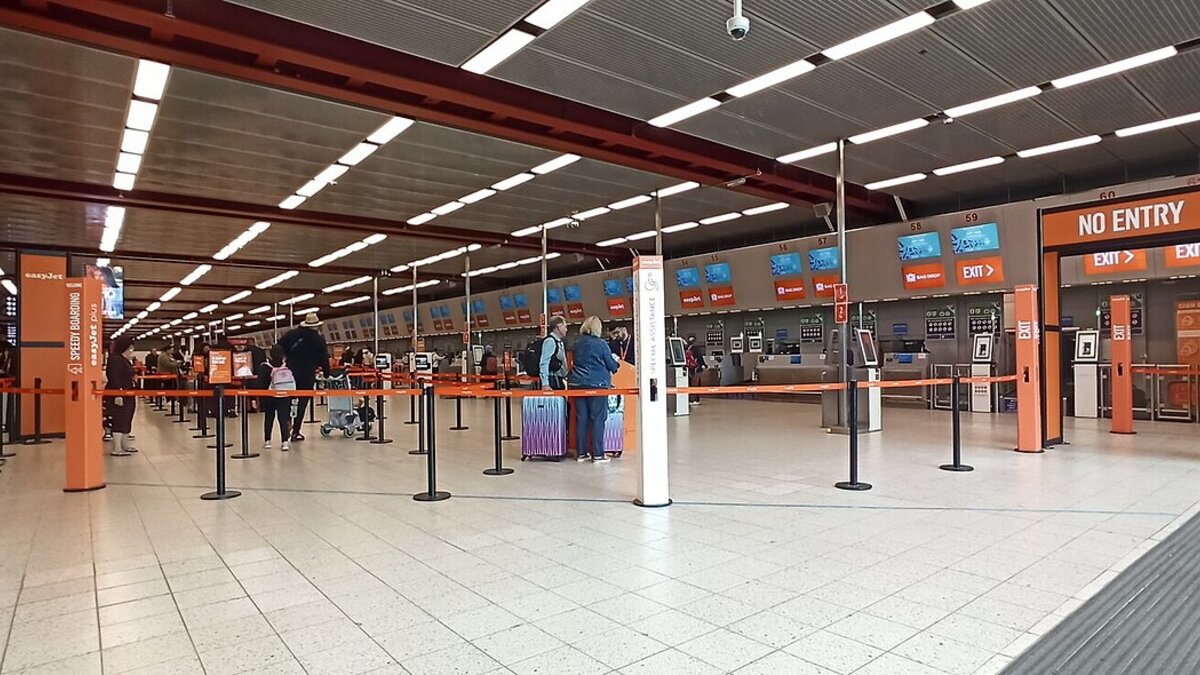
Cover image: easyJet check-in desks and bag-drop area at London Luton Airport — photo by Thomas Nugent, CC BY-SA 2.0, via Wikimedia Commons.
Two hours before a short-haul or domestic flight, three hours before an international one remains the working rule — and it is exactly what Heathrow, the UK's busiest airport, publishes: three hours for international departures, two hours for domestic and European flights. But the numbers that actually decide whether you fly are your airline's bag-drop closing time — typically 40 to 60 minutes before departure — and its gate closure, usually 15 to 30 minutes out. Miss either and the recommendation is irrelevant. Notably, the TSA no longer publishes a fixed figure for US airports at all: it tells passengers to check with their airline and offers historical checkpoint-busyness data in its MyTSA app instead.
How early should you get to the airport for an international flight?
Three hours is the standard advice, and it is not padding. Long-haul check-in adds steps short-haul flights don't have: airlines verify travel documents and advance passenger information at bag drop, and immigration formalities sit between security and the gate. At EU borders, the phased rollout of the Entry/Exit System has added biometric registration for many non-EU nationals — we documented the queues in our report on EES border delays.
Heathrow's published guidance is the clearest single benchmark: "We recommend getting to the airport three hours before your flight if you're travelling internationally, or two hours if you're travelling domestically or to Europe." Most large European and Asian hubs publish comparable figures; the three-hour figure also covers the walk times at airports where gates are 20 minutes apart by train.
How early is enough for a domestic or short-haul flight?
Two hours remains the sensible default for anyone with a checked bag, and 90 minutes is realistic if you have checked in online, are carrying hand luggage only and are flying from a smaller terminal. The TSA's current advice for US travellers is to contact your airline, "as times may vary depending on the airport and date of travel," and to check likely crowding in the MyTSA app, which shows how busy a checkpoint has historically been at your departure hour. Peak holiday weeks routinely turn a 20-minute wait into an hour.
Trusted-traveller programmes change the security half of the equation: Global Entry, TSA PreCheck and Clear each shorten a different queue, which is why their members can often arrive closer to 90 minutes before a domestic departure.
The deadlines that actually decide whether you fly
Airports publish recommendations; airlines publish deadlines. easyJet puts it bluntly in its check-in guidance: "If you're late, we may not accept you for travel and you'll miss your flight." Its gates "close promptly 30 minutes before your departure," online check-in closes two hours out, and bag drop closing times vary by airport. These are the airline's published timings, all measured from scheduled departure:
| easyJet flights from | Bag drop opens | Bag drop closes | Gate closes |
|---|---|---|---|
| Belfast, Birmingham, Bristol, Paris CDG, Glasgow, Liverpool, London Luton, Manchester, Newcastle and long-haul sun routes (Egypt, Israel, Jordan, Morocco, Tunisia, Cape Verde and more) | 3 hrs | 60 mins | 30 mins |
| Amsterdam, Antalya, Dalaman, Izmir, Larnaca, Lisbon, London Gatwick, Lyon, Malaga, Milas–Bodrum, Nice, Palma, Paphos | 2.5 hrs | 60 mins | 30 mins |
| Zurich, Edinburgh | 2.5 hrs | 50 mins | 30 mins |
| Geneva | 2 hrs | 50 mins | 30 mins |
| Naples | 2.5 hrs | 40 mins | 30 mins |
| Pristina | 3 hrs | 40 mins | 30 mins |
| All other airports | 2 hrs | 40 mins | 30 mins |
The pattern to remember: easyJet's bag drop closes 40 to 60 minutes before departure depending on the airport, and its gates close 30 minutes out — most airlines' cutoffs land in the same ranges. Whichever carrier you fly, treat its earliest published deadline, not the departure time, as the moment you must be processed. If you are cutting it fine, the bag-drop queue is the risk: our guide to Ryanair carry-on size enforcement explains what happens to passengers who try to beat the system with the wrong bag.
When to arrive earlier than the rule of thumb
- Peak dates. School holidays and the Monday-morning and Friday-evening peaks add 30-60 minutes at security and bag drop.
- Checked bags. Every bag adds a desk queue; hand-luggage-only travellers can walk past it entirely.
- Mega-hubs. Long walks, trains between terminals and secondary document checks make three hours reasonable even on some short-haul routes.
- Document-heavy itineraries. Visa checks at check-in, or EES biometric registration at EU borders, all happen before the gate.
- Groups and families. One delayed traveller holds the whole party at the desk.
When you can cut it finer
Online check-in completed, hand luggage only, a small single-terminal airport, no bags to drop: 60 to 90 minutes is often workable on a quiet short-haul rotation. Two cautions apply. First, the gate deadline binds everyone regardless of how fast you cleared security. Second, arriving too early has its own cost — bag drop desks at many airports open only two to three hours before departure, so a 5 a.m. arrival for an 8 a.m. flight may mean waiting for the desks to open.
If my flight leaves at 7am, what time should I be at the airport?
For a 07:00 short-haul departure, the two-hour rule puts you at the airport by 05:00 — and check that the bag drop is open, since desks at many airports open two to three hours out (easyJet's London Luton desks open three hours before departure and close 60 minutes before, so a 07:00 flight means desks from 04:00 to 06:00). For a 07:00 long-haul flight, target 04:00-04:30 to clear the three-hour benchmark, allowing for the early-morning queue of business travellers that builds at major hubs before 05:00.
What happens if you arrive too late?
Miss the bag-drop cutoff and the airline can refuse to accept you for travel; miss the gate and you are a no-show, which normally means the ticket's value is lost and rebooking costs a change fee or a fresh fare. None of it is compensable: delay and cancellation compensation covers disruption within the airline's control, not passengers who arrive after their own deadline. If you can see the cutoff approaching, call the airline before it passes — carriers are far more willing to move you to a later flight while your booking is still intact.
Frequently asked questions
How early should you get to the airport for an international flight?
Three hours before departure. Heathrow publishes that figure explicitly for international flights, and it accounts for document checks at bag drop, longer security and immigration queues and longer walks to gates. Add time at EU borders while EES biometric registration is being phased in.
Is two hours enough time before a domestic flight?
For most passengers with a checked bag, yes — two hours covers check-in, bag drop and security at a normal pace. If you have checked in online with hand luggage only, 90 minutes is usually sufficient at smaller airports, but peak-season queues and the airline's bag-drop cutoff can erase that margin.
What happens if I arrive late at the airport?
After the bag-drop cutoff the airline can decline to carry you; after gate closure you are a no-show and the ticket's value is generally lost. Compensation schemes do not apply to passenger lateness. Contact the airline before the cutoff passes to ask about moving to a later flight.
How early should I get to the airport with only hand luggage?
90 minutes before a short-haul flight is a reasonable target if you have checked in online and need no bag drop; 60 minutes can work at small airports. Keep the gate-closure time — typically 15 to 30 minutes before departure — as the hard limit, and allow for security queues at peak hours.