RevPAR is room revenue divided by available room nights, or occupancy times ADR. How it is calculated, how chains report it, and what TRevPAR and GOPPAR add.
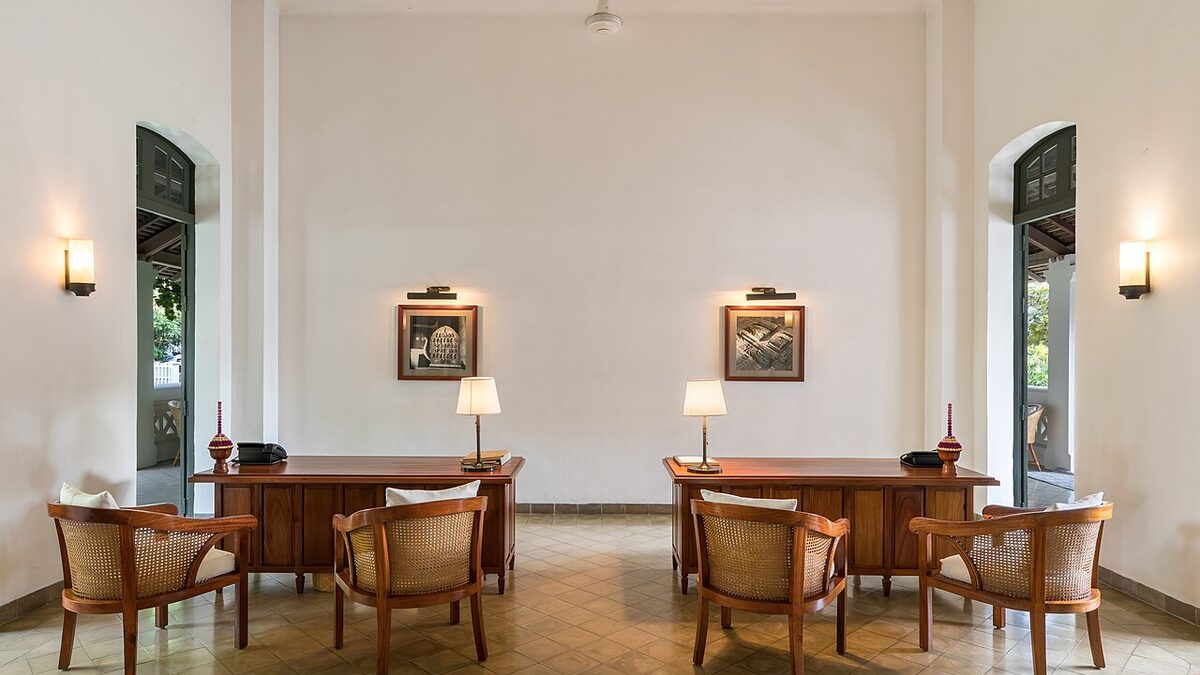
Cover image: Reception desks at a resort hotel in Luang Prabang, Laos (2023 file photo) — photo by Basile Morin, CC BY-SA 4.0, via Wikimedia Commons.
RevPAR, or revenue per available room, is a hotel's room revenue divided by the number of room nights it had available to sell. It is the same as occupancy multiplied by average daily rate (ADR), so one figure reflects both how full a hotel was and what it charged. Hilton's third quarter shows the arithmetic: occupancy of 75.8 per cent and an ADR of $164.57 produced system-wide comparable RevPAR of $124.70, up 5.8 per cent on a year earlier, the company reported on 27 October 2026.
So "what is RevPAR" is really a question about how the hotel trade keeps score: chains guide investors on it and owners benchmark against it. It has blind spots, too. It ignores restaurant and spa income and says nothing about costs, which is where TRevPAR and GOPPAR come in.
Last checked: 1 November 2026.
What is RevPAR and how do you calculate it?
Three formulas share the same inputs. Hilton and Hyatt define them in equivalent terms in their third-quarter releases:
- Occupancy = room nights sold ÷ room nights available
- ADR = room revenue ÷ room nights sold
- RevPAR = room revenue ÷ room nights available, or occupancy × ADR
Take an illustrative 200-room hotel in a 30-night month. It has 6,000 room nights to sell. If it sells 4,500 of them for $720,000 of room revenue, occupancy is 75 per cent (4,500 ÷ 6,000), ADR is $160 ($720,000 ÷ 4,500) and RevPAR is $120 ($720,000 ÷ 6,000, or 0.75 × $160).
Now say the same hotel sells 4,320 room nights at $172 the following year. Occupancy falls to 72 per cent, but room revenue rises to $743,040 and RevPAR to $123.84, up 3.2 per cent. Fewer rooms sold, more room revenue.
Watch the units. That fall is 3 percentage points, or 4 per cent in relative terms. Hilton and Hyatt quote occupancy changes in points; US hotel REIT Pebblebrook Hotel Trust called its third-quarter move from 79.6 to 80.6 per cent a 1.2 per cent increase.
A quick check: RevPAR growth is ADR growth compounded with the relative change in occupancy. Hilton's ADR rose 3.9 per cent and occupancy 1.4 points from 74.4 per cent (about 1.9 per cent relative), giving the reported 5.8 per cent, allowing for rounding. Hotels set those rates through revenue management, which our guide to how hotel room pricing works explains.
What are TRevPAR and GOPPAR?
Hyatt's definition of RevPAR explicitly leaves out food and beverage, parking and other guest-service revenue. TRevPAR (total revenue per available room) puts it back: Host Hotels & Resorts defines it as the sum of rooms, food and beverage and other revenues divided by available room nights. Pebblebrook, which owns 42 US hotels and resorts, shows the difference: its same-property RevPAR in the third quarter was $256.66 and its TRevPAR $398.11, so rooms brought in roughly 64 per cent of revenue.
GOPPAR (gross operating profit per available room) divides gross operating profit by available room nights. Under the Uniform System of Accounts for the Lodging Industry (USALI), the standard hotel profit-and-loss format, GOP is what remains after departmental expenses, such as staff and cost of goods in rooms and restaurants, and undistributed operating expenses, such as IT, sales and marketing, administration and utilities. It comes before management fees and fixed charges such as rent, property taxes and insurance, according to EHL Insights.
Owners watch it because profit can move faster than revenue, in both directions. HotStats, which benchmarks hotel profit-and-loss data, found Asia-Pacific TRevPAR up 3.8 per cent in the first seven months of 2026 and GOPPAR up 6.3 per cent. In the US, TRevPAR rose 5.2 per cent and GOPPAR 7.8 per cent. In Malaysia, by contrast, HotStats recorded year-to-date falls of 1.4 per cent in RevPAR, 2.0 per cent in TRevPAR and 4.6 per cent in GOPPAR.
What is the difference between system-wide and comparable RevPAR?
System-wide means the whole network, whoever owns each hotel. Hyatt's system-wide hotels are those it manages, franchises, owns, leases or provides services to, with all-inclusive resorts reported separately. Its owned and leased hotels alone posted RevPAR of $226.39 in the third quarter, against $154.80 for the system.
Comparable is the filter that makes year-on-year growth meaningful. Hilton counts a hotel only if it has been in the system for a full calendar year and was open on 1 January of the previous year, and drops hotels that changed brand or ownership type, underwent large-scale capital projects or suffered substantial damage or business interruption. Of its 9,494 hotels at 30 September 2026, 6,679 were comparable.
So "system-wide comparable RevPAR" tracks same-store performance across the brand network. It is not total room revenue.
Fee growth can outrun it. Hilton's management and franchise fee revenues rose 9.5 per cent in the quarter against 5.8 per cent comparable RevPAR growth. Its 10-Q attributes part of the increase to net hotel additions, which the comparable set leaves out (1,143 hotels joined after 1 January 2025 or changed brand or ownership type), and part to licensing fees, including those from co-branded credit cards.
Currency is the other adjustment. Hilton's ADR and RevPAR are currency neutral and Hyatt's are in constant dollars: both restate the prior year at current-period exchange rates.
Why can RevPAR rise while occupancy falls?
Because RevPAR multiplies the two, a big enough rise in rate outweighs a loss of occupancy.
Hyatt's Greater China hotels lost 0.7 points of occupancy but lifted ADR 3.0 per cent, and RevPAR still rose 2.1 per cent. Hilton's LXR luxury brand went further: occupancy down 0.9 points, ADR up 16.1 per cent, RevPAR up 14.3 per cent.
Rate does not always win. Hilton's Asia Pacific hotels lost 0.7 points of occupancy with ADR up only 0.5 per cent, so RevPAR slipped 0.5 per cent. Its quarterly filing blames China, citing softer consumer sentiment in leisure travel and government restrictions on business and group travel.
Which half moves matters for profit. Hyatt says occupancy gains bring extra variable costs such as housekeeping, utilities and room amenities, while rate changes "typically have a greater impact on margins and profitability". Fuller hotels can sell more food and beverage, it adds. For anyone contracting rooms, the test is which half of the formula is moving: rate-led growth means hotels are earning more per occupied room, not filling more of them.
How should you read the Q3 2026 RevPAR numbers?
The table breaks out selected Hilton and Hyatt segments for the quarter to 30 September 2026. Hilton's figures are comparable and currency neutral; Hyatt's are comparable and in constant dollars, except the all-inclusive row (reported dollars). The last column is our reading of the figures, not company commentary.
| Q3 2026, year on year | Occupancy (change) | ADR (change) | RevPAR (change) | What moved RevPAR (our reading) |
|---|---|---|---|---|
| Hilton, system-wide | 75.8% (+1.4 pts) | $164.57 (+3.9%) | $124.70 (+5.8%) | Rate and occupancy |
| Hyatt, system-wide hotels | 73.6% (+1.1 pts) | $210.36 (+5.7%) | $154.80 (+7.2%) | Rate and occupancy |
| Hyatt, Asia Pacific excl. Greater China | 75.2% (+1.9 pts) | $200.93 (+8.0%) | $151.18 (+10.8%) | Rate and occupancy |
| Hyatt, Greater China | 74.9% (−0.7 pts) | $126.61 (+3.0%) | $94.89 (+2.1%) | Rate outweighed lower occupancy |
| Hilton, LXR Hotels & Resorts | 56.3% (−0.9 pts) | $585.22 (+16.1%) | $329.67 (+14.3%) | Rate outweighed lower occupancy |
| Hilton, Asia Pacific | 71.9% (−0.7 pts) | $99.87 (+0.5%) | $71.78 (−0.5%) | Rate too small to offset occupancy |
| Hyatt, all-inclusive resorts (Net Package) | 69.6% (−4.0 pts) | $268.87 (+3.0%) | $187.19 (−2.5%) | Occupancy loss outweighed rate |
Compare like with like. Hilton's Asia Pacific RevPAR of $71.78 is less than half its Europe figure of $155.37, mostly because of rate ($99.87 against $189.66) rather than occupancy (71.9 against 81.9 per cent). As EHL Insights notes, RevPAR means little until it is benchmarked against past periods, budget and the market.
Check the calendar, too. Hilton said the third quarter benefited from the World Cup and favourable calendar and holiday shifts, and it guides to fourth-quarter growth of 3.0 to 3.5 per cent. As of 1 November 2026, Hilton expects full-year comparable RevPAR growth of 4.0 to 4.5 per cent and Hyatt 5.0 to 5.5 per cent. Our Hilton and Hyatt third-quarter results story covers what drove each upgrade; our hotel industry performance tracker follows the year.
Frequently asked questions
What is a good RevPAR for a hotel?
There is no universal figure. RevPAR depends on market, chain scale and season: in the third quarter of 2026 Hilton's comparable hotels averaged $71.78 in Asia Pacific and $155.37 in Europe. Judge a hotel against its own figure a year earlier, its budget and similar competitors, and check whether occupancy or rate is doing the work.
What is the difference between ADR and RevPAR?
ADR is room revenue divided by rooms sold, so it measures the average price of an occupied room. RevPAR is room revenue divided by rooms available, so it also counts the empty ones. RevPAR equals occupancy times ADR: a hotel at 75 per cent occupancy and a $160 ADR has a RevPAR of $120, so RevPAR can never exceed ADR.
Does RevPAR include food and beverage revenue?
No. RevPAR counts room revenue only, and Hyatt's definition explicitly excludes food and beverage, parking and other guest-service revenue. TRevPAR adds those streams by dividing total hotel revenue by available room nights. All-inclusive resorts are the exception: Hyatt reports them as Net Package RevPAR, which covers packaged rooms, food and drink and entertainment, net of compulsory tips.
Why do hotel chains report RevPAR in constant currency?
To strip out exchange-rate swings. Hotels in Tokyo or Paris earn in yen or euros, but Hilton and Hyatt report in US dollars, so a stronger or weaker dollar would move RevPAR even if room prices stood still. Both restate the prior year at current-period exchange rates, which Hilton calls currency neutral and Hyatt constant dollars.
Sources
- Hilton, third quarter 2026 results release
- Hilton, third quarter 2026 Form 10-Q
- Hyatt, third quarter 2026 results release
- Pebblebrook Hotel Trust, third quarter 2026 results
- Host Hotels & Resorts, second quarter 2026 results
- HotStats, Where cost pressure is (and isn't) building across APAC
- HotStats, Where cost pressure is actually building across the Americas
- EHL Insights, Hotel financial statements and P&L formats