Eight UK airports now allow liquids up to 2 litres, but Manchester, Stansted, Luton and most others still enforce 100ml. A dated airport-by-airport table, plus the return-leg trap.
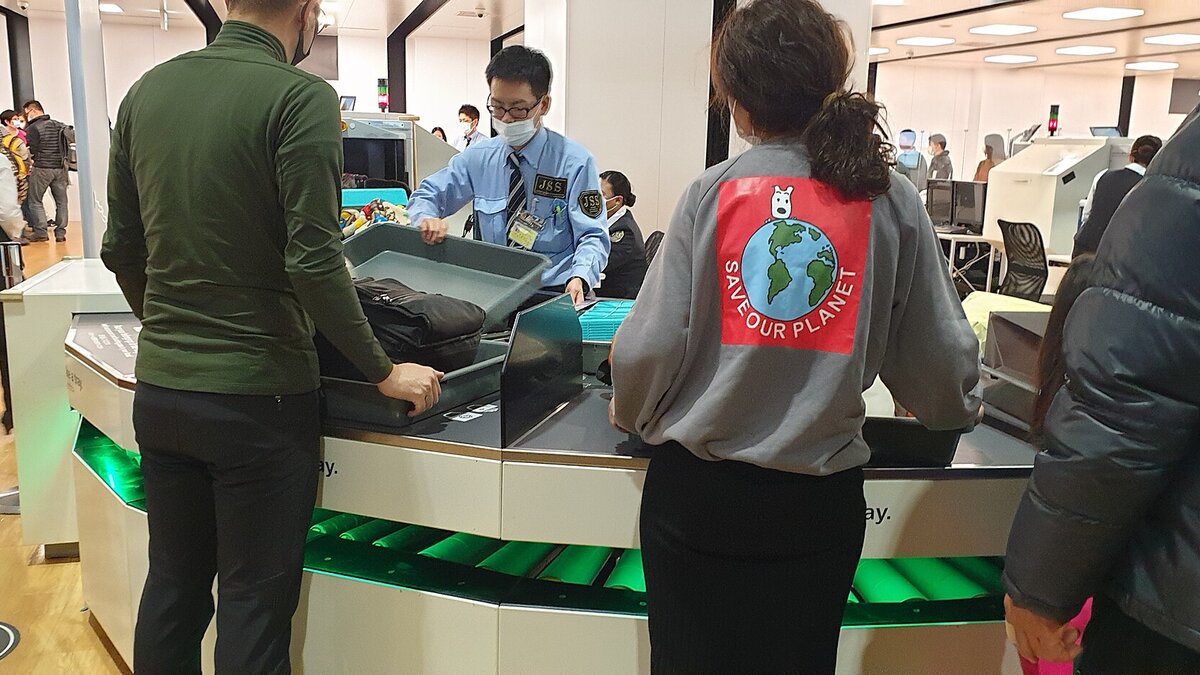
Cover image: Passengers loading cabin bags into trays at a modern airport security screening lane with next-generation CT scanners. — photo by Jeena Paradies from Varberg, Schweden, CC BY 2.0, via Wikimedia Commons.
The 100ml liquid rule at UK airports no longer applies everywhere — but it has not gone away either. As of August 2026, eight UK airports let you carry liquids in containers of up to 2 litres: Heathrow, Gatwick, Edinburgh, Birmingham, Bristol, Belfast International, Belfast City and Bournemouth. Everywhere else — including Manchester, Stansted, Luton, Glasgow, Liverpool, Newcastle, London City, Aberdeen and Teesside — the 100ml-per-container cap still applies, even where next-generation CT scanners are already installed. The one near-universal improvement: at almost every UK airport, liquids and electronics can now stay inside your bag at security, and the clear plastic pouch is no longer required at most of them. The catch competitors' guides rarely spell out: the rule that governs you is the one at your departure airport on every leg — fly out of 2-litre Heathrow and home from a 100ml EU airport, and that 500ml bottle in your cabin bag can be confiscated on the way back.
Which UK airports have scrapped the 100ml rule?
The table below reflects each airport's published rules and dated 2026 press coverage. Airports upgrade (and occasionally revert) at short notice, so treat anything older than a few weeks as "check before you fly".
| Airport | Liquids limit | Liquids & electronics stay in bag? | Status date |
|---|---|---|---|
| London Heathrow | Up to 2 litres | Yes | Lifted late Jan 2026; confirmed Jul 2026 |
| London Gatwick | Up to 2 litres | Yes | Confirmed Jul 2026 |
| Edinburgh | Up to 2 litres | Yes | Confirmed Jul 2026 |
| Birmingham | Up to 2 litres | Yes | Confirmed Jul 2026 |
| Bristol | Up to 2 litres | Yes | Confirmed Jul 2026 |
| Belfast International | Up to 2 litres | Yes | Confirmed Apr 2026 |
| Belfast City | Up to 2 litres | Yes | Confirmed Apr 2026 |
| Bournemouth | Up to 2 litres | Yes | Confirmed Apr 2026 |
| Manchester | 100ml | Yes (CT scanners installed; cap not yet lifted) | Confirmed Jul 2026 |
| London Stansted | 100ml | Yes | Confirmed Jul 2026 |
| London Luton | 100ml | Yes | Confirmed Jul 2026 |
| Glasgow | 100ml | Yes | Confirmed Jul 2026 |
| Liverpool | 100ml | Yes | Confirmed Jul 2026 |
| London City | 100ml | Yes | Confirmed Apr 2026 |
| Newcastle | 100ml | Yes | Confirmed Apr 2026 |
| Aberdeen | 100ml | Yes | Confirmed Apr 2026 |
| Teesside | 100ml | Yes | Confirmed Apr 2026 |
London City is the cautionary tale: it was the first UK airport to scrap the 100ml rule, in April 2023, only for the government to order it — along with Newcastle, Aberdeen, Teesside, Leeds Bradford and Southend — back to 100ml in June 2024. As of the most recent dated coverage (April 2026), it remains at 100ml. If your airport is not listed above, assume 100ml and check its official security page before you fly.
Why the rule that matters is your departure airport
Security screening applies where you depart, not where you land. On a return trip, that means two different rule sets can apply to the same bag.
The EU is the biggest trap. Brussels restored the 100ml cap across EU airports from 1 September 2024 after a certification problem with the new CT scanners, and only re-approved recertified equipment for up-to-2-litre screening in July 2025. Since then, adoption has been piecemeal: some airports, such as Frankfurt and Munich, allow larger liquids only at selected lanes with the new scanners, while most EU departures still enforce 100ml. So even if you flew out of Heathrow with a full-size toiletry bag, pack to 100ml for the flight home — or put the big bottles in checked luggage, subject to your airline's baggage allowance rules.
Note that the relaxation covers liquids only. Restrictions on other items are unchanged — lithium batteries, for instance, must still travel in the cabin under the usual power bank rules.
What counts as a liquid — and what's exempt?
Security treats anything you can pour, spread, spray or smear as a liquid: water, drinks, pastes, gels, creams, aerosols, toothpaste, peanut butter, yoghurt, honey and snow globes all count; solid food is generally fine.
Two exemptions apply everywhere, at any limit: baby food and baby milk (including expressed milk) in the quantities you need for the journey, and essential medicines, including liquid medicines over 100ml with a prescription or doctor's note. Both may be screened separately, so allow extra time. One quirk of the new scanners: vacuum-insulated flasks should be carried empty, as CT machines struggle to image liquid through double-walled insulation.
Duty-free bottles, STEBs and connections
A duty-free litre of gin bought airside is fine on a non-stop flight. The risk is connections and return legs through 100ml airports. The protection is the STEB — a sealed, tamper-evident bag with the receipt inside, which security at most airports will accept for liquids bought airside within the previous 24–48 hours, provided the seal is intact. Break the seal, and the bottle is an oversized liquid like any other and can be seized. Ask for a STEB at the till whenever you have an onward or return flight through a 100ml airport — the mechanics are covered in our explainers on how duty-free shopping works and taking alcohol on a plane.
When will the 100ml rule end across the UK?
No national end-date has been announced. The Department for Transport dropped its original June 2024 blanket deadline after scanner installation and certification delays, and now signs off airports individually once their CT lanes pass government checks. Manchester illustrates the lag: its scanners are fully installed, but the 100ml cap remains until approval lands. Expect the 2-litre list to keep growing through 2026–27 — and until your airport is on it, pack to 100ml and check its security page the week you travel.
Frequently asked questions
Which UK airports allow 2 litres of liquids in 2026?
As of August 2026: Heathrow, Gatwick, Edinburgh, Birmingham, Bristol, Belfast International, Belfast City and Bournemouth allow containers of up to 2 litres, with liquids and electronics left in your bag. All other UK airports, including Manchester, Stansted, Luton and Glasgow, still enforce 100ml.
Does the 100ml rule still apply at Manchester Airport?
Yes. Manchester has installed CT scanners on all security lanes, so liquids and laptops can stay in your bag, but the 100ml-per-container limit remains in force until the government signs off the change. Check Manchester's security page shortly before you fly.
Can I take a 500ml bottle home from an EU airport?
Usually not in hand luggage. The EU restored the 100ml cap in September 2024, and although recertified 2-litre scanners were re-approved in July 2025, most EU airports and lanes still enforce 100ml. Pack large bottles in checked luggage or buy airside in a sealed STEB bag.
Are baby milk and medicines exempt from the 100ml rule?
Yes, at every UK airport. Baby food and milk (including expressed milk) in journey quantities, and essential liquid medicines over 100ml with a prescription or doctor's note, are allowed through security at any airport, though they may be screened separately.
When will the 100ml rule be scrapped everywhere in the UK?
There is no announced national end-date. The Department for Transport approves airports one by one as their CT scanner lanes pass certification checks, so the 2-litre list will keep growing gradually through 2026 and beyond.
Sources
- Which? — Airport liquid rules in 2026, from 100ml containers to clear plastic bags
- Time Out — A full list of all the UK airports that still have the 100ml liquids rule
- TripBuffer — UK Airport Liquid Rules 2026: 100ml vs 2 Litres, Airport by Airport
- BBC News — Warning as carry-on rules revised at six airports
- BBC News — Airport liquid rule to be reintroduced temporarily
- IamExpat — German airports to enforce 100ml liquid rule again after EC ruling