There is no global authority for hotel stars. Who awards them in Europe, the UK, the US, India, Dubai, China and Australia, and what four and five stars require.
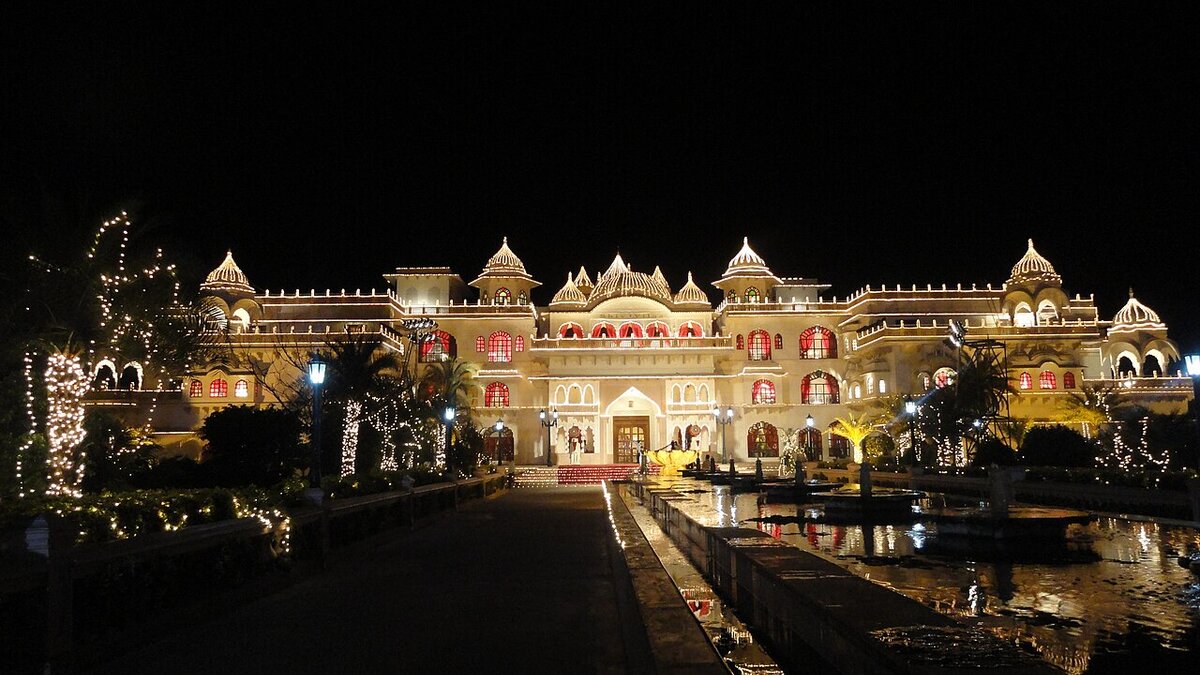
Cover image: luxury hotel facade — photo by Shiv vilas, CC BY-SA 4.0, via Wikimedia Commons.
Hotel star ratings are grades, usually from one to five, awarded by whichever body runs the scheme in a country, and there is no global authority behind them. Much of Europe uses the Hotelstars Union's shared 239-criteria catalogue, governments classify hotels in France, India and Dubai, and North America's best-known ratings come from private raters, AAA and Forbes Travel Guide.
The Hotelstars Union, covering 22 countries and more than 22,000 hotels, requires a four-star hotel to meet 91 mandatory criteria and score at least 410 points. AAA gives fewer than 1 per cent of its nearly 23,000 rated lodgings its top Five Diamonds. Booking.com says it neither assigns nor reviews the stars on its listings, so they may be the hotel's own claim.
Last checked: 25 October 2026.
Who gives hotels their star ratings?
It depends on where the hotel is. Some countries make classification a condition of trading, others let hotels opt in, and some have none: according to the Hotelstars Union, Finland and Norway have no star classification, while Spain runs 17 regional systems and Italy 21, each legally binding.
| Country or region | Who awards the rating | Scale | Mandatory or voluntary |
|---|---|---|---|
| 22 Hotelstars Union countries (e.g. Germany, Austria, Switzerland) | National hotel associations or governments, one shared catalogue | 1 to 5 stars, plus "Superior" | Mostly voluntary; mandatory in some members, e.g. Hungary, Lithuania, Malta, Slovenia and Azerbaijan |
| France | Atout France (state agency), after accredited inspection | 1 to 5 stars, plus Palace distinction | Voluntary |
| Spain and Italy | Regional governments | Varies by region | Legally binding regional rules |
| United Kingdom | The AA; VisitEngland in England | 3 to 5 stars, or "Quality Assessed" | Voluntary, fee-paying |
| US, Canada, Mexico, Caribbean, Costa Rica | AAA | Approved, then 3 to 5 Diamonds | Private scheme |
| Worldwide luxury | Forbes Travel Guide | Recommended, Four-Star, Five-Star | Private; ratings cannot be bought |
| India | Ministry of Tourism classification committee (HRACC) | 1 to 5 Star, 5 Star Deluxe, Heritage | Voluntary |
| Dubai (UAE) | Department of Economy and Tourism (formerly DTCM), under Decree No. 17 of 2013 | Hotels 1 to 5 stars; resorts 3 to 5 | Mandatory, part of licensing |
| China | National standard GB/T 14308-2023 (in force since 1 March 2024) | 1 to 5 stars | Not specified (a "recommended" standard) |
| Australia | Star Ratings Australia | 1 to 5 stars, with half stars | Voluntary; stars are a licensed trademark |
In a voluntary system, an unrated hotel may simply not have applied; in Dubai, every hotel must be licensed and classified before it receives guests.
How does the European hotel star rating system work?
The Hotelstars Union (HSU) was founded in 2009 under the patronage of HOTREC, the European hospitality trade body. Slovakia became its 22nd member in April 2026. The members are Armenia, Austria, Azerbaijan, Belgium, the Czech Republic, Denmark, Estonia, Georgia, Germany, Greece, Hungary, Latvia, Liechtenstein, Lithuania, Luxembourg, Malta, the Netherlands, Poland, Slovakia, Slovenia, Sweden and Switzerland. They classify more than 22,000 hotels with 1.2 million rooms.
Assessments cover 239 criteria in seven areas, from reception and rooms to meetings and online activity, each worth 1 to 20 points. A hotel must meet every mandatory criterion for its category and also reach a points threshold. One that scores well above its threshold (the next category's minimum, or 710 points at five stars) without meeting the next category's mandatory list can add "Superior". The catalogue, adopted in April 2024, runs from 2025 to 2030, and each classification is valid for a limited period.
| HSU category (2025–2030 catalogue) | Mandatory criteria | Minimum points | Points for "Superior" |
|---|---|---|---|
| 1 star | 49 | 95 | 180 |
| 2 stars | 52 | 180 | 270 |
| 3 stars | 74 | 270 | 410 |
| 4 stars | 91 | 410 | 610 |
| 5 stars | 113 | 610 | 710 |
A worked example: a city hotel that meets all 91 four-star mandatory criteria and scores 450 points is four-star. If optional extras such as an electric-car charger and larger rooms take it to 620 points, it still cannot be five-star without the five-star mandatory items, which include a 24-hour staffed reception, valet parking and a concierge. It becomes a four-star Superior. A breakfast-only hotel needs 20 fewer points in every category, so 390 for four stars, but can never be five-star. The maximum score is 988.
What makes a four-star hotel, and what does five-star add?
Under the HSU's published minimums, a four-star hotel needs a lobby with drinks service, a reception staffed 14 hours a day with someone physically available around the clock, a bar or lounge open at least five days a week, a staffed breakfast buffet, a minibar or 12-hour drinks room service, a choice of pillows, an upholstered armchair and bathrobes on request.
Five stars adds a 24-hour reception, a restaurant and bar open daily, 24-hour room service, a concierge, valet parking, turndown, an in-room safe and double beds at least 1.80 metres wide.
England's standards score quality as well as provision. A VisitEngland assessor stays overnight as a mystery guest and rates each area from 1 (poor) to 5 (excellent). The overall score must reach 70 to 84 per cent for four stars and 85 per cent for five, with cleanliness at least matching the rating. Four-star reception must run from at least 7am to 11pm; five-star calls for 24-hour reception and room service where there is market need, and at least one permanent luxury suite or superior room.
India's Ministry of Tourism sets physical minimums instead: bedrooms of at least 140 sq ft (about 13 square metres) excluding the bathroom at four stars and 200 sq ft at five-star and five-star deluxe, with every room air-conditioned from four stars up. A five-star hotel in a "Grade A" city needs a 24-hour multi-cuisine restaurant, a specialty restaurant and 24-hour room service.
How do AA ratings and AAA Diamonds work?
In the UK, AA inspectors visit as mystery guests and award three to five black stars for hospitality, service, bedrooms, bathrooms, cleanliness and food, with Silver Stars for standout hotels and Rosettes for cooking. In February 2024 the AA and VisitEngland announced that "Quality Assessed", a full inspection without stars, and an entry-level online accreditation, Visitor Ready, would replace one and two stars, The Caterer reported. Hotels pay to be assessed: VisitEngland's 2026–27 fee sheet, issued by AA Media on its behalf, lists a £120 joining fee plus £930 to £2,310 a year by room count, VAT included.
AAA, the North American motoring club, does not award stars. Its inspectors make unannounced visits to check the "4 Cs" (cleanliness, comfort, cuisine and consistency) and assign a designation: Approved, which replaced the old One and Two Diamond levels, then Three, Four or Five Diamonds. Of the nearly 23,000 AAA Diamond lodgings, about 7 per cent are Four Diamond (roughly 1,750 hotels) and fewer than 1 per cent Five Diamond (roughly 145), according to AAA's September 2026 announcements.
Five Diamond status also needs sign-off from a panel of experts. The Broadmoor in Colorado Springs has held it for 50 consecutive years.
Who decides which hotels count as luxury?
At the top of the market, private guides add their own verdicts. Forbes Travel Guide, which began as the Mobil Travel Guide in 1958, sends anonymous inspectors who pay their own way, stay at least two nights and assess up to 900 criteria, with an emphasis on service; it says no one can buy a rating. Its 2026 Star Awards named 343 Five-Star and 708 Four-Star hotels. Macau led with 28 Five-Star hotels, and Nujuma, a Ritz-Carlton Reserve, became the first Five-Star from Saudi Arabia's Red Sea project; the brand's first city property, Ritz-Carlton Reserve Shanghai, is due in 2030.
The Michelin Guide introduced the Michelin Key in 2024 as its hotel equivalent of the restaurant star. Its second global selection, published on 18 September 2026, lists 2,832 Key hotels, 155 of them with Three Keys. The World's 50 Best Hotels instead polls an 800-member academy on hotels stayed in within three years; its 2026 list put Rosewood Hong Kong at No. 1 for a second year, ahead of Capella Bangkok.
France, whose star classification is voluntary and valid for five years, adds an official tier above five stars. Atout France named 33 Palaces for 2026, including newcomers Cheval Blanc Paris and Hôtel Martinez in Cannes; the title lasts three years, and Le Figaro reported that three hotels, including the Park Hyatt Paris-Vendôme, had lost it.
None of the private guides is a legal "source of truth". For official stars, check the national register, such as the HSU's hotel search or Atout France's published list.
Are the stars on Booking.com, Expedia and Google official?
Not necessarily. Booking.com says it does not assign star ratings: depending on local rules, they come from the property or an independent rating body, and it does not review them unless it learns one is inaccurate. The yellow squares on some listings are a Booking.com "quality rating", calculated by machine learning from more than 400 features. Expedia Group's developer documentation names France, Italy, Turkey, the UAE and Israel as regions where its API can flag an official rating, and says its star-rating descriptions guarantee no particular feature; the HSU says Expedia also cites it as the source in member states. Google's class ratings blend third-party data with machine-learning inference from price, location and amenities.
This has become a regulatory fight. In November 2025 the Dutch advertising code committee ruled Booking.com's display of possibly self-assigned stars for Dutch hotels misleading, and its appeal board upheld that in April 2026. On 21 October 2026 the European Commission opened Digital Services Act proceedings to assess whether Booking.com did enough against fraudulent listings and phishing, and whether it failed to label paid-for boosted listings as ads. That case concerns fraud rather than stars, but the HSU, whose data Tripadvisor has cross-checked daily since June 2022, has offered Booking.com free access. The incentives behind listings are covered in how online travel agencies work and booking direct versus booking through an OTA.
Why can't star ratings be compared across countries?
Three differences explain the mismatch. The first is what gets measured: HSU criteria are mostly yes-or-no checks, India's are physical minimums, England's bands score quality and Forbes emphasises service. The second is who decides, from a government licence in Dubai to a voluntary industry scheme in Germany. The third is coverage: Sweden and Denmark use HSU stars while Finland and Norway have none, even though hotel groups plan the Nordics as one region, as the Hilton and Scandic Nordic development deal shows.
Before relying on a hotel's stars:
- Find the country's scheme in the table above and whether it is mandatory.
- Look the hotel up in the official register, not the listing.
- Check the date: French plaques show the year of award.
- On booking sites, tell stars apart from Booking.com's squares, which are its own algorithm.
- For luxury, cross-check the Forbes, Michelin or AAA lists, read recent reviews and weigh hotel loyalty programme benefits, which no star scheme measures.
Frequently asked questions
How do hotels get stars?
In most official systems the hotel applies, pays a fee and is audited on site against a published checklist: 239 criteria under the Hotelstars Union, a scored overnight stay with VisitEngland, a committee inspection in India. In Dubai, classification is part of the operating licence. Forbes Travel Guide and the Michelin Guide send anonymous inspectors and publish their own selections.
Does AAA give hotels stars?
No. AAA awards Diamonds, not stars, after unannounced inspections in the United States, Canada, Mexico, Costa Rica and the Caribbean. There are four designations: Approved, Three, Four and Five Diamond. About 145 hotels hold Five Diamonds, fewer than 1 per cent of the nearly 23,000 Diamond-rated lodgings, according to AAA in September 2026.
Is there such a thing as a 7-star hotel?
Not in any official scheme. The Hotelstars Union, the AA, India's Ministry of Tourism, Dubai's hotel decree and Star Ratings Australia all stop at five, with refinements on top: "Superior" in Europe, Five Star Deluxe in India and France's Palace distinction, held by 33 hotels in 2026. "Seven-star" is a marketing label, not a classification.
Can a hotel give itself stars?
Sometimes. Booking.com says stars on its site may come from the property itself where local rules allow, and it does not review them unless it learns one is inaccurate. Where stars are protected, self-rating is restricted: Star Ratings Australia sends legal notices to unlicensed properties that display stars, and Dubai classifies every hotel before it may receive guests.
How long does a hotel star rating last?
It varies. French and Indian classifications are each valid for five years, and France's Palace distinction for three. The Hotelstars Union says its classifications are valid for a limited period so hotels are reviewed regularly. AAA updates its Diamond lists monthly as inspectors visit through the year, and Forbes Travel Guide publishes its Star Awards annually.
Sources
- Hotelstars Union, Criteria 2025–2030
- Hotelstars Union, Real stars, real hotels (21 October 2026)
- European Commission, Booking.com DSA investigation
- VisitEngland, Quality Standards for Hotels
- AAA Newsroom, Four Diamonds (September 2026)
- Forbes Travel Guide, 2026 Star Awards
- Michelin, 2026 Michelin Key selection
- Ministry of Tourism (India), Hotel classification guidelines
- Dubai Legal Portal, Decree No. 17 of 2013
- Booking.com, How we work
- Euronews, France unveils 33 palaces for 2026 (4 June 2026)