Solid food sails through airport security, but the real test comes at arrival: EU meat and dairy bans, US declaration penalties and Australian biosecurity fines explained, gate by gate.
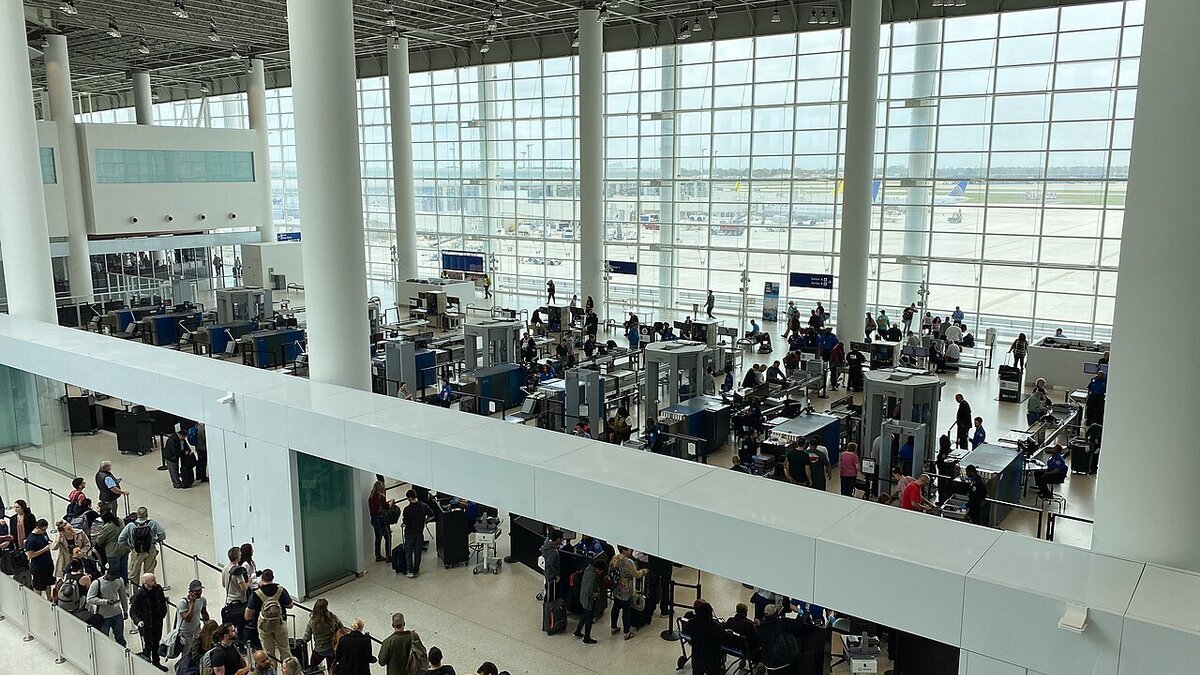
Cover image: Travellers and trays at a busy airport security screening checkpoint seen from above — photo by Tony Webster, CC BY 2.0, via Wikimedia Commons.
Can you bring food on an international flight? Yes — but the question hides two entirely separate checks, and most guides only cover the first. Gate one is airport security, which cares about the physical form of your food: solid items are fine in a carry-on, while anything liquid, gel-like or spreadable falls under the 100 ml (3.4 oz) rule. Gate two is customs and biosecurity at your destination, which cares about the ingredients — meat, dairy, fruit, seeds — and it is where the real money is lost. The EU bans meat and dairy arriving from outside the bloc, the US fines travellers who fail to declare agricultural items, and Australia has cancelled visas over undeclared pork and cheese. The working rule for any trip: pack solid, and always declare everything edible on arrival.
What food can you take through airport security?
Under TSA rules — mirrored closely by EU and UK checkpoints — solid food can travel in carry-on or checked bags without quantity limits. Sandwiches, fruit, hard cheese, chocolate, biscuits, jerky and nuts all pass. Officers may ask you to pull food out of your bag for X-ray clarity, but that is a screening step, not a restriction.
The trap is texture. Anything that spreads, pours or squeezes counts as a liquid: yogurt, nut butter, jam, honey, soft cheese, hummus, sauces, soup and canned goods with liquid. Each container must be 100 ml / 3.4 oz or less and fit in your one resealable liquids bag. A 340 g jar of peanut butter is a confiscation waiting to happen.
Two useful exceptions. Baby food, formula and breast milk are exempt from the liquids limit in reasonable quantities, though they get separate screening. And frozen items, including ice packs keeping food cold, are allowed only if frozen completely solid at the checkpoint — slushy or partially melted packs are treated as liquids. If your food is going in the hold instead, check weight limits first in our guide to airline baggage allowance rules.
What happens at customs when you land?
Security cleared your sandwich because it was solid. Customs may seize it because it contains ham. That is the two-gate distinction: arrival controls judge ingredients, not form, because the concern is animal and plant disease, not aviation security.
Travellers entering the EU from outside the bloc cannot bring meat or dairy products at all — no cured sausage, no cheese, no butter, no milk chocolate-covered exceptions for "sealed" or "vacuum-packed" goods. The narrow carve-outs are up to 2 kg of powdered infant milk, infant food or special medical foods in unopened commercial packaging, plus limited quantities of fruit, vegetables, eggs, honey and up to 20 kg of fish. Undeclared products are confiscated and destroyed, and you can be fined or prosecuted.
The United States takes a different approach: almost everything can be declared, but everything must be. CBP requires travellers to declare all food and agricultural products; declared items that fail inspection are simply destroyed, with no penalty to you. Fail to declare, and civil penalties for agricultural items can reach US$10,000 for knowing violations, with lower tiers for negligence. If you are entering on the visa waiver programme, a customs violation is a bad first impression — see our US ESTA entry requirements guide.
Which countries are strictest about food?
Australia and New Zealand run the world's toughest arrival regimes. Both screen essentially all arriving baggage for biosecurity risk with detector dogs and X-ray. In Australia, undeclared high-risk food can trigger an on-the-spot infringement notice of A$3,300 — and since 2023 the government has cancelled visitor visas over breaches, including a traveller caught with undeclared raw pork and cheese who was removed and faces a three-year re-entry exclusion. Declarations are now made through Australia's digital arrival card, which replaced the paper incoming passenger card.
New Zealand issues an instant NZ$400 infringement fee for undeclared risk goods — even a forgotten apple or airline snack in a jacket pocket, and even when the failure was accidental. Amnesty bins before the inspection point let you dump anything you forgot to list, penalty-free.
One more wrinkle: food bought after security is not exempt at the other end. Airside purchases skip the liquids rule on departure — covered in our explainer on how duty-free shopping works — but that sealed leg of jamón still counts as meat when you land.
Common foods: security vs customs at a glance
| Food | Through security (carry-on) | Into the EU (from outside) | Into the US / Australia / NZ |
|---|---|---|---|
| Sandwich | Yes — solid | No if it contains meat or cheese | Declare; meat fillings usually seized |
| Fresh fruit | Yes — solid | Limited quantities only | Declare; high seizure risk, fines if hidden |
| Hard cheese | Yes — solid | No — dairy is banned | Declare; admissibility decided at inspection |
| Cured meat / jerky | Yes — solid | No — meat is banned | Declare; commonly refused and destroyed |
| Nut butter, jam, honey | Only ≤100 ml containers | Yes in small personal quantities | Declare; shelf-stable jars usually pass |
| Chocolate and sweets | Yes — solid | Yes | Declare; commercially packaged usually fine |
| Baby food / formula | Exempt from liquids rule (extra screening) | Up to 2 kg powdered, unopened packaging | Declare; generally admitted for infant use |
| Home-cooked meals | Solid dishes yes; soups/sauces ≤100 ml | No if any meat or dairy content | Declare; highest-risk category, expect seizure |
The pattern is consistent: declaring costs you nothing but the food; concealing costs cash, and in Australia potentially your visa. When in doubt, tick the box.
Frequently asked questions
Can I bring snacks through TSA?
Yes. Solid snacks — sandwiches, fruit, crisps, chocolate, nuts, protein bars — are allowed through TSA checkpoints in unlimited quantities in carry-on bags. Officers may ask you to place food in a separate bin for X-ray screening. Spreadable or pourable snacks such as yogurt, hummus or nut butter count as liquids and must be in containers of 100 ml (3.4 oz) or less.
Can I take food bought after security onto the plane?
Yes. Anything purchased airside, including drinks and fresh food, can be carried onto the aircraft because it has already passed screening. The catch comes at arrival: airside and duty-free purchases are still subject to the destination's customs and biosecurity rules, so a vacuum-packed ham bought in the departure lounge will still be confiscated when you land in the EU, US, Australia or New Zealand.
What food can't I bring into Europe?
Travellers arriving in the EU from non-EU countries cannot bring any meat or dairy products, including cured sausage, ham, cheese, butter and milk-based spreads. Exceptions cover up to 2 kg of powdered infant milk, infant food or special medical foods in unopened commercial packaging. Limited quantities of fruit, vegetables, eggs, honey and up to 20 kg of fish products are allowed. Undeclared banned goods are confiscated and can bring fines.
What happens if I don't declare food in Australia?
Undeclared high-risk food discovered at the border can trigger an on-the-spot infringement notice of A$3,300, and serious breaches have led to visitor visas being cancelled on the spot, removal from Australia and a three-year re-entry ban. Declared items carry no penalty — biosecurity officers simply inspect them and destroy anything that poses a risk, so declaring everything is always the cheaper option.
Do frozen ice packs count as liquids at security?
Only if they have started to melt. TSA allows ice packs and frozen food through the checkpoint when they are frozen completely solid at screening. If a pack is slushy or has liquid pooling in the container, it is treated as a liquid and must meet the 100 ml (3.4 oz) rule. Medically necessary gel packs are exempt regardless of state.
Sources
- TSA — Solid Foods (What Can I Bring?)
- TSA — Frozen Food (What Can I Bring?)
- Your Europe — Taking animal products, food or plants with you in the EU
- US Customs and Border Protection — Bringing Food into the U.S.
- Australian Department of Agriculture — Attempted biosecurity breach earns traveller a penalty and visa cancellation
- NZ Ministry for Primary Industries — How to declare items when arriving in NZ