Delta, United, American and Southwest all beat Wall Street's Q2 2026 estimates despite fuel bills up as much as 84%. Delta's premium cabins outsold its main cabin for the first time, and United raised full-year guidance to $9-11 per share.
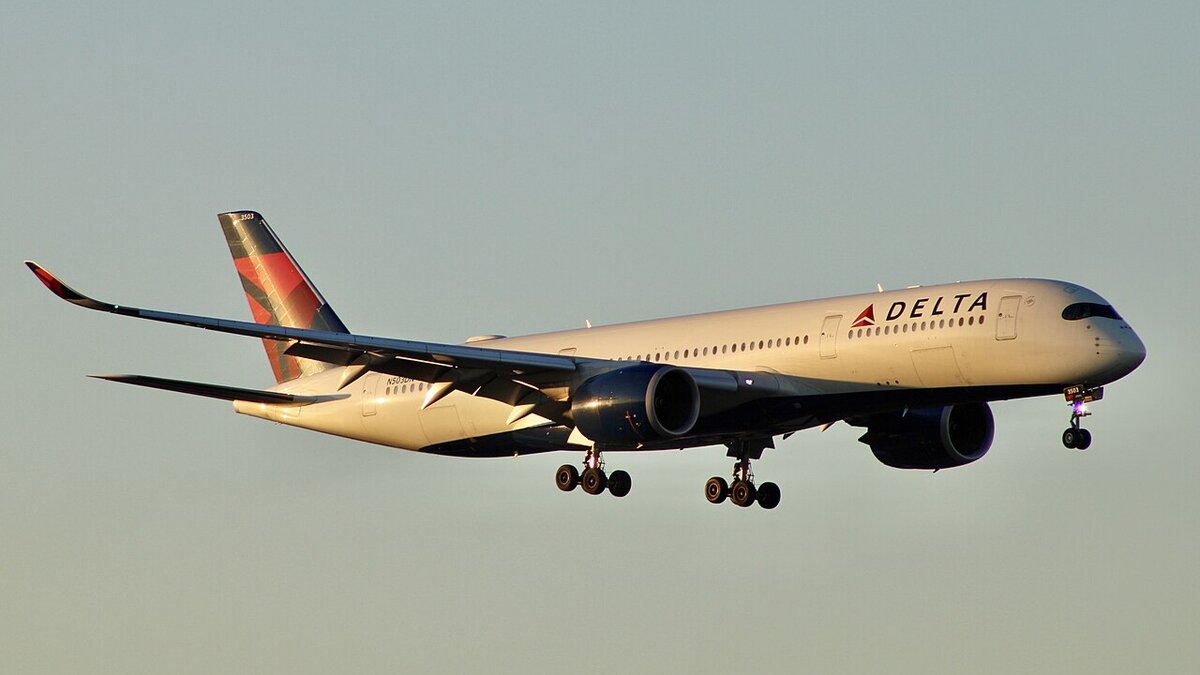
Cover image: A Delta Air Lines Airbus A350 on approach; the carrier's premium cabins generated $6.92 billion in the June 2026 quarter, outselling its main cabin for the first time. — photo by Matthew Groh, CC BY-SA 4.0, via Wikimedia Commons.
The four largest US airlines all cleared Wall Street's bar for the second quarter of 2026 — and did it while absorbing the steepest fuel-cost surge since 2022. Delta Air Lines reported adjusted earnings of $1.56 per share against a consensus of $1.48, on adjusted revenue of $17.67 billion, up 13.9% year on year, according to figures compiled by TradingKey from the carrier's results release. On 15 July, United Airlines posted record second-quarter revenue of $17.7 billion, up 16%, and raised its full-year adjusted earnings guidance to $9.00–$11.00 per share — even as its quarterly fuel bill jumped 84.1% to $5.1 billion, per the company's results announcement.
The quarter delivered a structural milestone: Delta's premium cabins generated $6.92 billion in revenue, surpassing the $6.85 billion earned by its main cabin for the first time. American Airlines Group and Southwest Airlines followed with beats of their own on 23 and 22 July respectively, though both trimmed or hedged full-year outlooks as fuel forecasts deteriorated. The results largely vindicate the setup we outlined in our airline Q2 2026 earnings preview: premium demand held, and the industry's ability to push fuel costs into fares became the quarter's defining question.
How did Delta and United perform in Q2 2026?
Delta's premium product revenue grew 17% year on year while main cabin revenue rose 8%, per its June-quarter results. Chief executive Ed Bastian said the airline "delivered $1.4 billion in pre-tax profit while absorbing the highest quarterly fuel expense in our history" — an adjusted $4.4 billion, up 77%, at $3.93 per gallon. Delta reaffirmed full-year adjusted earnings of $6.50–$7.50 per share, well above the roughly $5.97 analyst consensus, and held its $3–4 billion free cash flow target.
United's adjusted earnings of $1.99 per share came on an adjusted pre-tax margin of 4.8% and net income of $805 million, according to its results release. Premium revenue rose 16%, loyalty revenue 11% and cargo revenue 23%, while total unit revenue (TRASM) climbed 12.1%. Chief executive Scott Kirby said the results "show why we have been investing in customer improvements throughout every cabin and winning brand-loyal customers", adding that United "quickly and decisively acted to adjust our schedules" when oil prices spiked — capacity grew just 3.5%.
Why is premium cabin demand driving airline profits?
The premium story is no longer a Delta-only phenomenon. American reported premium passenger unit revenue up 13.4% against 8.8% for the main cabin, alongside a 26% jump in managed corporate revenue — its fifth straight quarter of double-digit corporate growth, per its earnings release. Southwest, historically an all-economy operator, posted a 20.3% rise in adjusted operating revenue to a record $8.7 billion as bag fees and other commercial initiatives introduced in 2025 matured.
Loyalty economics reinforced the trend. American's AAdvantage enrolments grew more than 30% year on year with co-branded card spend up 8%, while Southwest cited a 28% acceleration in Chase co-branded card acquisitions. That deepening bank-airline nexus is the machinery described in our guide to how travel credit card points work — and increasingly what sets US carriers apart globally, a divergence the International Air Transport Association (IATA) flagged in its 2026 industry profitability outlook.
How much did fuel costs rise — and who is paying?
Fuel was the quarter's common enemy. United paid an average of $4.19 per gallon, up 79.4%, and now expects nearly $6 billion of additional full-year fuel cost versus its January planning assumption. Delta's adjusted per-gallon price rose 75% to $3.93; American's fuel expense climbed $2.2 billion, or 83%; Southwest paid $3.92 per gallon against $2.32 a year earlier, an $889 million quarterly increase, per each carrier's release.
The pass-through maths is the number to watch. United says it recovered about half of the fuel increase through fares in Q2, expects 80–90% in Q3 and full recovery in Q4. Delta put its Q2 recovery at roughly 60%, heading towards about 100% in the third quarter, according to TradingKey's analysis of the earnings call. American said it offset nearly 50% of its increase through higher fares. The mechanics behind that lag — hedging, refinery capacity, booking curves — are covered in our explainer on how jet fuel costs feed into airfares.
How do the big four US airlines' Q2 2026 results compare?
| Airline | Q2 revenue (YoY) | Adjusted EPS | FY2026 adjusted EPS guidance |
|---|---|---|---|
| Delta Air Lines | $17.67bn adj. (+13.9%) | $1.56 | $6.50–$7.50 (reaffirmed) |
| United Airlines | $17.7bn (+16.0%) | $1.99 | $9.00–$11.00 (raised) |
| American Airlines | $16.7bn (+16.3%) | $0.15 | ($0.65)–$0.65 |
| Southwest Airlines | $8.7bn adj. (+20.3%) | $0.94 | $3.25–$4.25 (trimmed) |
The dispersion is stark. American beat its $0.03 consensus fivefold yet guides to roughly breakeven at the midpoint for the full year, with a projected Q3 adjusted loss of $0.10–$0.70 per share, with second-half fuel costs up nearly $1.6 billion since early July, per finance chief Devon May. Southwest cut its floor from "at least $4.00" to a $3.25–$4.25 range reflecting the forward fuel curve, per its release.
What do Q2 2026 airline results mean for airfares?
Three carriers independently told investors the same thing: fare recovery of fuel costs will approach 100% by the fourth quarter. With United growing capacity only 3.5% and American holding Q3 seat growth to 3–5%, supply discipline is doing the heavy lifting — American still expects Q3 revenue up 16–19% year on year. For travellers, that points to fares staying elevated through the northern winter, with the sharpest increases already embedded in premium cabins where demand is least price-sensitive.
The strategic takeaway for the trade is Delta's cabin crossover. Once premium outsells economy at the industry's most profitable carrier, every network airline's retrofit, retailing and corporate-sales agenda follows. Southwest chief executive Bob Jordan's claim that his airline now has "a broader and more diversified set of revenue and commercial levers than at any point in our history" is, in effect, the whole US industry's Q2 statement.
Frequently asked questions
Did Delta's premium cabin really outsell its main cabin in Q2 2026?
Yes. Premium products brought in $6.92 billion against $6.85 billion for the main cabin in the June quarter — the first time premium revenue has surpassed economy at Delta, according to TradingKey's review of the results. Premium grew 17% year on year versus 8% for the main cabin.
Why did United raise guidance while American and Southwest lowered theirs?
United expects to recover 80–90% of its extra fuel cost through fares in Q3 and 100% in Q4, and lifted its full-year range to $9.00–$11.00 per share. American and Southwest carry thinner margins and weaker pass-through — American offset only about half its fuel increase — so rising fuel forecasts hit their outlooks harder.
Will airfares keep rising in late 2026?
The carriers' own guidance implies yes. Delta, United and American all described progressively fuller recovery of fuel costs through fares into Q3 and Q4 2026, while keeping capacity growth in the low single digits. Premium and corporate fares are absorbing the largest share of the increases.
Sources
- United Airlines — United Posts Q2 Results Above Wall Street Expectations and Raises Full-Year 2026 Adjusted EPS Guidance
- Delta Air Lines — Delta Air Lines Announces June Quarter 2026 Financial Results
- TradingKey — Delta Air Lines Q2 Earnings Highlights: Premium Demand Supports Better-Than-Expected Profit
- American Airlines — American delivers highest quarterly revenue in company history
- Southwest Airlines — Southwest Airlines Reports Second Quarter 2026 Results