Akasa Air and BPCL flew India's first commercial SAF service on Sept 8, Mumbai to Goa on a 1% blend. Timings, quotes, aircraft details and what must happen before SAF scales.
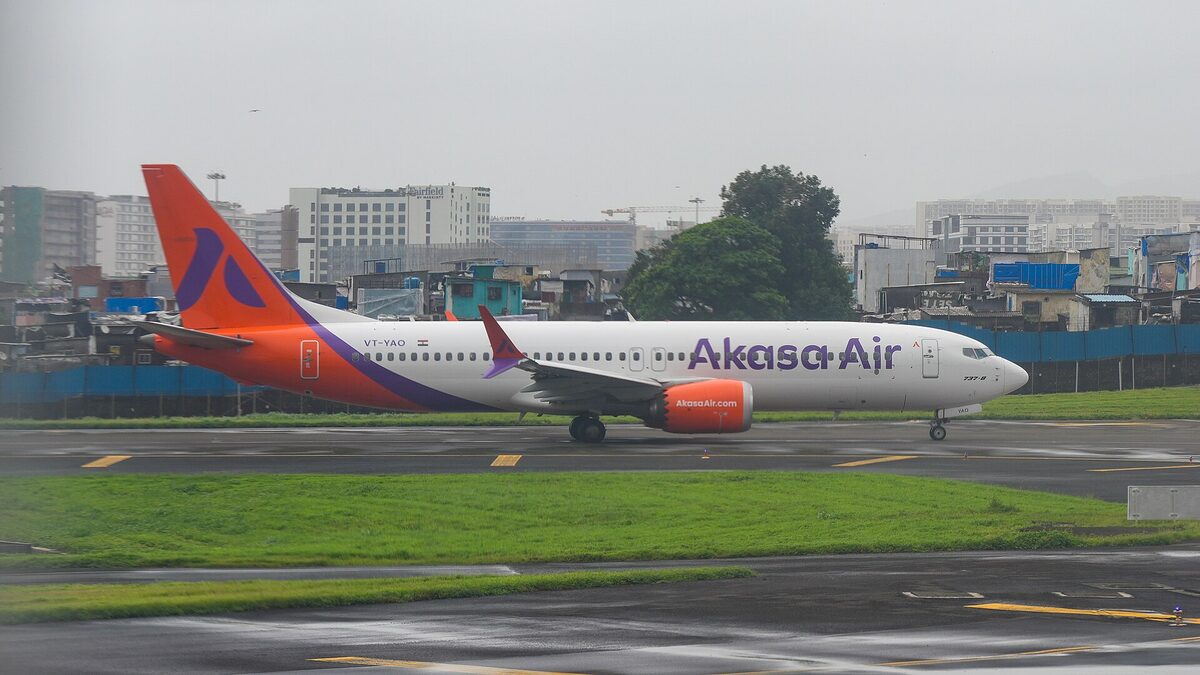
Cover image: an Akasa Air Boeing 737 MAX, registration VT-YAO, taxiing at Mumbai airport — photo by Timothy A. Gonsalves, CC BY-SA 4.0, via Wikimedia Commons.
Akasa Air has operated India's first commercial flight on a blend of sustainable aviation fuel. On September 8, 2026, an Akasa Boeing 737 MAX flew scheduled service from Mumbai's Chhatrapati Shivaji Maharaj International Airport to Manohar International Airport in Goa, departing 13:05 IST and landing 14:30 IST, with conventional turbine fuel blended with 1% sustainable aviation fuel (SAF). The flight, run with public-sector partner Bharat Petroleum (BPCL), needed no modification to the aircraft or fuelling infrastructure, demonstrating that drop-in biofuels work inside normal Indian line operations.
The service flows from a memorandum of understanding Akasa and BPCL signed in July 2026 to build commercial pathways for sustainable fuels and gather real-world performance data under Indian operating conditions. It is a demonstration, not yet a daily offering: scaling from a 1% blend on one sector to network-wide use will need domestic bio-refineries, farm-waste supply chains and supportive pricing. But as a first scheduled SAF service in Indian skies, it moves the country's decarbonisation debate from pledges to flight data.
What exactly flew on September 8?
The aircraft was an Akasa Boeing 737 MAX, the type that anchors the airline's young fleet, powered by CFM LEAP-1B engines. The fuel was standard Jet A-1 blended with 1% bio-derived SAF, a drop-in mix the existing engines and airport fuel systems handle without change. Departure from Mumbai was at 13:05 IST, with touchdown at Goa's Mopa airport at 14:30 IST, a normal 85-minute sector flown as scheduled commercial service rather than a test flight.
Regulatory clearances for the operation involved the Ministry of Petroleum and Natural Gas, the Ministry of Civil Aviation and the Directorate General of Civil Aviation, which BPCL credited with facilitating approvals. That multi-agency sign-off matters because it sets the template: future SAF services now have a flown precedent for certification and handling.
Who said what about the milestone?
Ankur Goel, Akasa Air's chief financial officer, said sustainability shapes how the airline is being built for the long term, pointing to its investments in next-generation aircraft and efficient operations on the ground and in the air. He added that scaling SAF in India will need coordinated action across the ecosystem, supported by domestic supply, enabling policy and commercial viability.
Subhankar Sen, BPCL's director of marketing, framed the shift as both an environmental imperative and a strategic necessity for an India that imports most of its crude. He acknowledged that fragmented feedstock supply chains have historically held SAF back, while arguing that sustained work across the value chain has now laid the foundation for a viable domestic SAF ecosystem tied to the country's energy transition.
How does this fit Akasa's wider green operation?
The SAF flight sits on top of an efficiency stack the airline has built since inception. The 737 MAX fleet delivers roughly 20% lower fuel burn and carbon emissions than the previous-generation single-aisle jets it replaces, alongside up to 50% less noise. Operationally, Akasa uses the SkyBreathe platform from OpenAirlines to mine flight telemetry for savings: single-engine taxiing, optimised climb profiles, continuous descent approaches and speed management, compounded across every sector.
On the ground, the carrier became India's first airline to scrap ceremonial water-cannon salutes for new routes and aircraft, a single policy change it says has saved more than 550,000 litres of treated water at Indian airports. Readers tracking the airline's network growth can pair this with Akasa's new Mumbai–Hanoi direct service, while the fuel itself is explained in our SAF reality check.
| Flight fact | Detail |
|---|---|
| Date and sector | September 8, 2026; Mumbai (BOM) 13:05 IST to Goa Mopa (GOX) 14:30 IST |
| Blend | Conventional Jet A-1 with 1% bio-derived SAF, drop-in, no modifications |
| Aircraft | Boeing 737 MAX with CFM LEAP-1B engines |
| Partners | Akasa Air and BPCL under a July 2026 MoU |
| Policy context | India's push toward a 5% SAF blend by 2030; Singapore is moving the other way with a passenger SAF levy |
What must happen before SAF goes mainstream in India?
Three constraints dominate. Feedstock aggregation tops the list: collecting agricultural waste at scale from fragmented farms to feed bio-refineries is a logistics business as much as an energy one. Capital for refining capacity comes second, since SAF plants need long-term offtake certainty before banks fund them. Tax and pricing treatment comes third: until blended fuel approaches cost parity with Jet A-1 on a lifecycle basis, airlines can only absorb demonstration volumes.
The September 8 flight answers the narrowest question, whether the technology works in Indian operations, with a yes. The harder questions about volumes and rupees are now BPCL's and the ministries' to solve.
Frequently asked questions
Was the Akasa SAF flight a scheduled service?
Yes. The September 8 Mumbai–Goa sector operated as normal commercial service with a 1% SAF blend in standard turbine fuel, departing 13:05 IST and arriving 14:30 IST, rather than as a closed test flight.
Is the flight safe? Was the aircraft modified?
No modifications were needed. The 1% blend is a certified drop-in fuel that existing 737 MAX engines and airport fuelling systems handle exactly like conventional Jet A-1. Regulators including the DGCA cleared the operation, and the aircraft worked a normal turnaround at Goa before operating onward sectors.
Will passengers pay more for SAF flights?
Not on this service; no fare surcharge was announced. At 1% blend the cost uplift is negligible, but meaningful SAF shares would need policy support before airlines could absorb them without fare effects.
What is India's SAF target?
The flight feeds India's push toward a 5% sustainable fuel blend by 2030, the goal cited around the operation. Reaching it will require domestic bio-refineries, aggregated farm-waste supply chains and enabling tax treatment.