

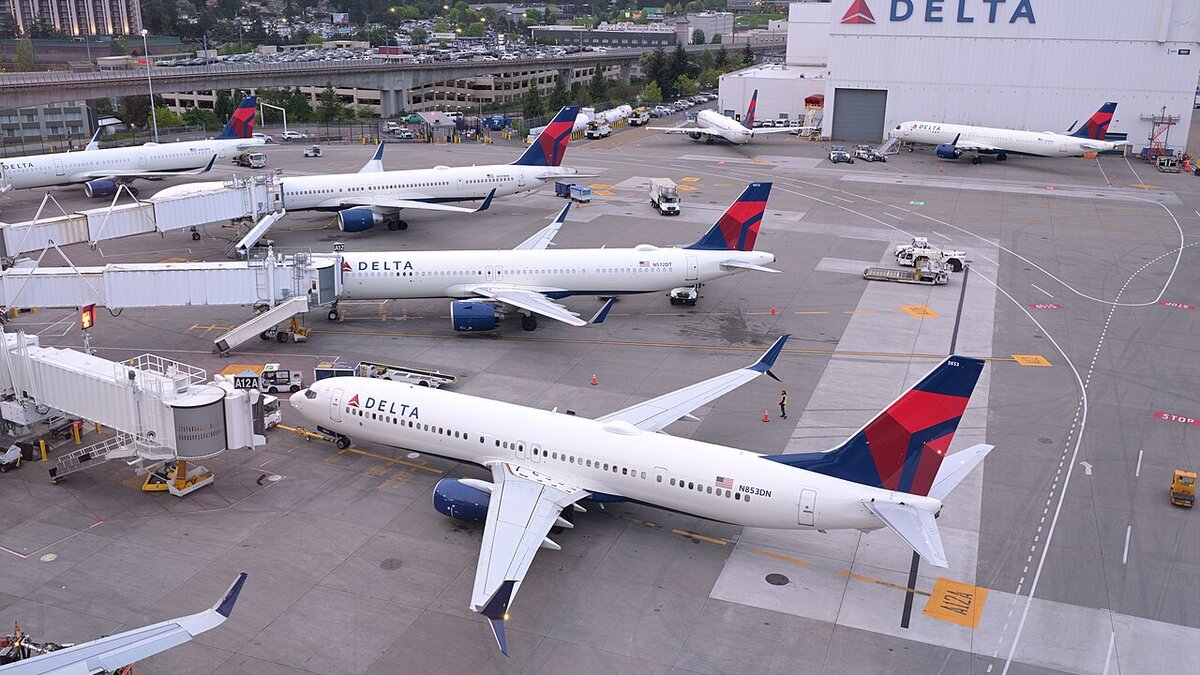
Delta kicks off the airline Q2 2026 earnings season on 10 July with consensus EPS down nearly 30% despite double-digit revenue growth. Spring's fuel spike, premium-cabin strength and a fading cost headwind will define the quarter.
Cover image: delta air lines widebody jet at its atlanta hub gate — photo by 4300streetcar, CC BY 4.0, via Wikimedia Commons.
The airline Q2 2026 earnings season opens on 10 July, when Delta Air Lines reports June-quarter results before the US market opens. Wall Street expects a profitable but visibly squeezed quarter: the analyst consensus tracked by AlphaStreet points to adjusted earnings of $1.48 per share, down 29.5% from $2.10 a year earlier, even as revenue is forecast to grow roughly 12.8% from the $16.65 billion Delta booked in the same quarter of 2025. United Airlines follows, with its earnings call scheduled for 16 July, having guided to adjusted earnings of $1.00 to $2.00 per share on an assumed fuel price of about $4.30 per gallon. American Airlines, reporting later in the month, has guided to a range straddling breakeven, between a $0.20 loss and a $0.20 profit per share, despite projecting revenue growth of 13.5% to 16.5%. The story of the quarter is a scissors effect: record demand and strong fares on top, and a spring jet-fuel spike that peaked at $4.88 a gallon on 2 April cutting deep into the bottom line.
When do the major US airlines report Q2 2026 earnings?
Delta, as usual, sets the tone for the whole transport sector. Its 10 July release will be the first hard read on how the peak summer quarter actually landed after months of fuel-driven guidance cuts across the industry.
| Carrier | Q2 report | Street / company expectation | Fuel assumption |
|---|---|---|---|
| Delta Air Lines | 10 July, pre-market | Consensus adj. EPS $1.48 (vs $2.10 in Q2 2025); revenue up low teens | Not disclosed in guidance summary |
| United Airlines | Earnings call 16 July | Guided adj. EPS $1.00–$2.00; full-year $7–$11 | ~$4.30 per gallon |
| American Airlines | Later in July | Guided adj. EPS ($0.20)–$0.20; revenue up 13.5–16.5% | ~$4.00 per gallon |
Why are airline profits falling when revenue is rising?
Fuel is the short answer. Jet fuel, which industry data puts at 25% to 33% of airline operating costs, spiked in the spring after conflict-related disruption around the Strait of Hormuz removed Middle East refinery output from the market and pushed jet crack spreads above $121 a barrel. US spot prices hit $4.88 a gallon on 2 April before sliding all the way back to $2.70 by 18 June, according to price data compiled by Moneywise.
Airlines could not reprice tickets fast enough to keep up. United told investors it expects to recover only 40% to 50% of the fuel-cost increase through fares and other revenue measures during the quarter. Non-fuel costs are grinding higher too: the Zacks consensus for Delta's adjusted cost per available seat mile is 14.25 cents, up from 13.49 cents a year earlier, with labour the main driver. That cost pressure comes on top of the structural constraints covered in our report on aviation's supply-chain squeeze and record-old fleet, which keeps maintenance bills high and capacity growth capped.
How strong is the fare environment this summer?
Demand, by contrast, has held up. Delta guided to June-quarter revenue growth in the low teens year on year, citing strong consumer and corporate demand, and reported record corporate sales with double-digit growth in the previous quarter. Analysts tracked by S&P Global's Visible Alpha expect unit revenue growth to remain positive across the US carriers, with yields climbing on the back of segmentation strategies and constrained capacity.
The premium cabin is doing disproportionate work. An Associated Press report published this week describes US airlines deepening the divide between fare classes as they chase higher-margin premium traffic, and American has said it plans to expand premium seating by 50% by the end of the decade. A packed events calendar is helping fill those seats: the FIFA World Cup travel surge across North America has landed squarely in the June and September quarters. For travellers, the flip side of resilient yields is the fare inflation we examined in why 2026 airfares cost more as jet fuel bites back.
Will falling jet fuel prices lift second-half guidance?
This is the swing factor for the whole earnings season. With spot jet fuel back below $2.80 a gallon in the US, far under the $4.30 United assumed and the roughly $4.00 American assumed for their Q2 guidance, carriers head into the September quarter with a meaningful cost tailwind, provided prices hold.
That is why full-year guidance updates may matter more than the Q2 numbers themselves. Points to watch:
- Delta's full-year outlook: the carrier has guided conservatively all year and has beaten consensus in each of the last four quarters by an average of 5.4%, per Zacks; any raise would reset expectations for the sector.
- United's $7–$11 full-year EPS range: a narrowing towards the top end would confirm the fuel tailwind is flowing through.
- American's breakeven quarter: whether revenue growth of up to 16.5% can offset its cost base will show how much cushion the weakest of the big three has.
- Unit revenue (RASM) trends: evidence of whether pricing power survived the peak-summer capacity additions.
The industry backdrop remains thin-margined. IATA, the airline trade body, forecast a record $41 billion industry net profit for 2026 at a net margin of just 3.9%, about $7.90 per passenger, a projection made before the spring fuel spike, as we detailed in our analysis of why airline profits are stabilising on wafer-thin margins.
Frequently asked questions
When does Delta report its Q2 2026 results?
Delta Air Lines reports June-quarter 2026 results on 10 July, before the US market opens. Analysts expect adjusted earnings of about $1.48 per share on revenue growth of roughly 13% year on year.
Will airfares come down now that jet fuel is cheaper?
Not quickly. Airlines recovered only part of the spring fuel spike through fares, and with demand strong and capacity constrained they have little incentive to cut prices in peak summer. Any relief is more likely to show in autumn and winter fares.
Why is premium cabin demand so important this quarter?
Premium and corporate travellers generate far higher margins than main-cabin passengers, and their spending has proved more resilient to fare increases. That mix shift is cushioning airline profits against the fuel-cost hit, which is why carriers such as American are expanding premium seating aggressively.
Sources
- AlphaStreet — Delta Air Lines Q2 2026 earnings preview: Street expects $1.48 EPS
- Yahoo Finance / Zacks — Delta Air Lines to report Q2 earnings: what's in the offing?
- Moneywise — Jet fuel prices crashed from $4.88 to $2.70 a gallon, but airfares aren't following
- IATA — Airline profitability stabilizes with 3.9% net margin expected in 2026

Post a comment