Farnborough 2026 closed with 327 firm Airbus and Boeing orders, dominated by SMBC Aviation Capital's 200-jet split deal. Boeing edged Airbus on firm sales, but analysts say the industry's real constraint is deliveries, not demand.
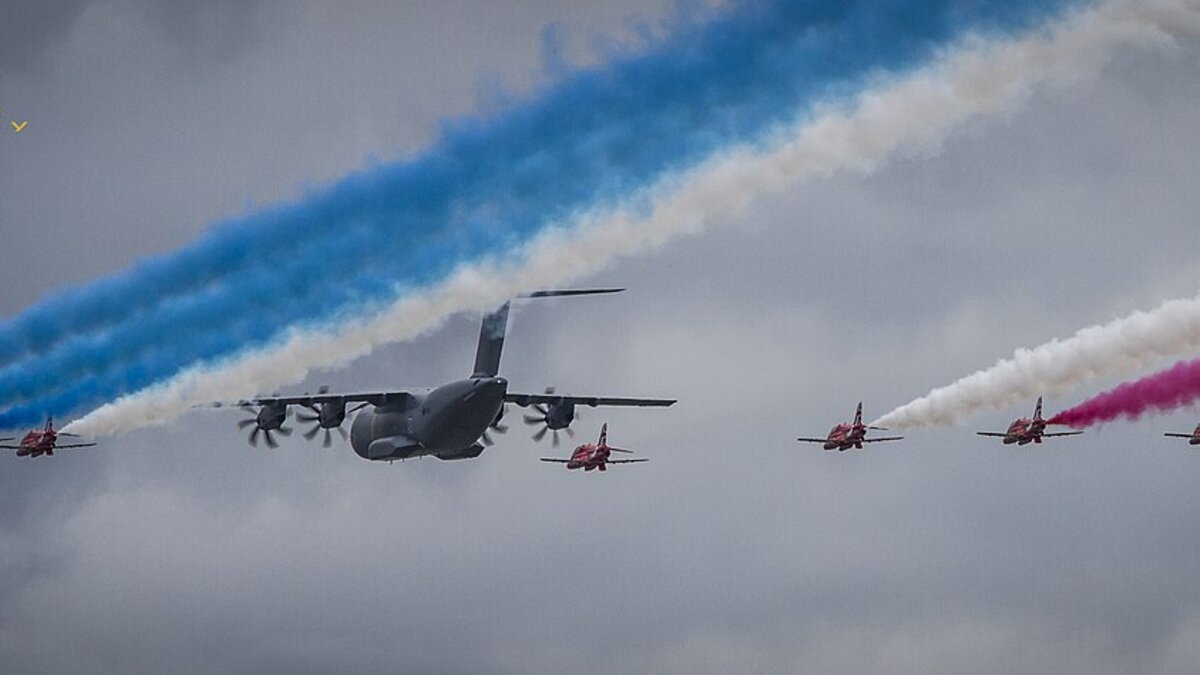
Cover image: The Royal Air Force Red Arrows aerobatic team flies in formation with an Airbus A400M transport aircraft during the flying display at the Farnborough International Airshow. — photo by Phil Fiddes from Woking, England, CC BY 2.0, via Wikimedia Commons.
The Farnborough International Airshow closed its 2026 edition with 327 firm orders for Airbus and Boeing aircraft across the show's three main trading days, by AvioRadar's tally — a restrained total propped up by a single customer. Dublin-based lessor SMBC Aviation Capital signed for 200 narrowbodies on the opening day, 20 July, split evenly between 100 Boeing 737 MAX jets and 100 Airbus A320neo-family aircraft, accounting for more than 60 per cent of that combined firm total.
On the scoreboard, Boeing edged Airbus with 186 firm orders against 157, according to a separate tally by Aerospace Global News — a lead that widens to 206 versus 166 once preliminary commitments and memoranda of understanding are included. AvioRadar put the show's overall commercial haul at roughly 377 aircraft across all manufacturers, while analysts at AirInsight counted 432 including options and MoUs — of which around 203 were previously agreed deals being formalised rather than new demand.
The result lands broadly where our Farnborough 2026 preview pointed: a lessor-led, supply-constrained show where the order headlines mattered less than the question hanging over every chalet — when will any of these aircraft actually be delivered?
Who won the Farnborough 2026 order race?
By the firm-order count, Boeing. Aerospace Global News' breakdown gives the American manufacturer a seven-aircraft lead in narrowbodies (134 to 127) and a 22-aircraft lead in widebodies (52 to 30). Beyond the SMBC deal, Boeing's week included 28 Boeing 787s for Saudi start-up Riyadh Air, 15 787-9s for lessor AerCap, and an eight-aircraft order from Uganda Airlines covering four 737 MAX 8s and four 787-9s.
Airbus' counter-punches were thinner: alongside SMBC's 100 A320neo-family jets, Saudi budget carrier flynas committed to 25 aircraft (20 A321neo and five A330neo), and Philippine Airlines signed a memorandum of understanding for nine A350-1000s — while also striking an initial agreement with Boeing for 15 787-10s plus five options.
| Manufacturer | Firm orders | Incl. commitments/MoUs | Headline deal |
|---|---|---|---|
| Boeing | 186 | 206 | SMBC: 100 737 MAX |
| Airbus | 157 | 166 | SMBC: 100 A320neo family |
| Embraer | 45 | 90 (with options and purchase rights) | Abra and Binter regional-jet orders |
Order tallies per Aerospace Global News and AirInsight; totals vary by counting method.
Embraer arguably had the strongest show relative to expectations. AirInsight credits the Brazilian manufacturer with 45 new firm orders plus 10 options and 30 purchase rights, driven by Latin American group Abra and Spain's Binter — genuinely new business at a show where much of the Airbus and Boeing volume was backlog clearance.
Why did one lessor dominate the show?
SMBC Aviation Capital's 200-jet double order was the largest transaction of the week by a wide margin — and its structure says as much about the market as its size. The Boeing tranche comprises 60 737-10s and 40 737-8s, the lessor's first purchase of the MAX family's largest variant and, per Boeing, the biggest lessor order yet for the 737-10. The Airbus side splits into 65 A321neo and 35 A320neo aircraft.
"This significant new order will give our airline customers access to a continuous delivery pipeline of the latest technology A320neo family aircraft into the mid-2030s," SMBC Aviation Capital chief executive Peter Barrett said in the Airbus announcement — a delivery-slot pitch, not a growth pitch. Boeing notes that lessors now hold more than 1,450 737 MAX orders, about 20 per cent of the programme backlog, while SMBC's owned, managed and committed MAX portfolio rises to 450 jets with this deal.
The lessor-heavy pattern reflects airline caution over capital. With fares under pressure and fuel costs still shaping ticket prices, carriers are increasingly happy to let lessors carry the balance-sheet risk of decade-out delivery positions — and for start-ups such as Riyadh Air, which began London Heathrow flights this year, lessor channels are often the fastest route to metal.
Are airshow order numbers what they seem?
Not entirely. Reuters' final tally, cited by AvioRadar, found that only 218 of the announced aircraft represented genuinely new additions to manufacturer backlogs once previously recorded deals were stripped out; AirInsight's own audit reached a similar figure of roughly 229. Several long-rumoured orders — from Singapore Airlines, Etihad Airways, Ethiopian Airlines and Qantas among others — never materialised.
Context matters too. The 327 combined Airbus-Boeing firm total slightly improved on Farnborough 2024, but sits far below the 1,109 aircraft the two manufacturers announced at the 2018 show, per AvioRadar. Airshows are no longer where the industry's demand story is written; the backlog already tells it.
Why are deliveries, not orders, the industry's real constraint?
The near-unanimous analyst verdict from Farnborough was that the order race is now a sideshow. As AvioRadar put it, industrial execution has become more important than demand itself: airlines no longer question the need for new aircraft, they question whether those aircraft will arrive on time. Aerospace Global News notes both manufacturers have production effectively sold out for years, with combined backlogs approaching 17,000 aircraft.
That means every jet signed for this week joins a queue stretching towards the mid-2030s. Engine availability, supplier bottlenecks and production-rate limits — the same forces behind the aviation supply-chain crisis that is keeping ageing fleets flying — will determine which airlines actually grow. For how each manufacturer is converting backlog into aircraft, see our tracker of the Airbus-Boeing 2026 delivery race.
For the travel trade, the practical read-through is straightforward: capacity growth on key routes will stay constrained, older aircraft will stay in service longer, and lessors — not manufacturers' order books — will increasingly decide who gets new narrowbodies first.
Frequently asked questions
How many orders were placed at the Farnborough Airshow 2026?
By AvioRadar's count, Airbus and Boeing booked a combined 327 firm orders; Aerospace Global News' methodology put Boeing at 186 firm orders and Airbus at 157. Wider tallies including commitments, options and Embraer ranged from roughly 377 to 432 aircraft.
What was the biggest deal at Farnborough 2026?
SMBC Aviation Capital's 200-aircraft split order, announced on 20 July: 100 Boeing 737 MAX jets (60 737-10s and 40 737-8s) and 100 Airbus A320neo-family aircraft (65 A321neo and 35 A320neo). The single deal represented more than 60 per cent of the combined Airbus-Boeing firm total.
Did Boeing or Airbus win Farnborough 2026?
Boeing led on firm orders, 186 to 157 per Aerospace Global News, with a seven-aircraft edge in narrowbodies and a 22-aircraft edge in widebodies. Analysts cautioned that a large share of both manufacturers' announcements formalised previously agreed deals rather than new demand, so the "win" is narrower than headlines suggest.
When will the aircraft ordered at Farnborough be delivered?
Mostly not for years. Both Airbus and Boeing have production sold out well into the next decade, with combined backlogs approaching 17,000 aircraft. SMBC itself framed its order as securing a delivery pipeline "into the mid-2030s".
Sources
- Aerospace Global News — Airbus vs Boeing: Who won Farnborough Airshow 2026?
- AvioRadar — Farnborough 2026 concludes with nearly 400 aircraft orders, but deliveries matter more than new sales
- Boeing — SMBC Aviation Capital Orders 100 Boeing 737 MAX Jets
- Airbus — SMBC Aviation Capital orders 100 Airbus A320neo Family aircraft
- AirInsight — Day 4 Farnborough: It's A Wrap Up