Hilton posted 3.9% systemwide RevPAR growth in Q2 2026 and raised full-year guidance to 3-3.5%, citing World Cup demand across the US, Canada and Mexico. Luxury and business travel stayed firm while the Middle East lagged.
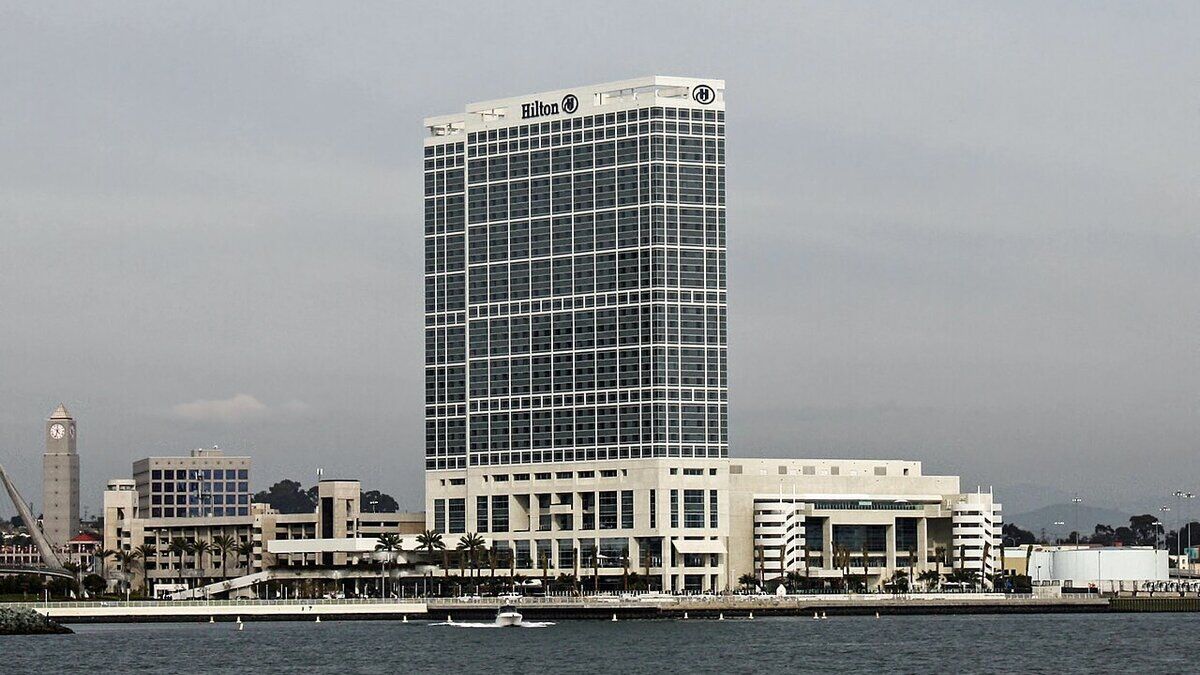
Cover image: A waterfront Hilton hotel tower; the group's systemwide RevPAR rose 3.9% year on year in the second quarter of 2026, prompting a raised full-year outlook. — photo by Bernard Gagnon, CC BY-SA 3.0, via Wikimedia Commons.
Hilton Worldwide Holdings reported systemwide comparable revenue per available room (RevPAR) growth of 3.9% year on year for the second quarter of 2026 on 28 July, driven by gains in both occupancy and average daily rate (ADR), and raised its full-year systemwide RevPAR guidance to 3% to 3.5%, up from the 2% to 3% range it gave a quarter earlier.
The quarter produced net income of $482 million, adjusted EBITDA of $1.054 billion (up from $1.008 billion a year earlier) and adjusted earnings per share of $2.29, on revenue of $3.34 billion, according to figures reported by Hotel Business and Benzinga. Management and franchise fee revenue rose 6.4% year on year.
A key driver of the raised outlook is FIFA World Cup demand across the United States, Canada and Mexico: management guided to roughly 4% systemwide RevPAR growth in the third quarter, citing expected World Cup benefits and favourable calendar shifts, per Hotel Business.
How did Hilton perform in Q2 2026?
Growth was led by corporate rather than leisure demand. On the earnings call, reported by Yahoo Finance, Hilton said business transient RevPAR rose 5.7% globally — an acceleration from the first quarter — while group RevPAR gained 3.7%, helped by company meetings and event-calendar shifts. Leisure transient grew a more modest 1.6%.
Development kept pace. Hilton opened 207 hotels with 24,100 rooms in the quarter, adding 21,600 net rooms, and its pipeline reached a record 3,853 hotels and 541,300 rooms across 132 countries. Net unit growth ran at 6.1% year on year. That expansion mirrors the wider supply story covered in our review of the global hotel construction pipeline in 2026.
Why did Hilton raise its full-year RevPAR guidance?
Hilton lifted the low end of its systemwide RevPAR range by a full percentage point and the top end by half a point, to 3–3.5%. Alongside it, full-year adjusted EPS guidance rose to $8.89–$9.01 (from $8.79–$8.91) and adjusted EBITDA to $4.04–$4.08 billion, per Proactive Investors. The company plans to return roughly $3.5 billion to shareholders this year.
The cadence is uneven, however. Third-quarter RevPAR is seen up about 4% on World Cup travel demand and calendar benefits, but management flagged that the fourth quarter faces headwinds from the US midterm elections and unfavourable calendar changes, per Benzinga. Q3 profit guidance — adjusted EPS of $2.28–$2.34 against a $2.42 consensus — disappointed the market, and Hilton shares fell 3.4% on the day despite the raised full-year outlook, Proactive Investors reported. Jefferies analysts nonetheless said the results reflect continued strength, with the shifting calendar effects in the guidance seen as roughly neutral for the shares.
Where was demand strongest — and weakest?
Regionally, the Americas carried the quarter while the Middle East lagged. Figures disclosed on the earnings call, as reported by Yahoo Finance, show US comparable RevPAR up 5.4% — well ahead of the systemwide 3.9% — with the Americas outside the US up 4.6% and Europe up 4.3%, led by the UK and Ireland.
| Region | Q2 2026 comparable RevPAR | Driver |
|---|---|---|
| United States | +5.4% | World Cup, business transient |
| Americas ex-US | +4.6% | World Cup (Canada, Mexico) |
| Europe | +4.3% | UK and Ireland strength |
| Asia Pacific ex-China | +6.3% | Inbound travel recovery |
| China | -2.2% | Soft domestic demand |
| Middle East & Africa | -30% (approx.) | Regional conflict disruption |
Luxury demand remained robust: more than 20% of the quarter's hotel openings were in luxury and lifestyle brands, and Hilton launched Undergraduate by Hilton, a new upper-midscale brand aimed at college markets that it believes could exceed 400 hotels over the long term. The clear weak spot was the Middle East and Africa, where RevPAR fell roughly 30% year on year amid regional conflict disruption — though chief financial officer Kevin Jacobs said the declines came in "better than Hilton's prior expectations". The conflict is expected to shave more than $20 million off full-year adjusted EBITDA.
What does the latest STR data say about US hotel rates?
Hilton's outperformance sits on top of a firming US industry backdrop. For the week ending 11 July 2026, CoStar's STR benchmark data — drawn from a global sample of 94,000 properties and 12 million rooms — put US hotel occupancy at 67.6% (up 0.7% year on year), ADR at $166.04 (up 4.5%) and RevPAR at $112.18 (up 5.2%), per Hospitality Net.
World Cup host cities drove the standouts. Miami posted a 37.6% ADR jump to $232.47 and RevPAR growth of 38.0% around the England–Norway quarterfinal on 11 July, while Boston's ADR rose 21.8% to $279.21 on the France–Morocco tie. Las Vegas RevPAR climbed 23.9% and Detroit led occupancy gains at +9.3% — the same event-driven pattern we tracked in the knockout-stage travel surge.
What does this signal for room rates?
The composition of the growth matters for buyers. With US occupancy up less than a point but ADR up 4.5% in the STR week, 2026's RevPAR gains are overwhelmingly rate-led — hotels are pricing into event compression and resilient corporate demand rather than filling materially more rooms. For travel managers and tour operators, that argues for booking well ahead of compression dates and negotiating around them; the mechanics are set out in our explainer on how hotel room pricing works.
Expect the pattern to persist through the third quarter while the World Cup runs, then ease: Hilton's own guidance implies a softer fourth quarter as election-related displacement and tougher comparisons bite. Luxury pricing power looks intact; Middle East rates remain the outlier until regional disruption clears.
Frequently asked questions
What were Hilton's Q2 2026 results?
Hilton reported systemwide comparable RevPAR growth of 3.9% year on year, net income of $482 million, adjusted EBITDA of $1.054 billion and adjusted EPS of $2.29 on revenue of $3.34 billion. It opened 207 hotels and grew its pipeline to a record 541,300 rooms.
What is Hilton's RevPAR guidance for 2026?
Hilton raised full-year systemwide RevPAR growth guidance to 3–3.5%, from 2–3% previously. It expects roughly 4% growth in the third quarter on World Cup demand, but flagged fourth-quarter headwinds from the US midterm elections and an unfavourable calendar.
How is the World Cup affecting hotel rates?
Sharply, in host markets. STR data for the week ending 11 July showed Miami ADR up 37.6% to $232.47 and Boston ADR up 21.8% to $279.21 around quarterfinal matches, against a US national ADR gain of 4.5% to $166.04.
Sources
- Hotel Business — Hilton reports 3.9% RevPAR growth in Q2
- Proactive Investors — Hilton sees World Cup boost but shares fall on soft guidance
- Yahoo Finance — Hilton Worldwide Q2 earnings call highlights
- Benzinga — Hilton raises 2026 outlook but soft Q3 guidance weighs on shares
- Hospitality Net — U.S. hotel results for week ending 11 July