The world's hotel construction pipeline stands at a record 15,900-plus projects, with the Middle East and Asia Pacific at all-time highs. Yet actual US supply will grow just 1.4% in 2026 — a gap that is keeping room rates firm.
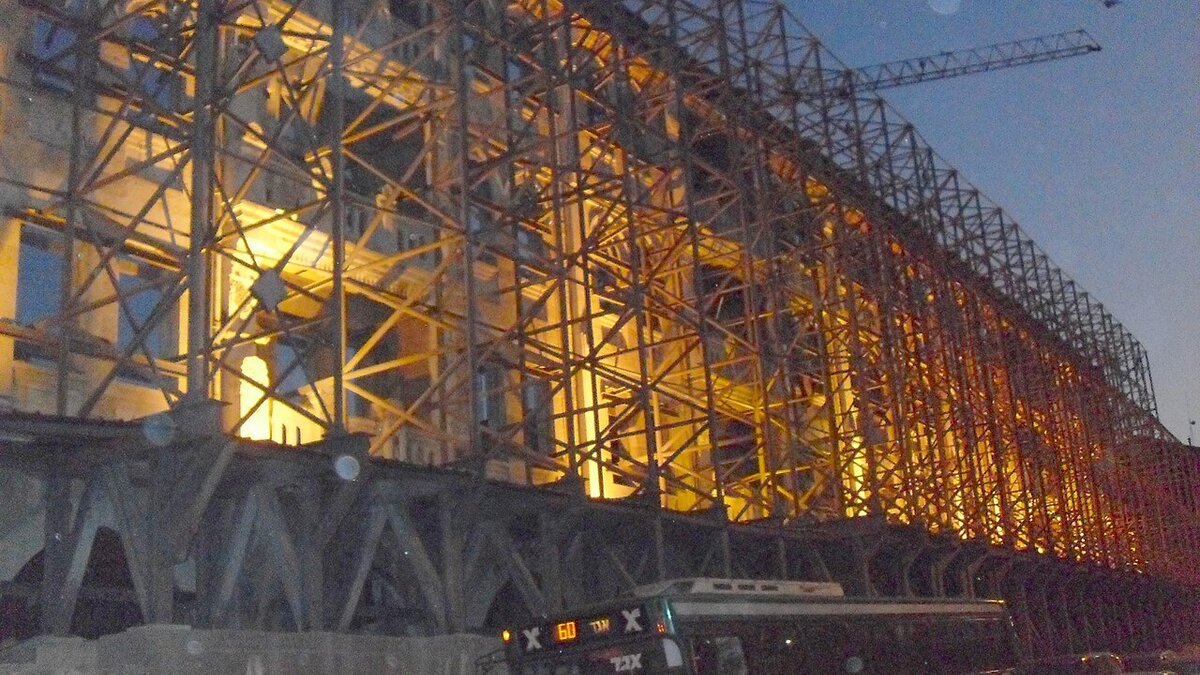
Cover image: construction cranes over a rising hotel development — photo by Utilisateur:Djampa - User:Djampa, CC BY-SA 4.0, via Wikimedia Commons.
The global hotel construction pipeline has never been bigger on paper — 15,922 projects representing roughly 2.4 million rooms at the end of 2025, a record high, according to development analyst Lodging Econometrics. The momentum has carried into 2026: at the close of the first quarter, the Middle East hit a record 717 projects and 177,110 rooms, Asia Pacific excluding China reached a record 2,387 projects, and the global conversion pipeline stood at an all-time high after 2,815 conversion projects were counted at year-end, up 13% year on year. The United States remains the largest single market with 6,020 projects and 705,825 rooms, though that total is down about 5% from a year earlier. The catch for travellers: very little of this pipeline is opening soon. Only 682 new US hotels (77,323 rooms) are forecast to open in 2026 — supply growth of just 1.4% — and CoStar puts census supply growth at 0.4%. Scarce new rooms plus growing demand means room rates are staying firm.
How big is the global hotel construction pipeline in 2026?
Lodging Econometrics' year-end 2025 census counted 15,922 projects worldwide — 6,140 under construction, 3,845 scheduled to start within 12 months and a record 5,937 in early planning. The United States accounts for 39% of the global pipeline and China a further 23%, with China alone holding 3,602 projects and 640,328 rooms at the Q1 2026 close.
The top end of the market is driving the growth. The global luxury pipeline reached a record 1,328 projects with 252,544 rooms at the end of 2025, up 8% by projects year on year, while upper upscale hit a record 1,883 projects. In the US, the luxury segment set another record in Q1 2026 at 102 projects and 25,527 rooms, up 16% by projects and 23% by rooms.
By city, Dallas leads the world with 184 pipeline projects at Q1 2026, ahead of Atlanta (158) and China's Chengdu (136 at year-end). Dallas's totals have eased as projects rushed to completion ahead of the FIFA World Cup — part of the broader World Cup 2026 travel surge now reshaping North American demand.
Which regions are building the most hotels?
The 2026 story is one of diverging regions: records in the Middle East and Asia Pacific, steady growth in Europe, and a mild pullback in the US, where Lodging Econometrics senior vice president Bruce Ford attributes the 5% decline to projects completing ahead of the World Cup and to the elevated debt costs of 2025 slowing new deals.
| Region (Q1 2026) | Projects | Rooms | Trend |
|---|---|---|---|
| United States | 6,020 | 705,825 | Down ~5% year on year |
| China | 3,602 | 640,328 | Broadly stable |
| Asia Pacific (excl. China) | 2,387 | 442,973 | Record; up 15% by projects |
| Europe | 1,731 | 255,354 | Up 3%; record early planning |
| Latin America | 755 | 113,663 | Up 6% by projects |
| Middle East | 717 | 177,110 | Record; up 13% by projects |
The Middle East's record run is powered chiefly by giga-project development in Saudi Arabia, where hotel building is a central plank of the kingdom's Vision 2030 tourism push. In Europe, the United Kingdom leads with 268 projects, followed by Turkey at a record 157.
Why are hotel conversions booming?
The fastest-growing slice of the pipeline is not new construction at all. The global conversion pipeline — existing hotels changing flag to join a brand system — hit a record 2,815 projects at the end of 2025, up 13% year on year, and US conversions stood at 1,461 projects and 141,971 rooms at Q1 2026, up 3% by projects.
The economics are straightforward: with construction costs and debt still elevated, converting an existing property is cheaper and faster than building, and the big brand groups have built products to capture it:
- Marriott International is expanding its conversion-friendly Series by Marriott and Outdoor Collection brands alongside its record luxury pipeline.
- Hilton is growing Outset, its lifestyle collection launched for conversions, with more than 60 hotels in development across the US, per Hotel Dive's 2026 development outlook.
- IHG and Hyatt are likewise prioritising conversions and luxury as their principal net-unit-growth engines.
For the brands, conversions deliver fee growth without waiting three years for a crane. For the market, they add almost no net new rooms — the same beds simply change signage, doing nothing to relieve rate pressure.
What does the record pipeline mean for hotel room rates?
A record pipeline sounds like relief for travellers, but the composition says otherwise. CoStar, which produces STR benchmarking data, notes that while the US pipeline holds a near-record 767,000 rooms, only 19% are actually in construction — the lowest share in 12 years. Its Q2 2026 forecast with Tourism Economics cut expected US supply growth to just 0.4% for 2026 while upgrading RevPAR growth to +2.8%, with luxury average daily rates running about 6% ahead in the year to April.
Scarce supply meets robust demand: international arrivals are heading for a record 1.58 billion in 2026, giving operators pricing power precisely where new rooms are not being added. Revenue managers set prices dynamically against that demand — a system unpacked in this guide to how hotel room pricing works — and when the supply valve barely opens, rates ratchet upward, sharpest at the luxury end.
The relief valve is further out. Lodging Econometrics projects 750 US openings in 2027, and the record 5,937 projects in global early planning point to a heavier delivery wave in 2027-2028, assuming financing costs ease. Until then, expect competition among brands for conversions, not a price war for guests.
Update: the pipeline at the end of Q2 2026
Lodging Econometrics' Q2 2026 report set a new record: 15,976 projects and 2,433,948 rooms in development worldwide. The growth is at the front of the funnel. A best-ever 6,059 projects (860,332 rooms) sit in early planning, up 5% by projects and 8% by rooms year on year, while the overall pipeline grew less than 1% by project count. During the quarter developers announced 974 new projects and broke ground on 602. The firm's first 2028 forecast calls for 2,499 new hotels with 361,430 rooms.
| Pipeline stage, Q2 2026 | Projects | Rooms |
|---|---|---|
| Under construction | 6,174 | 1,043,290 |
| Scheduled to start within 12 months | 3,743 | 530,326 |
| Early planning (record) | 6,059 | 860,332 |
| Total | 15,976 | 2,433,948 |
Frequently asked questions
Will hotel prices go down in 2026 because of all the new hotels?
Unlikely. Despite the record pipeline, actual US supply will grow only 0.4-1.4% in 2026, while CoStar forecasts revenue per available room to rise 2.8%. New openings are too few to outpace demand, so rates should keep climbing, especially in luxury.
Where are the most new hotels being built in 2026?
The United States has the largest pipeline (6,020 projects), led by Dallas, Atlanta and Phoenix, with China second at 3,602 projects. The fastest growth is in the Middle East and Asia Pacific excluding China, both at record highs, driven by Saudi Arabia, India and Southeast Asia.
What is a hotel conversion, and why does it matter to guests?
A conversion is an existing hotel switching to a new brand rather than being built from scratch — a record 2,815 such projects were in the global pipeline at end-2025. Guests may see refreshed rooms and new loyalty-programme access, but conversions add no new supply, so they do not push rates down.
When will new hotel supply actually catch up with demand?
Analysts point to 2027-2028. Lodging Econometrics forecasts 750 US openings in 2027 and a record number of projects in early planning globally, but those projects need cheaper financing before they become open doors and softer rates.
Sources
- Lodging Econometrics — Strong conversion and new development totals in the US hotel construction pipeline at Q1 2026 close
- Lodging Econometrics — Middle East hotel construction pipeline reaches a record 717 projects in Q1 2026
- Hotel Dive — US led the record global hotel construction pipeline in Q4 2025 as luxury drove growth
- Hospitality Net — Global hotel construction pipeline reaches record project count at Q2 2026 close
- Hotel Dive — US led record global hotel construction pipeline in Q2 2026