Atlanta handled 106.3 million passengers in 2025 to stay the world's busiest airport. ACI's top 20, the international leaders and how 2026 is reshaping the table.
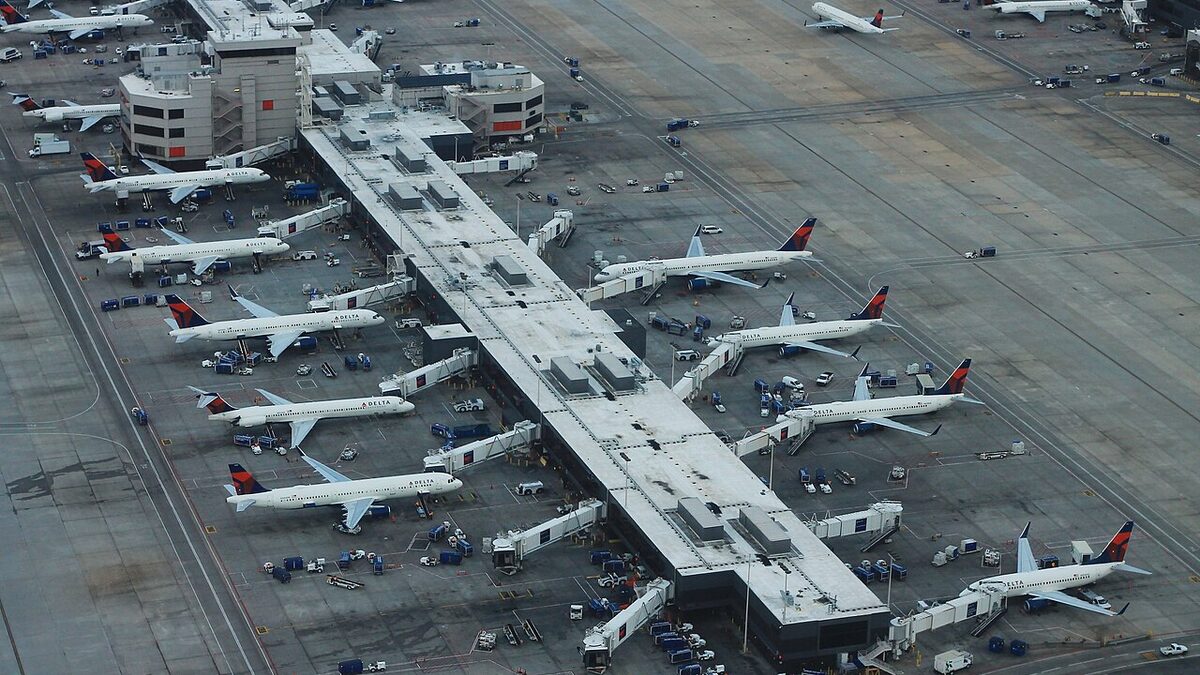
Cover image: Delta Air Lines aircraft at Concourse A of Hartsfield-Jackson Atlanta International Airport (file photo) — photo by formulanone, CC BY-SA 2.0, via Wikimedia Commons.
Hartsfield-Jackson Atlanta International is the world's busiest airport, with 106.3 million passengers in 2025, according to the final ranking Airports Council International (ACI) World published on 15 July 2026. Dubai International (95.2 million) and Tokyo Haneda (91.7 million) complete the top three. That is the newest full-year table: ACI publishes preliminary rankings each April and confirms them in July, so the first official ranking of 2026 traffic is due in April 2027.
Dubai led for international passengers in 2025. This year is reshuffling the order: Dubai's traffic fell 28.1 per cent in the first nine months of 2026 after regional conflict disrupted Gulf airspace, and Seoul's Incheon says it led the world for international passengers in the first half, citing provisional ACI data.
Last checked: 29 November 2026.
Which are the world's busiest airports in 2026?
Atlanta kept first place in 2025 despite a 1.6 per cent fall, and its lead over Dubai has narrowed to 11.1 million passengers (our calculation). Below the top three the field is tight: the seven airports from fourth to tenth, Dallas/Fort Worth down to Denver, sit within 3.2 million passengers of each other.
Asia-Pacific did most of the climbing. Shanghai Pudong rose from 10th to 5th, Kuala Lumpur jumped six places to 20th, and Guangzhou, 57th in 2022, is back at 9th, ACI said.
ACI says the top 20 handled 1.59 billion passengers, 16 per cent of the global total.
Basis: passengers enplaned and deplaned, transit passengers counted once. Source: ACI World final 2025 data, 15 July 2026.
| Rank 2025 | Rank 2024 | Airport (code) | Country | Passengers, 2025 (ACI final) | Change vs 2024 (%) |
|---|---|---|---|---|---|
| 1 | 1 | Atlanta Hartsfield-Jackson (ATL) | United States | 106,302,208 | -1.6 |
| 2 | 2 | Dubai International (DXB) | United Arab Emirates | 95,192,160 | +3.1 |
| 3 | 4 | Tokyo Haneda (HND) | Japan | 91,679,814 | +6.7 |
| 4 | 3 | Dallas/Fort Worth (DFW) | United States | 85,660,127 | -2.5 |
| 5 | 10 | Shanghai Pudong (PVG) | China | 84,994,548 | +10.7 |
| 6 | 8 | Chicago O'Hare (ORD) | United States | 84,856,018 | +6.0 |
| 7 | 5 | London Heathrow (LHR) | United Kingdom | 84,482,126 | +0.7 |
| 8 | 7 | Istanbul (IST) | Türkiye | 84,437,710 | +5.5 |
| 9 | 12 | Guangzhou Baiyun (CAN) | China | 83,582,952 | +9.5 |
| 10 | 6 | Denver (DEN) | United States | 82,427,962 | +0.1 |
| 11 | 9 | Delhi Indira Gandhi (DEL) | India | 78,148,081 | +0.4 |
| 12 | 13 | Seoul Incheon (ICN) | South Korea | 74,126,912 | +4.1 |
| 13 | 11 | Los Angeles (LAX) | United States | 73,709,594 | -3.8 |
| 14 | 14 | Paris Charles de Gaulle (CDG) | France | 72,029,407 | +2.5 |
| 15 | 16 | Beijing Capital (PEK) | China | 70,742,712 | +5.0 |
| 16 | 15 | Singapore Changi (SIN) | Singapore | 69,982,000 | +3.5 |
| 17 | 17 | Amsterdam Schiphol (AMS) | Netherlands | 68,771,592 | +2.9 |
| 18 | 18 | Madrid Barajas (MAD) | Spain | 68,118,754 | +3.0 |
| 19 | 22 | Shenzhen Bao'an (SZX) | China | 66,485,213 | +8.2 |
| 20 | 26 | Kuala Lumpur International (KUL) | Malaysia | 63,409,501 | +11.0 |
Which airports lead for international passengers, cargo and flights?
Count only international passengers and Atlanta, mostly a domestic airport, drops out of ACI's top 20. Dubai, whose traffic is all international, ranks first. ACI's final 2025 international top ten:
- Dubai (DXB): 95.2 million, up 3.1%
- London Heathrow (LHR): 79.9 million, up 0.9%
- Seoul Incheon (ICN): 73.6 million, up 4.1%
- Singapore Changi (SIN): 69.4 million, up 3.5%
- Amsterdam Schiphol (AMS): 68.8 million, up 2.9%
- Istanbul (IST): 66.6 million, up 5.8%
- Paris Charles de Gaulle (CDG): 66.1 million, up 2.6%
- Hong Kong (HKG): 60.8 million, up 14.9%
- Frankfurt (FRA): 57.5 million, up 2.4%
- Doha (DOH): 54.3 million, up 3.1%
Hong Kong is the busiest cargo airport, with 5.07 million tonnes of freight and mail in 2025. Chicago O'Hare logged 857,392 take-offs and landings, taking first place for aircraft movements from Atlanta, which had led since 2020.
How has 2026 changed the busiest airport ranking?
Growth has slowed sharply. ACI estimates global passenger traffic at about 4.7 billion in the first half of 2026, up just 0.6 per cent. The Middle East fell 21 per cent "as the region bore the impact of the escalating crisis and airspace disruption", while North America was largely flat.
Dubai has been hit hard. DXB handled 50.4 million passengers from January to September, down 28.1 per cent, with third-quarter traffic down 22.1 per cent at 18.8 million, Dubai Airports said on 17 November. Chief executive Paul Griffiths expects "more than 70 million" for 2026.
That puts Dubai's international crown in doubt. To match Heathrow's 2025 international total of 79.9 million, DXB would need about 29.5 million passengers in the fourth quarter, roughly 57 per cent more than in the third (our calculation).
Incheon says it has already moved ahead on a half-year basis. Its operator, Incheon International Airport Corp., said on 13 August that the airport handled 38.39 million international passengers in January to June, the most among 1,234 airports in ACI's provisional data, ahead of Heathrow (37.79 million) and Changi (34.53 million). It credited demand diverted from Middle East hubs; the number of passengers changing planes there rose 18.1 per cent. For agents and tour operators, the lesson is that connecting traffic moves to rival hubs fast.
In OAG's ranking for December 2026, which counts scheduled seats rather than passengers, Atlanta leads with 5.19 million seats. Dubai is second with 4.75 million, 14 per cent fewer than a year earlier, but still first for international seats.
How are airport passenger rankings counted?
ACI counts every passenger who boards or leaves an aircraft ("enplaned and deplaned"), but a passenger in transit, who arrives and leaves on the same flight, counts once. A traveller who changes planes leaves one flight and boards another, so is counted on both sides. ACI says transfer hubs often handle far more passengers than airports serving mainly local markets.
Figures move between editions. Hong Kong's 2025 international count went from 60,824,359 in ACI's April list to 60,810,724 in the final data.
Seat rankings measure something else. OAG counts the seats airlines schedule, filled or not; ACI says such rankings "measure airline capacity rather than actual airport traffic". Seat and passenger figures should not be compared directly.
Why do hubs and Asia-Pacific airports keep climbing?
Hubs draw two flows: local travellers and connecting ones. In September 2026, 51 per cent of Dubai's passengers were connecting, Dubai Airports said. Our explainer on how airline hubs work covers connection banks and what hubs do to fares.
The US entries rest on domestic scale. Four of the five US airports in the top 20 are 80 to 95 per cent domestic; Los Angeles, at 68 per cent, is the exception, ACI said.
Regional growth explains the rest. In 2025 traffic rose 9.0 per cent in Africa, 6.5 per cent in the Middle East and 5.1 per cent in Asia-Pacific, while North America slipped 0.7 per cent, ACI's annual report found.
Which busy airports are running out of room?
Most of them. In a slot-policy white paper on 15 September 2026, ACI said 85.5 per cent of airports serving more than 40 million passengers a year are at or near full capacity. Our guide to airport slots explains how scarce take-off and landing times are shared out.
Several cities are building new or second airports:
- Dubai: an AED128 billion terminal at Al Maktoum International (DWC), approved on 28 April 2024, is to take ultimate capacity past 260 million passengers a year, with all DXB operations moving there in the coming years, the Dubai Media Office said.
- Mumbai: Navi Mumbai International opened on 25 December 2025 with capacity for 20 million passengers a year, 90 million when complete, Adani said. Mumbai's main airport is now pushing some Gulf airlines to Navi Mumbai from summer 2027.
- Delhi region: Noida International at Jewar began commercial flights on 15 June 2026 with first-phase capacity of 12 million passengers a year, India's aviation minister said, according to All India Radio.
- Sydney: Western Sydney International opened on 25 October 2026 with capacity for up to 10 million passengers a year, SBS reported.
- Riyadh: the King Salman International masterplan of November 2022 targets 120 million passengers by 2030, Gulf News reported. The existing airport has had a disrupted year (see our report on its reopening).
Frequently asked questions
Which is the busiest airport in the world in 2026?
Hartsfield-Jackson Atlanta, on the latest official full-year data. ACI World's final 2025 ranking gives it 106.3 million passengers, ahead of Dubai (95.2 million) and Tokyo Haneda (91.7 million). Atlanta also leads OAG's December 2026 ranking of scheduled seats. ACI publishes preliminary rankings each April, so its first official ranking of 2026 traffic is due in April 2027.
Which is the world's busiest international airport?
Dubai International, with 95.2 million international passengers in 2025, ahead of London Heathrow (79.9 million) and Seoul Incheon (73.6 million), according to ACI World. In 2026 Incheon said it led for international passengers in the first half, citing provisional ACI data, while Dubai's traffic fell 28.1 per cent from January to September.
What is the largest airport in the world?
It depends on the measure. By passengers, Atlanta. By planned capacity, Dubai's Al Maktoum International, designed for more than 260 million passengers a year on 70 square kilometres with five parallel runways, according to the Dubai Media Office. Its first phase, for 150 million passengers, is expected within 10 years of the April 2024 approval.
Why is Atlanta busier than Dubai when Dubai has more international passengers?
Atlanta's traffic is mostly domestic. ACI says four of the five US airports in its top 20, Atlanta among them, are predominantly domestic hubs, with 80 to 95 per cent domestic traffic. All of Dubai's 95.2 million passengers in 2025 were international: its total and international counts are identical in ACI's data.
Sources
- ACI World, final 2025 busiest airports rankings (15 July 2026)
- ACI World, busiest airports rankings and methodology
- ACI World, 2026 World Airport Traffic Report release (23 September 2026)
- ACI World, airport slot policy white paper (15 September 2026)
- Dubai Media Office, DXB nine-month 2026 traffic (17 November 2026)
- Dubai Media Office, Al Maktoum International terminal (28 April 2024)
- OAG, busiest airports by seats, December 2026
- Korea.net, Incheon tops world in international traffic, first half 2026