Ecuador is cutting VAT from 15% to 8% on tourism services around national holidays and stripping taxes out of commercial aviation, betting cheaper trips and airfares will revive visitor demand.
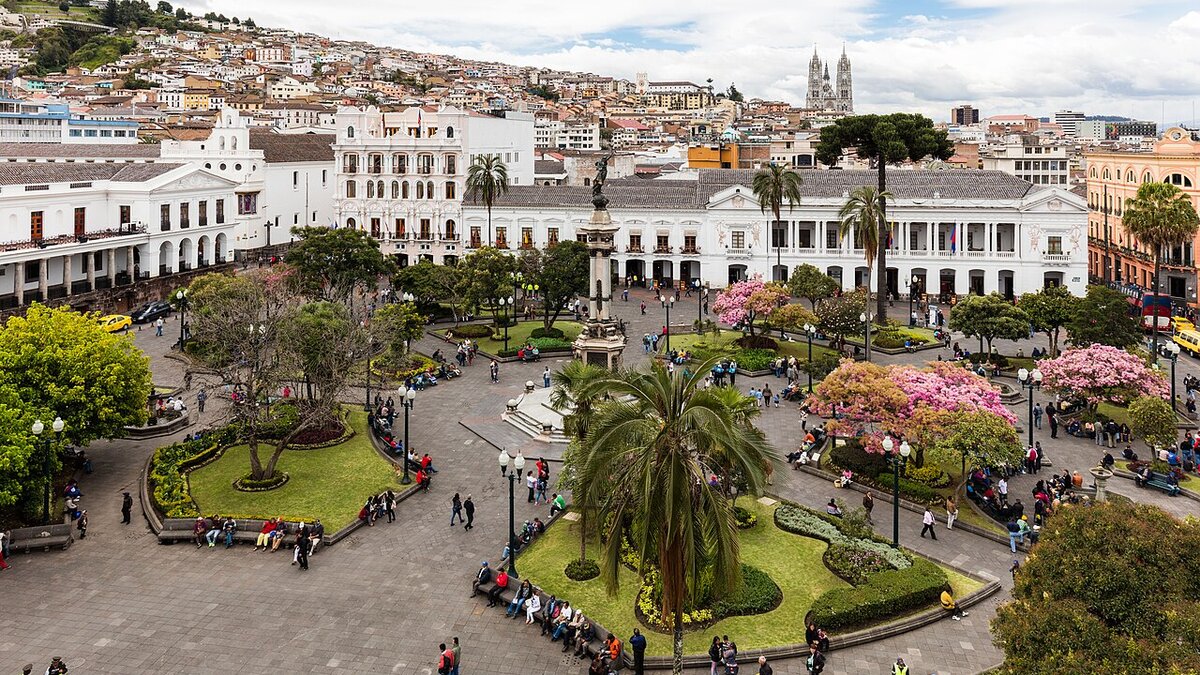
Cover image: Aerial view of Plaza Grande in Quito's historic old town, Ecuador — photo by Diego Delso, CC BY-SA 4.0, via Wikimedia Commons.
Ecuador's tourism VAT cut has become the centrepiece of a two-track tax strategy to revive the country's visitor economy. Around national holidays, the standard 15% value-added tax drops to 8% for registered tourism services — lodging, restaurants, tourist transport and guided excursions — under a mechanism President Daniel Noboa has now activated five times in 2026 by executive decree. In parallel, the government's 2026 tourism finance framework strips structural taxes and surcharges out of commercial aviation, an attempt to bring down Ecuador's stubbornly high international airfares and attract airline capacity to Quito, Guayaquil and the Galápagos.
The logic is straightforward: Ecuador competes with Colombia and Peru for the same long-haul traveller, and officials believe price — on the ground and in the air — is where the country has been losing. The reforms aim to lower travel costs, improve connectivity and strengthen demand at a moment when global tourism is setting arrival records that Ecuador has largely watched from the sidelines.
How does Ecuador's 8% tourism VAT work?
The reduced rate is temporary and targeted. Ecuador's enabling framework lets the executive lower VAT from 15% to 8% for tourism activities during national holiday periods, for up to 12 days per calendar year, with each window set by presidential decree. The discount applies only to services classified as tourism activities under Article 5 of Ecuador's Tourism Law — accommodation, food and beverage, tour operation and travel agencies, tourist transport and guiding — not to general retail or utilities.
Enforcement sits with the Servicio de Rentas Internas (SRI), Ecuador's tax authority, and registered establishments must update billing systems to invoice at 8% during each window. The most recent decree, Executive Decree 391 signed on 22 May 2026, explicitly covered hotels, hostels, restaurants, excursions, package tours, guiding, tourist vehicle hire and organised transfers.
When does the reduced VAT apply in 2026?
President Daniel Noboa has issued five decrees applying the 8% rate so far this year:
- New Year — 1–4 January (Decree 271)
- Carnival — 14–17 February (Decree 304)
- Easter — 3–5 April (Decree 348)
- Labour Day weekend — 30 April–3 May (Decree 368)
- Battle of Pichincha — 23–25 May (Decree 391)
The pattern is now predictable enough for the trade to plan against: each long weekend on Ecuador's holiday calendar has, to date, been paired with a decree signed days before it begins. Local reporting suggests the government intends to keep applying the discount to remaining 2026 holidays, so operators packaging Ecuador should watch the official gazette ahead of each feriado.
Will flights to Ecuador get cheaper?
The second strand tackles what airlines have long cited as a barrier: Ecuador ranks among South America's most expensive markets to fly into, thanks to layered ticket taxes, airport fees and fuel costs. The 2026 tourism finance framework removes structural taxes on commercial aviation, and — according to a detailed report by NomadLawyer on the tourism finance bill — permanently eliminates the 5% surcharge on commercial aviation fuel and grants international carriers a 0% foreign remittance tax (ISD) rate on cross-border transfers, lowering operating costs at Quito's Mariscal Sucre and Guayaquil's José Joaquín de Olmedo airports, with benefits extending to Galápagos routes.
Fuel and fuel-related levies are among the largest inputs airlines price into fares, so removing a structural surcharge should feed through — though, as our analysis of how fuel costs and taxes shape airfares shows, the pass-through is rarely immediate or complete. The more reliable effect may be on capacity decisions: a cheaper operating environment strengthens Quito and Guayaquil's case when carriers allocate aircraft across Latin American networks.
What it means for travellers and the trade
For travellers, the VAT windows are a genuine discount: a 7-percentage-point cut on hotels, meals and tours applies at the point of sale to anyone consuming the service in Ecuador, foreign visitors included — no refund paperwork required. For domestic tourism, which the decrees primarily target, it has become a recurring holiday stimulus.
For the trade, the aviation reform is the bigger story. Tour operators and DMCs selling Ecuador have long had to price around expensive air access; any structural reduction changes packaging economics for Galápagos itineraries in particular. The reform also reportedly creates a tourism development fund to finance international marketing — a signal Ecuador wants to compete more aggressively as destination marketing budgets escalate worldwide.
The caveats are real. The VAT relief is measured in days per year, not a permanent repositioning, and the aviation measures will take at least a season or two to show up in fares and schedules. But as destination tax experiments go, Ecuador's is unusually coherent: cut the cost of being there, and cut the cost of getting there.
Frequently asked questions
Do foreign tourists get the 8% VAT rate in Ecuador?
Yes. The reduced rate applies to the service itself during the decreed window, so anyone — Ecuadorian or foreign — paying for qualifying tourism services in that period is invoiced at 8% instead of 15%. There is no nationality test and no refund claim to file.
Which services qualify for the reduced VAT?
Services classified as tourism activities under Article 5 of Ecuador's Tourism Law: accommodation, restaurants and food service, tour operators and travel agencies, tourist transport and vehicle hire, guided excursions and package tours. Ordinary retail, groceries and utilities stay at 15%.
Is the VAT cut permanent?
No. It is a temporary reduction limited to specific national-holiday windows, each activated by executive decree, within an annual cap set by the enabling framework. Outside those windows the standard 15% rate applies.
When is the next reduced-VAT holiday in 2026?
Five windows have been decreed so far, the latest for the Battle of Pichincha holiday on 23–25 May. Ecuadorian media report the government intends to keep pairing decrees with upcoming feriados, so check for a new decree shortly before each national holiday.
Sources
- El Universo — Feriado por la Batalla del Pichincha: IVA bajará del 15% al 8%
- Primicias — IVA baja al 8% para turismo durante el feriado del 24 de mayo
- Tobar ZVS — VAT reduction to 8% for tourism during the Labor Day holiday (Executive Decree 368)
- VATupdate — Ecuador cuts VAT to 8% for tourism services during Carnival
- NomadLawyer — Ecuador enacts tourism finance reform dropping VAT to 8% and removing aviation surcharges