UN Tourism reports international arrivals rose just 0.4% to 690 million trips in H1 2026, and has cut its full-year forecast to 1-2% as conflict and fares bite.
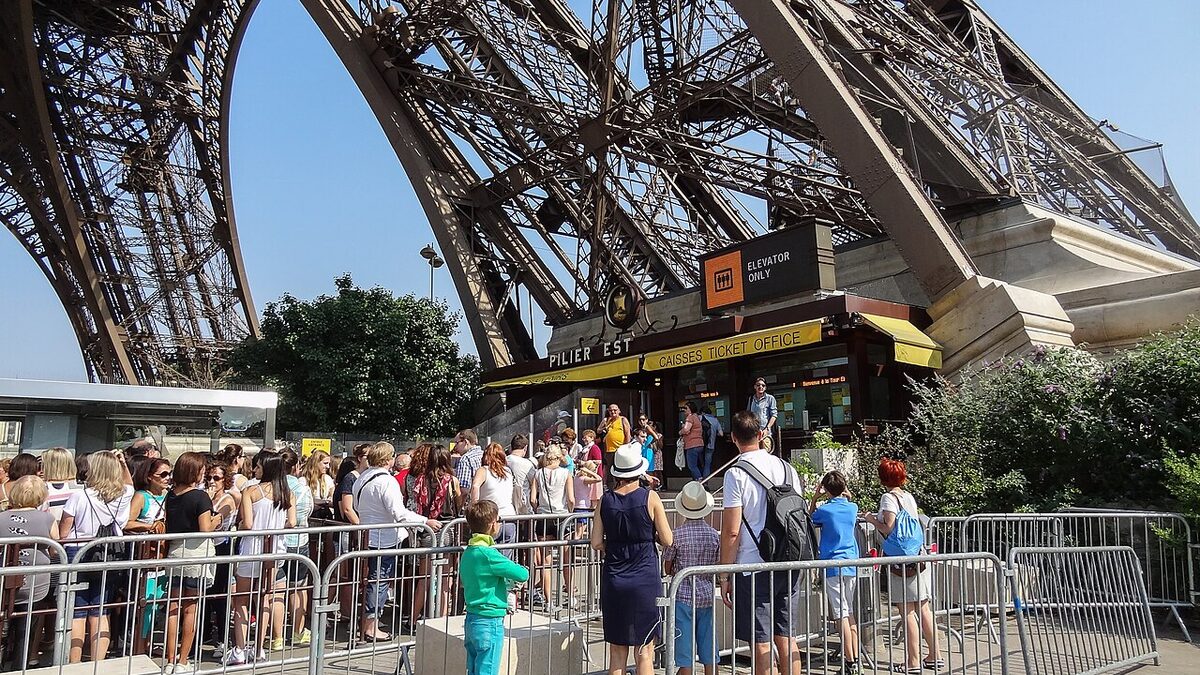
Cover image: Tourists queue at the Eiffel Tower east pillar ticket office in Paris — photo by Eutouring, CC BY-SA 4.0, via Wikimedia Commons.
International tourism barely grew in the first half of 2026. UN Tourism reports that arrivals rose just 0.4% year on year to about 690 million trips between January and June, roughly 3 million more than the same period last year. The agency has cut its full-year forecast from 3-4% growth to 1-2%, citing the Middle East conflict, high air fares and a weak second quarter in which arrivals fell 1%.
The headline matters for anyone selling travel: after two years of post-pandemic recovery arithmetic, demand has stopped compounding. Q1 still managed 2% growth, but April arrivals dropped 3% and June fell 3% worldwide. For operators, the message is that 2026 is a year for defending yield and share, not riding a wave. Our Q1 readout already showed momentum fading; the half-year data confirms it.
Which regions grew, and which shrank?
Growth was uneven to the point of splitting the map. Africa led at +4%, followed by Europe (+3%) and the Americas (+2%). Asia and the Pacific managed +1% over the six months but remain about 11% below 2019 levels. The Middle East fell 22%, a direct consequence of conflict, closed airspace and rerouted flight schedules (see our piece on Middle East schedule changes).
Within Asia the picture fractured further: North-East Asia grew 3%, South-East Asia slipped 1% and South Asia dropped 5%. June was brutal in mature markets, with Western Europe down 6%, South-East Asia down 5% and Oceania down 6% in that month alone.
| Region | H1 2026 vs H1 2025 | What moved it |
|---|---|---|
| Africa | +4% | Strongest first-half growth worldwide |
| Europe | +3% | June heatwave dented Western Europe (-6% in June) |
| Americas | +2% | Steady but unspectacular |
| Asia and the Pacific | +1% | Still ~11% below 2019; soft intra-Asian demand |
| Middle East | -22% | Conflict, airspace closures, lost connectivity |
Why did growth stall?
UN Tourism points to a pile-up rather than a single cause. The Middle East conflict disrupted traffic far beyond the region, forcing detours that raised fuel burn and fares. High petroleum costs and broad inflation kept trip prices elevated, while higher air fares priced out marginal travellers (US agency data shows average ticket prices up 17% year on year).
Calendar effects played a part too: Easter fell in March, shifting holiday travel out of the Q2 comparison. A Western Europe heatwave suppressed June demand, and Typhoon Sinlaku hit Oceania in the second quarter. Underneath it all, the agency flags softer demand inside Asian markets and geopolitical tensions weighing on booking confidence.
What does the 1-2% forecast mean for the trade?
A full year at 1-2% growth would make 2026 the weakest year for international tourism since the pandemic rebound began, and the record $12 trillion valuation WTTC projects for the wider travel economy will have to come from spending per trip rather than headcount. That favours premium product, longer stays and ancillary revenue over volume plays.
There are bright spots worth chasing. North-East Asia's 3% growth backs the record inbound run Japan is enjoying, and Africa's 4% suggests under-toured regions are taking share. Cruise operators are already adjusting itineraries around the Red Sea disruption, as Explora Journeys' 2027 redeployment shows. In a 1% world, share shifts like these are the whole game.
UN Tourism Secretary-General Shaikha Al Nuwais called the data proof of a sector "absorbing real pressure and finding a way forward", adding: "Tourism has not stopped growing, but that growth is fragile." Her warning that the "Middle East situation has touched destinations far beyond the region itself" is the line operators should pin to the planning wall, alongside her prescription that "resilience needs to be built everywhere and not just when a crisis begins".
Frequently asked questions
How much did international tourism grow in the first half of 2026?
Just 0.4% year on year, to about 690 million international trips, according to UN Tourism's World Tourism Barometer. Q1 grew 2% but Q2 fell 1%, with April and June each down 3%.
What is UN Tourism's forecast for 2026?
The agency cut its full-year outlook from 3-4% growth (projected in January) to 1-2%, citing the Middle East conflict, high travel costs and weak second-quarter demand.
Which region performed worst in H1 2026?
The Middle East, down 22%, as conflict closed airspace and severed connectivity. South Asia (-5%) and South-East Asia (-1%) also shrank, while Africa (+4%) led growth.
Why did tourism growth slow in 2026?
A combination of the Middle East conflict and rerouted flights, high fuel costs and air fares, inflation, a March Easter distorting comparisons, the Western Europe heatwave and softer Asian demand.