Public comments close 21 August on a DOT proposal to relax the Full Fare Rule, letting airlines give base fares equal billing with the all-in price — and possibly scrap the rule entirely.
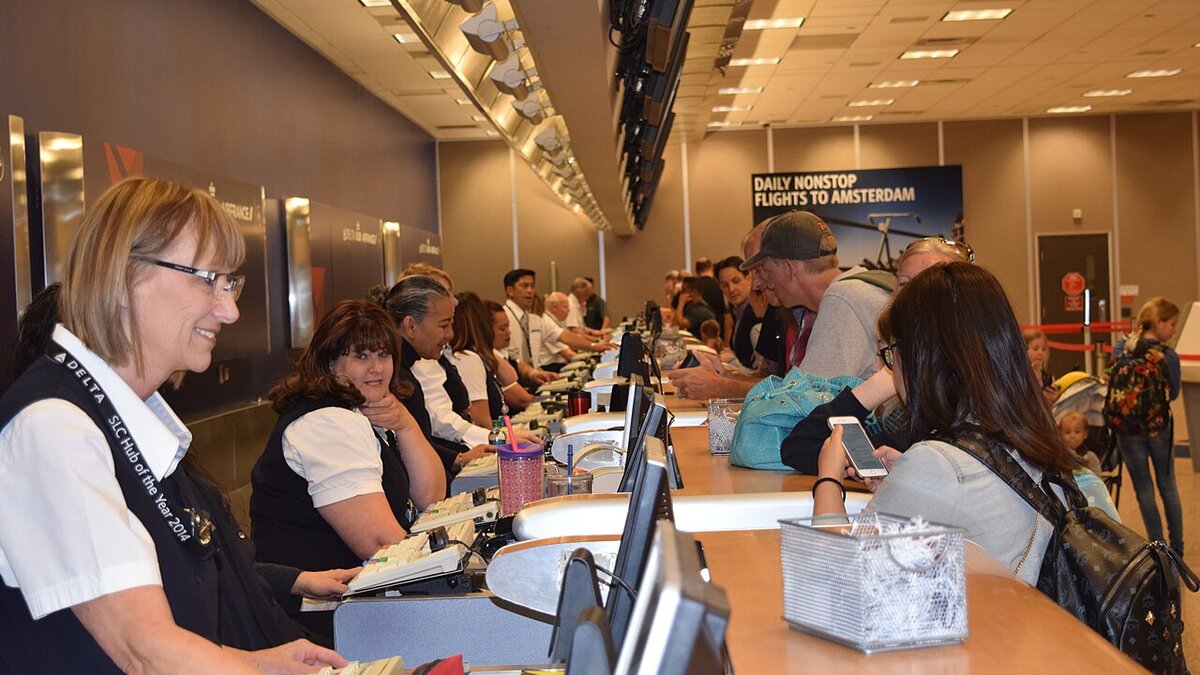
Cover image: Delta Air Lines ticket counters at Salt Lake City International Airport — photo by Delta News Hub, CC BY 2.0, via Wikimedia Commons.
The public comment window on the US Department of Transportation's proposal to loosen the DOT Full Fare Rule closes today, 21 August 2026. The notice of proposed rulemaking, titled "Enhancing Flexibility of Air Fare Price Advertising" and issued on 1 July 2026 under docket DOT-OST-2025-0831, would end the requirement that the all-in ticket price — base fare plus taxes and fees — be the most prominent figure in airline advertising. Instead, carriers and ticket agents could display fare components with equal or greater prominence than the total. The department would also rescind nine fare-advertising guidance documents it describes as outdated, and it has floated a more sweeping alternative: repealing the Full Fare Rule altogether. The comment deadline was originally 31 July but was extended by three weeks after requests from Airlines for America, which filed on 20 July, and Southwest Airlines, which followed on 22 July.
What is the DOT Full Fare Rule?
Adopted in 2011 and in force since 2012, the Full Fare Rule (codified at 14 CFR 399.84) requires that any advertised airfare in the United States be the full price the customer will actually pay, with government taxes and mandatory carrier fees included, and that this total be displayed more prominently than any breakdown of its components.
The rule was a response to the pre-2012 practice of advertising eye-catching base fares — sometimes a fraction of the final price — with taxes and fees surfacing only later in the booking flow, a pattern consumer advocates call drip pricing. Spirit Airlines and other carriers challenged the rule as a restriction on commercial speech, but the US Court of Appeals for the DC Circuit upheld it in 2012, and the Supreme Court declined to hear the case.
What is the DOT proposing to change?
The NPRM does not remove the obligation to disclose the total price. What it changes is prominence: airlines would gain what the department calls "greater flexibility" to present the base fare and itemised taxes and fees as prominently as — or more prominently than — the all-in figure.
| Element | Current Full Fare Rule | Proposed change |
|---|---|---|
| Advertised price | Total price (fare + taxes + fees) must be most prominent | Components may be shown with equal or greater prominence than the total |
| Guidance documents | Nine DOT fare-advertising guidance documents in effect | All nine rescinded as outdated |
| Alternative on the table | — | Repealing the Full Fare Rule "in whole" |
The alternative is the part drawing the sharpest attention. As AirlineGeeks reported, the department states it "is considering repealing the Full Fare Rule in whole" — which would allow airlines and ticket agents to advertise the base fare upfront and disclose taxes and fees separately.
Will airlines be able to advertise prices without taxes again?
Under the primary proposal, no — the total must still be disclosed; it just loses its guaranteed top billing. Under the repeal alternative, the answer is effectively yes: base-fare-first advertising, the norm before 2012, would again be lawful.
Consumer-side commenters on the docket have objected to weakening price transparency, warning that shoppers could once more see a headline fare that balloons with fees by checkout. The concern dovetails with how fares are already set: pricing systems adjust continuously, as we explain in our guide to airline dynamic pricing and AI, and unbundled fees are central to how low-cost airlines make money. Comparing offers across carriers gets harder when the most visible number is not the number you pay.
Notably, the industry is not uniformly in favour of going all the way. Southwest Airlines, while seeking more time to comment, signalled preliminary opposition to full repeal, arguing that after fourteen years travellers have come to expect the tax-inclusive price upfront and that reversing course would be "extremely disruptive". Airlines have long argued the prominence mandate restricts how they communicate prices — the commercial-speech objection Spirit pressed in court in 2012 — and that itemising government taxes shows customers what portion of the fare is not the airline's.
What happens after the comment period closes?
Once the docket closes on 21 August, DOT must review the submissions before deciding its next step. Broadly, the department can:
- Finalise the rule as proposed, relaxing the prominence requirement and rescinding the nine guidance documents;
- Adopt the alternative and repeal the Full Fare Rule entirely;
- Modify the proposal in response to comments, or withdraw it and leave the 2011 rule intact.
Any final rule would be published in the Federal Register with an effective date, and a repeal or significant weakening would likely draw legal challenges from consumer groups. Nothing changes for travellers today: advertised US fares must still show the all-in price most prominently until a final rule takes effect.
The rulemaking sits alongside other consumer-protection files travellers should watch, from denied-boarding rights to flight-delay compensation rules, where US protections already trail those in Europe.
Frequently asked questions
What does the DOT Full Fare Rule require today?
Since 2012, any advertised airfare in the US must be the full price the customer pays, including government taxes and mandatory fees, and that total must be displayed more prominently than any component breakdown. The rule applies to airlines and ticket agents alike and was upheld by a federal appeals court against a First Amendment challenge from Spirit Airlines.
What is DOT proposing to change about airfare advertising?
The proposal would let airlines display fare components — base fare, taxes and fees — with the same or greater prominence than the all-in total, and would rescind nine fare-advertising guidance documents DOT calls outdated. As an alternative, the department says it is considering repealing the Full Fare Rule in whole, which would permit base-fare-only advertising upfront.
When do comments close and how were they extended?
Comments on docket DOT-OST-2025-0831 close on 21 August 2026, filed via regulations.gov. The original deadline was 31 July, but DOT granted a 21-day extension after requests from Airlines for America on 20 July and Southwest Airlines on 22 July 2026, both citing the need for more time to assess the proposal.
Why do consumer groups oppose the change?
Commenters warn it could revive drip pricing — advertising a low headline fare that grows with taxes and fees by checkout. That practice was common before 2012 and makes comparing fares across airlines harder. Even Southwest has signalled preliminary opposition to full repeal, saying travellers now expect the tax-inclusive price first and reversal would be extremely disruptive.
Sources
- Federal Register — Enhancing Flexibility of Air Fare Price Advertising
- US Department of Transportation — Extension of Comment Period: Enhancing Flexibility of Air Fare Price Advertising
- AirlineGeeks — DOT Proposal Could Change How Air Fares Are Advertised
- GWU Regulatory Studies Center — Comment on Enhancing Flexibility of Air Fare Price Advertising
- US Transport News — The government wants to let airlines bury the total fare again, and even Southwest is uneasy