

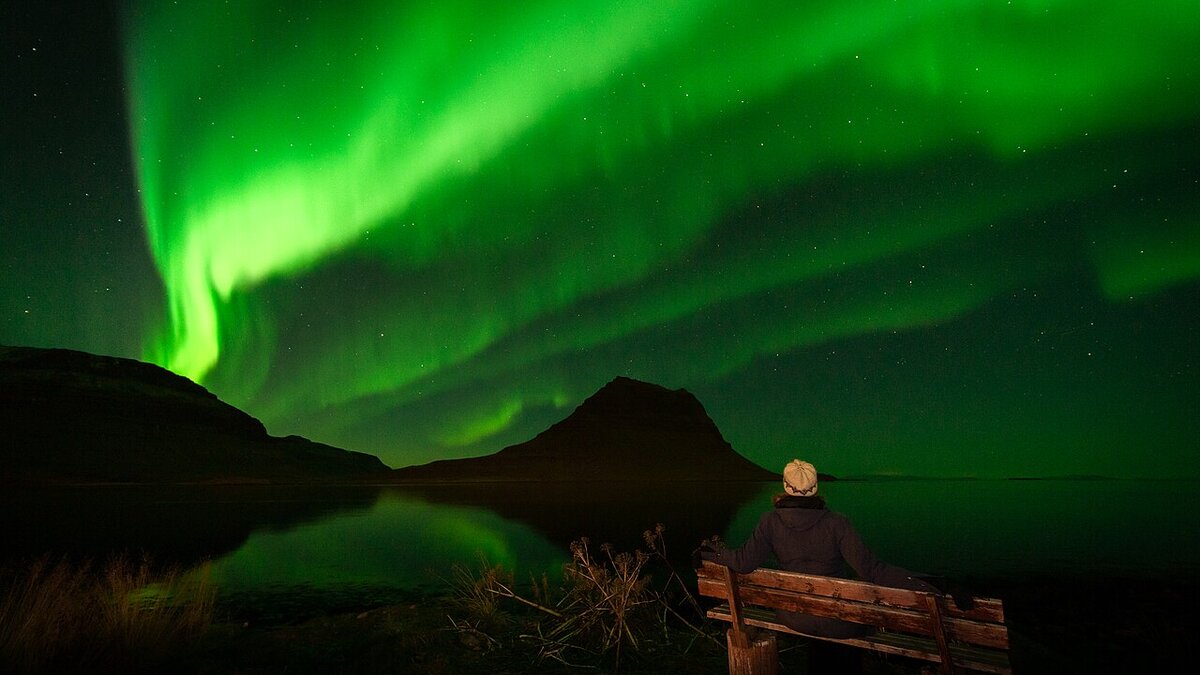
A realistic 3-4 night aurora trip runs about $1,000-1,500 per person at the budget end and $3,500-6,000+ for a glass-igloo splurge. Here is where the money goes, base by base, for the 2026-27 season.
Cover image: A traveller sits on a bench watching green northern lights arc over Kirkjufell mountain in western Iceland. — photo by Chr Grundo, CC BY-SA 4.0, via Wikimedia Commons.
Budget roughly $1,000-1,500 per person for a no-frills 3-4 night northern lights trip from the US East Coast or the UK, $1,800-2,600 for a comfortable mid-range version, and $3,500-6,000+ if a glass igloo in Finnish Lapland is the point of the exercise. Those bands hold across the five main aurora bases — Tromsø, Reykjavik, Finnish Lapland, Fairbanks and Yellowknife — for the 2026-27 season, which runs September to early April.
How much a northern lights trip costs comes down to three inputs: when you go (Christmas week can double accommodation costs), whether you chase the lights yourself in a hire car or pay a guide $60-285 a night, and how hard you lean into Arctic add-ons such as igloos, huskies and snowmobiles, which are priced as extras almost everywhere.
What does a northern lights trip cost per person?
The figures below are per-person estimates for 3-4 nights, two sharing, including return airfare from the US East Coast where direct or one-stop services exist. They are built from operator and fare prices captured in August 2026 (see Sources) — treat them as planning ranges, not quotes.
| Base | Budget | Mid-range | Luxury |
|---|---|---|---|
| Reykjavik, Iceland | $1,000-1,400 | $1,600-2,200 | $3,000+ |
| Tromsø, Norway | $1,300-1,700 | $1,900-2,600 | $3,500+ |
| Finnish Lapland | $1,400-1,800 | $2,000-2,800 | $3,500-6,000+ |
| Fairbanks, Alaska | $1,200-1,600 | $1,800-2,500 | $3,000-5,700 |
| Yellowknife, Canada | $1,100-1,500 | $1,700-2,300 | $3,000+ |
The building blocks: New York-Reykjavik returns start around $421 on Icelandair, with $565 the KAYAK route average; New York-Rovaniemi returns on Finnair start near $799. A guided evening aurora chase runs from about $60 in Reykjavik and $100-120 in Tromsø for a minibus seat, up to $235-285 per person for Fairbanks Aurora Tours' small-group photography chase. In Yellowknife, Aurora Village charges about CA$145 (roughly US$105) for a night at its heated teepee viewing camp. Mid-range hotel maths bites hardest in Norway: three peak-season nights in a mid-range Tromsø hotel run roughly €1,400-1,800 for a couple, while an autumn budget trip for two — hostel or apartment, self-catering, no tours — can land near €900-1,000 all-in on the ground.
Which northern lights destination is cheapest?
Reykjavik is usually the cheapest overall from North America thanks to low transatlantic fares and $60 group tours; Yellowknife has the lowest tour prices and arguably the most reliable skies, sitting under the auroral oval with famously clear, cold winters. Fairbanks packages span everything from $678 for a basic four-day itinerary to $5,728 for a premium eight-day trip, so it covers both ends. Tromsø and Finnish Lapland cost more on the ground — Nordic food and hotel prices are the culprit — a squeeze amplified by the region's surging popularity as Scandinavia's coolcation boom pushes winter demand to record levels.
Are glass igloos worth the money?
Finnish Lapland's signature splurge is priced accordingly. Entry-level glass cabins start around €150-250 a night in the September-October shoulder, standard units run €250-380, and Christmas week peaks at €900-2,000 a night at the best-known properties. Kakslauttanen Arctic Resort starts from about €424 a night including breakfast and dinner; Levi's hillside Golden Crown igloos list around €299-399. Add €150-400 a day if you stack on huskies, reindeer and snowmobiles.
Worth it? One or two nights, yes — the roof-window wake-up-when-it-glows experience is genuinely different. Booking all four nights in glass is what turns a $2,000 trip into a $5,000 one; most operators suggest pairing one igloo night with cheaper cabin or hotel nights.
When is the cheapest time to see the northern lights?
Late September-October and March are the sweet spots: aurora activity historically peaks around the equinoxes, while flights and rooms sit well below the December-January surge. The solar backdrop cooperates too — Solar Cycle 25 peaked in late 2024, and space-weather analysts expect the declining phase to keep geomagnetic activity elevated through 2026-27, with strong storms still possible years after maximum. It is a textbook case for the shoulder-season playbook, and autumn brings bonuses: milder temperatures, open hiking roads and reflections in unfrozen lakes. Several aurora bases feature in our autumn 2026 destination picks for exactly that reason.
Can you see the northern lights without paying for a tour?
Yes — the lights are free; you are paying for transport, forecasting and cloud-dodging. A hire car in Iceland or Fairbanks plus a free forecast app replaces $60-285-a-night tours, though winter driving on ice is not for everyone and guides materially raise your hit rate on marginal nights. Two rules protect your odds either way: stay at least three nights, which is the minimum most operators quote for a realistic chance through variable weather, and protect the trip itself — a cancelled Arctic connection in a snowstorm is precisely the scenario a decent policy covers, as our travel insurance guide sets out.
Frequently asked questions
How much should I budget for a 4-night northern lights trip?
From the US East Coast or UK, plan on $1,000-1,500 per person for a budget trip (Reykjavik or Yellowknife, shared room, one tour or a hire car), $1,800-2,600 mid-range, and $3,500-6,000+ for a luxury Lapland itinerary with glass-igloo nights.
How much do aurora tours cost per night?
Minibus group chases start around $60 in Reykjavik and $100-120 in Tromsø; small-group photography chases such as Fairbanks Aurora Tours run $235-285 per person; Yellowknife's Aurora Village viewing night is about CA$145.
Is 2026-27 still a good season for the northern lights?
Yes. Solar maximum passed in late 2024, but the declining phase of Solar Cycle 25 is expected to keep activity elevated through 2027, with the strongest displays clustering around the equinoxes.
How many nights do I need to see the aurora?
Book at least three nights. Clouds, not solar activity, are the usual spoiler, and a three-to-four-night window is what operators consistently cite for realistic viewing odds.
Sources
- Fairbanks Aurora Tours — Aurora Chasing Photography Tour pricing
- Glass-Igloos.com — Glass Igloo Prices 2026-2027, Finland
- Capture the Atlas — Best Northern Lights Tour Packages in 2026
- Icelandair — Flights from New York to Iceland
- Road Is Calling — How Much Does a Trip to Tromsø Cost?
- Space.com — Will 2026 still bring strong auroras?




Post a comment