

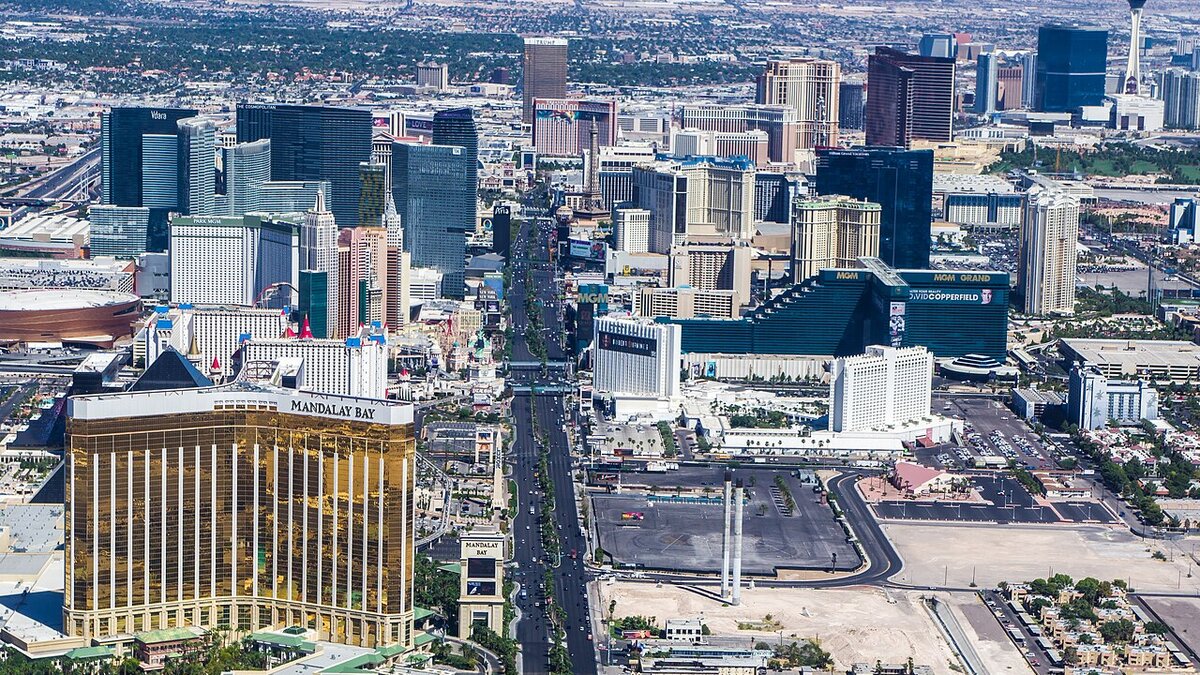
A five-star-looking Las Vegas hotel that never existed appeared on Booking.com and Expedia with AI-generated photos, funnelling guests to the poorly rated OYO Hotel & Casino. Platforms are investigating.
Cover image: Aerial view of the Las Vegas Strip with its hotel-casino towers at dusk — photo by Ron Reiring, CC BY 2.0, via Wikimedia Commons.
A fake hotel listing called the Palette Las Vegas — a polished, five-star-looking property illustrated with AI-generated photos — appeared on Booking.com, Expedia and other major travel sites this month, even though no such hotel exists. Guests who booked it, along with a second phantom listing named Collection O Las Vegas, arrived instead at the OYO Hotel & Casino Las Vegas, the poorly rated former Hooters property whose address both listings used. After the story went viral in mid-August and drew press scrutiny, the listings were suspended or emptied of inventory; Booking.com and Expedia say they are investigating. It is the first high-profile case of AI-dressed phantom hotel listings slipping through the big online travel agencies' verification — and, per reporting, the listings came from inside the hotel's own corporate family, not from an outside fraudster.
What is the Palette Las Vegas?
On paper, the Palette looked like a boutique upgrade: fresh imagery, a pool, an off-Strip address at 117 E. Tropicana Avenue. In reality, that address belongs to the OYO Hotel & Casino Las Vegas, which One Mile at a Time notes ranks near the bottom of the city's hotels on Tripadvisor — around 240th of 260.
The deception unravelled when Las Vegas content creator Ariana Patiño, who booked the Palette specifically to avoid OYO's reputation, arrived to find only the OYO at the address and posted a TikTok that went viral. Her digging surfaced the second phantom listing, Collection O. According to View From The Wing, all three listings used the same pool photograph — with the OYO signage digitally replaced by signs for the made-up hotels. Patiño said staff described the alternate listing as a marketing test and initially refused her refund request.
Other details did not stand up either: room counts varied between platforms — 20 to 25 for the Palette, 16 to 34 for Collection O — and the listings claimed a 2023 opening for a building that is decades old.
How did a non-existent hotel get on Booking.com and Expedia?
The most striking part of the story is who created the listings. Both "Palette" and "Collection O" are brands belonging to Prism, OYO's parent company, the Las Vegas Review-Journal reported. In a statement reported by 8 News Now, OYO said it had been "evaluating how different blocks, or room categories could be positioned under different brands" and that "the listing went live while the related renovations and signage at the property were still being completed." A hotel representative quoted by One Mile at a Time was blunter: the listing was put up "to see which ad would gain more traction."
Whatever the intent, the episode exposes a gap in how online travel agencies verify the properties they sell. OTA onboarding checks that an address and payment details exist — not that the brand, photos and star presentation attached to that address describe a real, distinct hotel. AI imagery makes that gap easy to exploit: the phantom listings spread beyond Booking.com and Expedia to Travelocity, Orbitz and Trip.com before anyone flagged them.
What have the platforms and regulators said?
An Expedia representative told the Review-Journal both listings were suspended pending an investigation with OYO: "If we identify content that does not comply with the policy, we will take appropriate action." Booking.com said: "We take the process of verifying accommodation listings seriously," citing teams that monitor for fraudulent postings.
The clean-up has been rapid but uneven. View From The Wing reported that OYO removed both phantom hotels from its own booking system, that Expedia disabled Collection O on 14 August — marking it "closed" through August 2028 — and that by late last week the Palette survived only as an unbookable shell, while Trip.com still showed both properties. The same outlet argues the scrubbing is happening ahead of possible action by Nevada regulators, since state deceptive trade practices law and gaming regulations prohibit false or materially misleading advertising by licensed casino properties — and the OYO operates a casino floor. Neither OYO nor Prism responded to the Review-Journal's requests for comment.
How can you spot a fake or AI-generated hotel listing?
Phantom listings are a new twist on an old problem, and the tools behind this one — generative imagery and instant brand invention — are cheap and widely available. The scepticism travellers are learning to apply to AI trip-planning tools now applies to the listings themselves. Red flags to check before you pay:
- Search the hotel's name plus its address. If the address returns a different property — as 117 E. Tropicana did — stop.
- Look for an independent footprint. A real hotel has its own website, a Google Business profile and reviews on more than one platform.
- Check the photos. Too-perfect lighting, warped signage and garbled text are hallmarks of AI generation; reverse-image-search the lead photo.
- Compare basic facts across sites. Room counts, opening dates and star ratings that differ between platforms suggest nobody has verified them.
- Be wary of very new listings with few reviews, or reviews that repeatedly say "this is actually another hotel".
- Cross-check the rate directly. A look at the hotel's own site is a useful authenticity test — one of several reasons to compare direct booking against the OTA price anyway.
Frequently asked questions
What should I do if I booked the Palette Las Vegas?
Contact the platform you booked through, not the hotel. Expedia has suspended both listings pending its investigation with OYO, and Booking.com says it is reviewing them. Keep screenshots of the listing, your confirmation and any correspondence — they are your evidence that what you bought was not what was delivered.
Can I get a refund for a fake hotel listing?
No blanket refund has been announced — Patiño said her request was initially refused at the property. In general, if a listing materially misrepresented the property, pursue the OTA's misleading-content and customer-service channels first; failing that, a card chargeback for services "not as described" is the usual fallback. The same document-everything discipline applies as with other travel refund claims.
Are AI photos allowed on booking sites?
Platforms do not ban AI-assisted imagery outright, but their content rules require listings to accurately represent the property. Expedia pointed to its misleading-content policy when suspending the two listings; Booking.com cited its verification process. Imagery that invents a hotel, or digitally swaps its signage, falls foul of those rules.
Did OYO admit creating the listings?
OYO did not call them fake. In a statement reported by 8 News Now, it said it had been evaluating how room blocks could be positioned under different brands, and that the listings went live before renovations and signage were completed. Both brand names belong to OYO's parent company, Prism.
Sources
- One Mile at a Time — Las Vegas hotel scams guests with fake name, AI photos
- Las Vegas Review-Journal — Expedia, Booking.com investigating non-existent Las Vegas hotel listings
- View From The Wing — Two fake Las Vegas hotels are luring guests with AI photos
- View From The Wing — Hotel is scrubbing the internet of fake listings before Nevada gaming regulators act
- 8 News Now — Las Vegas hotel listings raise questions after traveler books Palette, arrives at OYO


Post a comment