

Lufthansa Group now expects 2026 adjusted EBIT of €1.7–2.2bn, retreating from earlier guidance, after kerosene prices jumped 60% and the Middle East crisis pushed the group to a first-half operating loss. Q2 operating profit fell 56% to €383m despite revenue rising 8%.
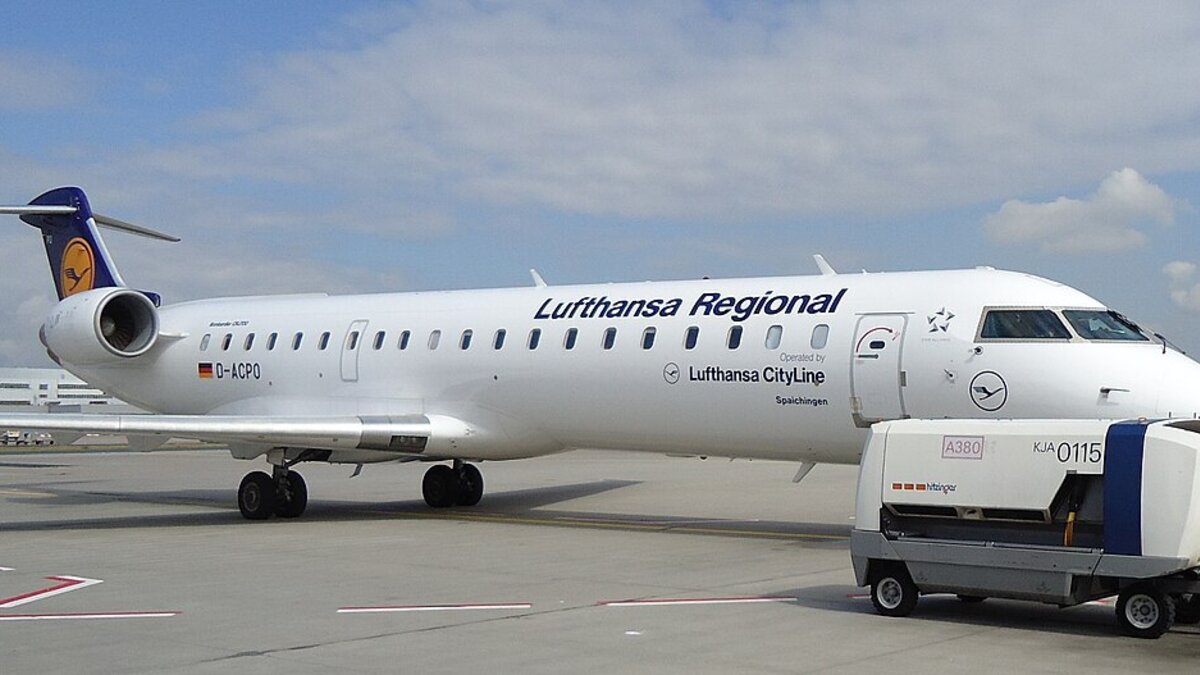
Cover image: Lufthansa CityLine Bombardier CRJ-900 regional jet on the apron at Frankfurt Airport — photo by Bento Mattos, CC BY-SA 4.0, via Wikimedia Commons.
Lufthansa Group cut its full-year profit outlook on Tuesday 4 August 2026, telling investors it now expects adjusted EBIT of between €1.7bn and €2.2bn for 2026 — a range whose midpoint is roughly level with last year's €1.96bn, and a clear retreat from its previous forecast of earnings "significantly higher than the previous year". The Frankfurt-based group blamed the crisis in the Middle East, which has driven its average kerosene price up 60% year-on-year to $1,133.90 per tonne in the first half, forced temporary route cancellations to the Gulf and shortened booking cycles.
Second-quarter results show the squeeze in hard numbers. Q2 revenue rose 8% to €11.1bn, but adjusted EBIT more than halved to €383m from €870m a year earlier, and net profit collapsed 88% to €123m. Over the first half, Europe's largest airline group posted an adjusted operating loss of €229m — down €378m year-on-year — and a net loss of €542m, against a €127m profit a year earlier.
Why has Lufthansa cut its 2026 profit outlook?
The short answer is fuel. Group fuel expenses rose 18% to €4.18bn in the first half, up roughly €640m, even though hedging contributed €585m and consumption actually fell 3%. The company puts the additional cost burden from higher fuel prices at around €750m.
Behind that sits an oil market reshaped by the conflict: average Brent crude climbed 24% year-on-year to $87.44 a barrel in the first half, while the jet fuel crack — the refining premium for kerosene over crude — tripled to $56.92 a barrel, up 201%, according to the interim report. Lufthansa says about 86% of its 2026 kerosene requirement is hedged, which softens but does not eliminate the hit. We analysed these pass-through dynamics in our look at how jet fuel costs feed through into airfares.
The reset goes beyond the headline number. Passenger capacity for 2026 is now expected to be roughly flat on 2025, versus growth of 0–2% previously; net capital expenditure has been trimmed from €2.9bn to around €2.5bn on delayed aircraft deliveries; and adjusted free cash flow is guided to about €0.9bn, below last year's €1.19bn.
How bad were Lufthansa's Q2 2026 results?
Demand is not the problem. CEO Carsten Spohr pointed to strong global appetite for air travel, especially in the premium classes, and the Network Airlines' unit revenues rose 6.4% in the second quarter, with first-half load factor up 1.9 points at 82.4%. Traffic to Asia and Africa has picked up sharply as passenger flows divert away from Gulf hubs — a shift we examined in our report on Gulf carriers and the airspace disruption.
But costs ran faster. Alongside fuel, strikes by the Vereinigung Cockpit pilots' union and the UFO cabin crew union in February, March and April cost the group more than €150m, per the results release. CFO Till Streichert pointed to the group's €10.7bn liquidity buffer, while the interim report concedes that fuel-price volatility and "significantly shortened booking cycles" are hampering forecasting — hence the wide €500m guidance band.
Which Lufthansa divisions are losing money?
The split is stark: the passenger airlines are absorbing the entire shock while logistics and maintenance are having a strong year, partly because of the same geopolitical upheaval rerouting freight flows.
| Segment | H1 2026 adj. EBIT | H1 2025 | FY 2026 outlook (adj. EBIT) |
|---|---|---|---|
| Network Airlines | –€468m | –€113m | €750m–€1,150m (cut) |
| Point-to-Point (Eurowings) | –€252m | –€137m | –€50m to €20m (cut) |
| Logistics (Lufthansa Cargo) | €199m (+47%) | €135m | Significant increase |
| MRO (Lufthansa Technik) | €315m (+2%) | €310m | Significant increase |
Within the Network Airlines, second-quarter adjusted EBIT fell to €137m from €627m. Lufthansa Cargo, by contrast, lifted first-half earnings 47% as closed maritime corridors and rerouted logistics flows drove cargo yields up 11.3% in the half and segment revenue up 27% in Q2. The ITA Airways equity stake swung to a –€58m first-half contribution, including €32m of adverse currency effects.
How is Lufthansa cutting costs and fuel burn?
The headline restructuring move: all 39 Lufthansa CityLine aircraft have been removed from the service offering since the 16 April announcement, with the entire 23-aircraft Canadair CRJ-900 sub-fleet being decommissioned and six A319s plus four A321 freighters redeployed elsewhere in the group.
- Long-haul retirements: four fuel-hungry Airbus A340-600s leave the fleet after the summer timetable, and two Boeing 747-400s will be temporarily withdrawn from October for the winter.
- Winter capacity: short- and medium-haul capacity will also be reduced in the winter flight timetable.
- Hedging benefit: kerosene saved comes out of the unhedged share of the fuel bill — a "disproportionate" earnings effect, per the company.
- Fleet renewal: a 20-aircraft order (ten A350-900s, ten 787-9s) approved in May arrives between 2032 and 2034.
Consolidation continues regardless. In June Lufthansa exercised its option to lift its ITA Airways stake from 41% to 90% for €325m, with completion expected in Q1 2027 pending EU and US approval, and on 29 July it bid for an initial minority stake in TAP Air Portugal.
What does the outlook cut mean for winter capacity and fares in Europe?
Flat group capacity, retired aircraft and an industry-wide effort to pass fuel costs through point one way: firmer fares in Europe this winter. Lufthansa's own report notes airlines are trimming capacity and raising ticket prices, with the Network Airlines' unit revenues up 5% in the first half and yields strengthening through the second quarter.
The contrast with the United States is striking: as our round-up of Q2 2026 airline earnings showed, US majors — largely insulated from rerouting costs and buying fuel in their home currency — have fared better this season. And the industry picture has darkened since IATA's earlier, steadier profitability outlook: in June the association slashed its 2026 global industry profit forecast to $23.0bn, from $41.0bn previously and $45.0bn earned in 2025, and now sees global traffic growing just 2% this year instead of 5%. For European travel sellers, the message from Frankfurt is to expect tighter seat supply, resilient premium demand — and little relief on price.
Frequently asked questions
What is Lufthansa's new profit guidance for 2026?
The group now forecasts full-year adjusted EBIT of €1.7bn to €2.2bn, against €1.96bn earned in 2025. Its previous guidance was for a result "significantly higher" than last year, so only the top of the new range preserves that ambition.
Did Lufthansa make money in the second quarter of 2026?
Yes. Q2 adjusted EBIT was €383m on revenue of €11.1bn, with net profit of €123m. But operating profit fell 56% year-on-year, leaving a first-half net loss of €542m.
Why are Lufthansa's fuel costs so high in 2026?
The Middle East crisis lifted average Brent crude 24% to $87.44 a barrel in the first half, while the jet fuel refining premium tripled to $56.92 a barrel. Lufthansa's average kerosene price rose 60% to $1,133.90 per tonne, adding roughly €750m in costs despite 86% of 2026 volumes being hedged.
Will Lufthansa cut flights this winter?
Yes. Four A340-600s leave after the summer timetable, two 747-400s are temporarily withdrawn from October, short- and medium-haul winter capacity is being cut, and all 39 CityLine aircraft are already gone. Group capacity is expected to be roughly flat on 2025.
Sources
Related coverage
 Business Travel Spending to Hit Record $1.71 Trillion in 2026, GBTA Says — but $2 Trillion Slips to 2030
04 Aug 2026
Business Travel Spending to Hit Record $1.71 Trillion in 2026, GBTA Says — but $2 Trillion Slips to 2030
04 Aug 2026
 Tourism Board Campaigns 2026 Compared: Who Is Spending What to Win Your Next Trip
04 Aug 2026
Tourism Board Campaigns 2026 Compared: Who Is Spending What to Win Your Next Trip
04 Aug 2026
 El Niño Quiets the 2026 Hurricane Season — and Opens the Caribbean's Deepest Deal Window
04 Aug 2026
El Niño Quiets the 2026 Hurricane Season — and Opens the Caribbean's Deepest Deal Window
04 Aug 2026


Post a comment