Tourism boards — destination marketing organisations — promote destinations, manage visitor flows and fund the campaigns behind travel demand. How DMOs work, who pays for them and how success is measured, from Brand USA's budget cut to HKTB's record HK$1.66bn subvention.
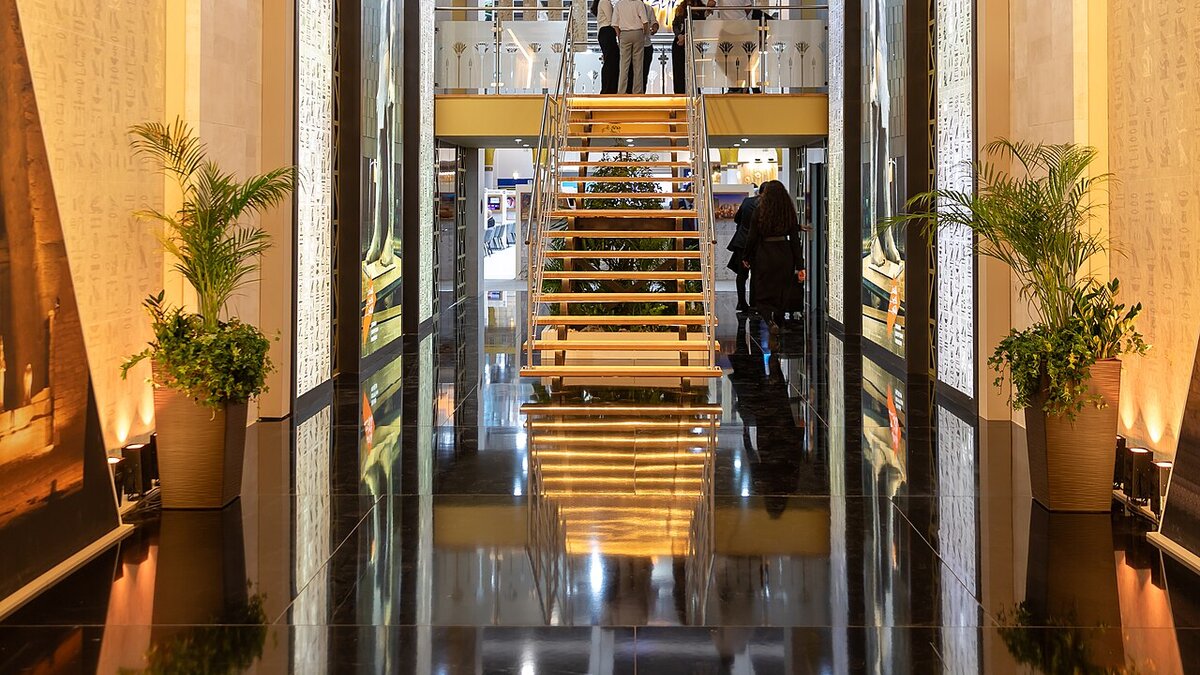
Cover image: Egypt pavilion drawing trade visitors at the ITB Berlin travel show — photo by Matti Blume, CC BY-SA, via Wikimedia Commons.
A tourism board — known in the industry as a destination marketing organisation, or DMO — is the body formally charged with promoting a destination to travellers and the travel trade, and increasingly with managing what tourism does to the destination itself. UN Tourism defines DMOs as the organisations "responsible for the management and/or marketing of individual tourist destinations", a deliberately broad remit that covers everything from television campaigns and trade-show pavilions to visitor-flow planning and sustainability policy.
The sums involved are serious. Hong Kong's government allocated the Hong Kong Tourism Board (HKTB) HK$1.66 billion in the 2026-27 budget — reported locally as the largest single-year subvention in the board's history. In the opposite direction, the United States cut Brand USA's federal contribution from US$100 million to US$20 million for fiscal 2026 under the budget reconciliation bill signed on 4 July 2025, according to Travel Market Report. And Malaysia has put more than RM700 million behind Visit Malaysia 2026 and its target of 47 million international arrivals, according to Travel Daily News Asia. When a destination's marketing engine is switched on — or off — the effects ripple through airlines, hotels, tour operators and agents.
What does a tourism board actually do all day?
The most visible half of the job is destination marketing: building the brand that makes travellers choose one place over another. That means consumer advertising campaigns, PR and media hosting, social content, and celebrity-fronted launches — Visit Malaysia 2026 opened on 3 January with Michelle Yeoh alongside Prime Minister Anwar Ibrahim.
Less visible but equally important is trade marketing. Tourism boards staff national pavilions at trade shows such as ITB Berlin — which drew nearly 97,000 attendees and 5,601 exhibitors from 166 countries to its 60th-anniversary edition in March 2026, according to organiser figures — and WTM London, brokering meetings between their local suppliers and international buyers. They also run co-operative ("co-op") marketing: jointly funded campaigns with airlines, online travel agencies and tour operators, where the board pays a share of the media cost in exchange for bookable product carrying its message. HKTB's worldwide push this year, examined in our report on the Hong Kong Tourism Board's 2026 global campaign, leans heavily on exactly this co-op model.
What is destination management, as opposed to marketing?
Modern DMOs have moved beyond pure promotion. UN Tourism describes the DMO's evolving role as that of a "strategic leader in destination development" — coordinating stakeholders around competitiveness and sustainability, not just demand generation. In practice that covers spreading visitors across seasons and regions to ease overtourism pressure, developing new product, setting service standards, and steering crisis response when a shock hits arrivals.
One point of frequent confusion for newcomers: a DMO is not a DMC. A destination management company (DMC) is a commercial, in-destination business that operates tours, transfers and events for a margin. The DMO is the (usually public or public-private) body that markets and manages the destination as a whole — it promotes, but generally does not sell.
How are tourism boards funded?
Funding models vary widely, and they shape behaviour. According to Destinations International's performance-reporting platform, public money accounts for 92% of destination organisation revenue, with private sources making up the remaining 8%. The main models:
- Government appropriation: a direct budget line, as with Tourism Malaysia, the Tourism Authority of Thailand, or HKTB's HK$1.66 billion subvention.
- Hotel occupancy taxes: the dominant model for US city bureaux, where a levy on overnight stays flows back into promotion.
- Matched public-private funding: Brand USA receives a share of ESTA fees paid by Visa Waiver Program travellers, released only when matched by cash or in-kind contributions from industry partners.
- Membership dues and commercial revenue: supplementary income from member hotels, attractions and operators, plus paid partnerships.
| Organisation | Type | Primary funding | Recent numbers |
|---|---|---|---|
| Brand USA | NTO (public-private) | ESTA fees + matched industry contributions | Federal share cut US$100m → US$20m for FY2026 |
| Hong Kong Tourism Board | Statutory body | Government subvention | HK$1.66bn for 2026-27, its largest ever |
| Tourism Malaysia | Government agency (NTO) | State budget | RM700m+ behind Visit Malaysia 2026; 47m arrivals target |
| Tourism Authority of Thailand | Government agency (NTO) | State budget | 2026 arrivals forecast trimmed to ~33m |
| US city CVBs | City/county DMO | Hotel occupancy taxes, membership dues | 92% of DMO revenue is public money (Destinations International) |
Funding is also fragile. Brand USA's cut forced it to eliminate 12 positions — about 15% of staff — and shut its GoUSA TV streaming channel, according to Travel Weekly, and a bipartisan Visit USA Act to restore the US$100 million is still working through Congress.
What is the difference between an NTO, a regional DMO and a city CVB?
The industry uses a rough three-tier hierarchy. A national tourism organisation (NTO) — VisitBritain, Tourism Malaysia, the Jamaica Tourist Board, the Tourism Authority of Thailand — markets an entire country abroad and usually reports to a tourism ministry. Regional or state DMOs cover a province, state or island grouping and often split funding between the national body and local government.
At city level, especially in North America, sits the convention and visitors bureau (CVB), whose distinguishing job is bidding for meetings, conventions and events alongside leisure promotion. The tiers frequently co-fund campaigns: a national brand platform, activated regionally, with a city bureau closing the convention bid.
How does the travel trade work with tourism boards?
For agents, operators and DMCs, tourism boards are a resource, not a competitor. The standard touchpoints:
- Co-op funds: boards part-fund campaigns, brochures and OTA placements that feature their destination — often 50/50 — stretching a partner's marketing budget.
- Familiarisation ("fam") trips: hosted itineraries that let front-line sellers experience the product they are selling.
- Trade portals and e-learning: specialist-agent programmes that certify sellers and route qualified leads their way.
- Trade shows and roadshows: appointment-driven events, from ITB and WTM pavilions to city-by-city sales missions.
How is a tourism board's success measured?
The headline metrics are visitor arrivals and visitor spend — the numbers behind milestones such as the record international arrivals the industry is tracking in 2026. Boards increasingly emphasise spend over volume: HKTB executive director Dane Cheng has argued its events programme returns roughly HK$15 in visitor spending for every HK$1 invested.
Below the headlines sit hotel occupancy and RevPAR, campaign reach and media value, conversion studies estimating incremental trips per marketing dollar, and — in the destination-management era — resident sentiment and seasonality spread. How the big boards stack up on these measures this year is the subject of our companion analysis comparing the major 2026 tourism board campaigns.
Frequently asked questions
Is a tourism board the same as a destination management company?
No. A tourism board (DMO) is a public or public-private organisation that markets and manages a destination; a DMC is a commercial ground-handling business that operates tours, transfers and events for paying clients.
Who pays for tourism boards?
Mostly taxpayers and visitors. Destinations International's reporting platform puts public funding at 92% of destination-organisation revenue, drawn from government budgets and hotel occupancy taxes, topped up by membership dues, commercial partnerships and — in Brand USA's case — ESTA fees matched by industry contributions.
Do tourism boards sell holidays directly?
Almost never. Boards generate demand and hand it to the trade — airlines, OTAs, operators and agents — through co-op campaigns, specialist programmes and lead referral. Selling directly would put them in competition with the industry partners that co-fund their work.
What is a fam trip?
A familiarisation trip is a hosted visit a tourism board organises for travel agents, tour operators or media, so participants can experience hotels, attractions and logistics first-hand and sell or cover the destination credibly. Boards typically cover most in-destination costs.
Sources
- news.gov.hk — HK to enhance tourism appeal (2026-27 Budget)
- Travel Market Report — Brand USA funding faces uncertain future even as inbound travel plummets
- Travel Weekly — The battle for Brand USA's survival
- Hotel News Resource — ITB Berlin 2026 marks 60th anniversary with 97,000 attendees
- UN Tourism — Policy and destination management
- Travel Daily News Asia — Visit Malaysia Year 2026 targets 47 million international arrivals
- Destinations International — New insights from the Destination Organization Performance Reporting Platform