May to September is the best time to visit Bali, with August the driest at 15mm rain and May and September the value sweet spots.
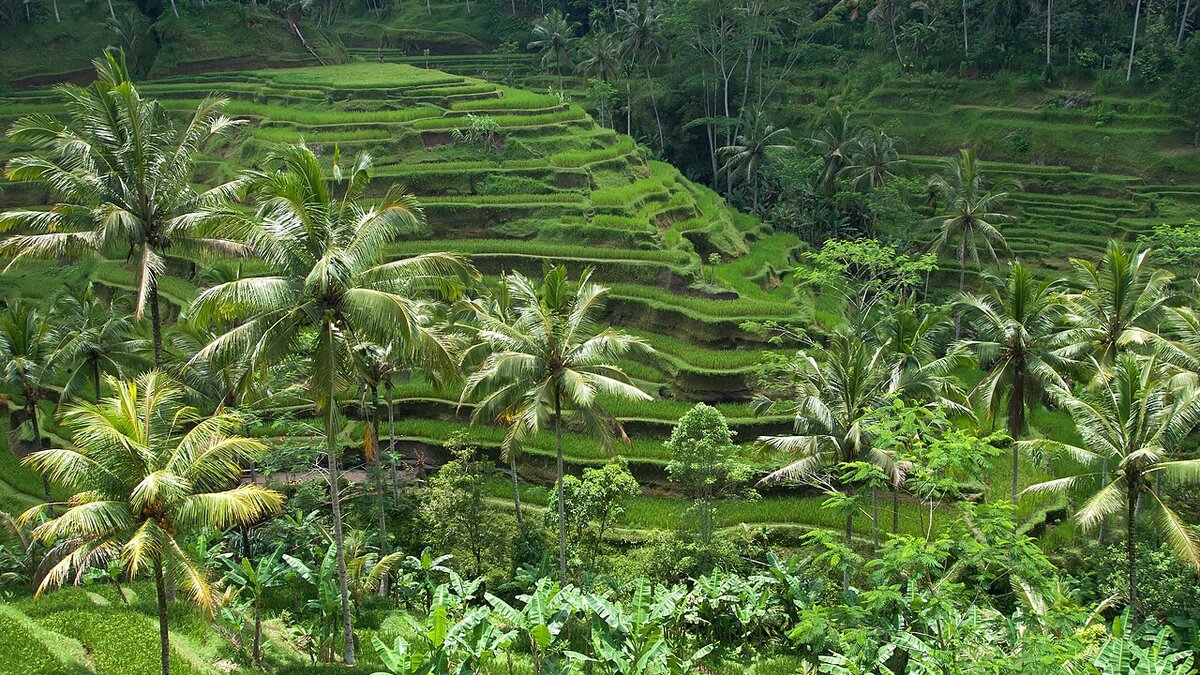
Cover image: the terraced rice fields of Ubud, Bali with palm trees — photo by Vyacheslav Argenberg, CC BY 4.0, via Wikimedia Commons.
The best time to visit Bali is May, June, August and September. These four months sit in the dry season between the west monsoon (roughly October to April) and offer the lowest rainfall, humidity around 75 percent instead of 85 percent, daytime temperatures near 30°C and calm seas on the south coast. August is the driest month on the island average at just 15 mm of rain, followed by July at 50 mm, June and May around 70 to 75 mm and September at 40 mm. Outside this window you get significant rain, particularly December to March, with January averaging 350 mm.
Bali is warm all year. Average daytime temperatures at low elevations range between 20 and 33°C, with island-average daily means from 26.4°C in August to 28.3°C in November. Sea temperatures stay near 28°C year round. So the choice is not about cold versus hot, but about rain, humidity, surf, crowds and price. Indian travellers planning around Diwali, Christmas or summer holidays can still make wet months work with the right base.
When is the dry season and wet season in Bali?
Bali's west monsoon brings significant rain from approximately October to April, heaviest from December to March. The dry season from May to September has relatively low humidity and little rain in lowland areas, according to the climate summary for the island. November and October are transition months with 90 to 150 mm. The annual average total is about 1,715 mm, but the south including Kuta, Seminyak and Jimbaran is drier than the mountains around Ubud and Bedugul, where orographic rain is heavier.
Humidity averages near 85 percent in the wet months and drops into the mid 70s in the dry months. That ten-point difference matters more than the thermometer. A 31°C day in August feels comfortable in Bali's dry air, while 31°C in January with 85 percent humidity feels sticky and thunderstorms build by afternoon. Even in the dry season, short tropical showers are possible, usually at night or in late afternoon, and they clear quickly.
What does each month offer in Bali?
| Month | Avg rain | What to expect | Crowds and prices |
|---|---|---|---|
| Jan | 350 mm | Wettest, afternoon downpours, rough seas, quieter temples | Low season, cheapest hotels after New Year |
| Feb | 280 mm | Still wet, but good for surfers on west coast | Low season |
| Mar | 215 mm | Rain easing, Nyepi silent day shuts the whole island | Shoulder, watch Nyepi dates |
| Apr | 90 mm | Inter-monsoon, warm and clearer | Shoulder, good value |
| May | 75 mm | Sweet spot: dry, green, calm seas | Moderate, pre-peak |
| Jun | 70 mm | Dry and sunny, ideal for first-timers | High season begins |
| Jul | 50 mm | Dry, cooler nights, strong trade winds for surf | Peak, highest prices |
| Aug | 15 mm | Driest, balmy, best beach weather | Peak |
| Sep | 40 mm | Still dry, humidity lower than May | Shoulder, post-peak value |
| Oct | 90 mm | Rains returning, occasional storms | Shoulder |
| Nov | 150 mm | Wet builds, greener rice terraces | Low season value |
| Dec | 290 mm | Wet, hot and humid, Christmas rush | Peak for holidays |
Nyepi, the Balinese Day of Silence, closes the entire island including Ngurah Rai Airport for 24 hours from 6am. In 2026 Nyepi fell on 19 March; the 2027 date also follows the Balinese saka calendar, so confirm it before booking a March trip. On Nyepi you must stay inside your hotel with lights dimmed. Melasti processions in the days before are photogenic. If your dates include Nyepi, book a hotel that embraces the experience rather than fighting it.
Which region should you base in for your travel style?
South Bali (Kuta, Seminyak, Canggu, Uluwatu): best in dry season May to September for beach clubs, sunsets and dry sand. Wet months still attract Australian school-holiday families in December and January, but sea swimming is rougher and beach erosion is visible after storms.
Ubud and central Bali: greenest in the shoulder months April, May, October and November when rice terraces are vibrant and waterfalls run full. August terraces can look brown after harvest. Ubud is the best wet-season base because culture, spas and food are not rain dependent.
East Bali (Amed, Sidemen) and north (Lovina): drier micro-climates and good for diving in calm dry-season seas. Visibility peaks around August to October. Surf on the Bukit Peninsula is best May to September on offshore trades, while east-coast breaks like Nusa Dua work in the wet season.
How to avoid crowds and get better value from India?
The cheapest windows from India are November to March excluding the Christmas and New Year fortnight, when fares from Delhi and Mumbai via Kuala Lumpur or Singapore on AirAsia, Batik Air or IndiGo often drop below INR 22,000 return in sales. The most expensive weeks are late December, Easter and 15 July to 20 August when European holidays overlap with Australian winter escapes.
For the best balance of weather and price, aim for the first two weeks of May or the last two weeks of September. Hotels in Seminyak and Ubud run 25 to 35 percent below July and August, villa pools are still usable, and you avoid the Idul Fitri domestic rush when many Indonesians travel. If you must travel in the wet season, book a hotel with a covered pool, choose east Bali for more sun and keep temple visits to mornings before clouds build. Check Do I Need a Visa for Bali for the 500,000 IDR Visa on Arrival and the separate 150,000 IDR Bali levy since 14 February 2024, and Is Bali Safe for petty theft, scooter and current advisories.
Compare island seasons across the region: the dry window for Bali aligns with Phuket and Krabi on the Andaman side, but is the opposite of The Cheapest Time to Visit Koh Samui, where September to November is the monsoon and March to April is the value sweet spot. That matters if you are trying to island-hop between Indonesia and Thailand in one trip.
Travelling to Bali from India
Air India flies non-stop from Delhi to Denpasar daily, and IndiGo flies non-stop from Bengaluru and Mumbai (its Delhi service stops briefly at Bhubaneswar), so from those cities you can reach Bali in about seven to eight hours. From other cities, or for lower fares, AirAsia via Kuala Lumpur is usually the price leader from Chennai, Bengaluru and Kochi, with Batik Air Malaysia and Malaysia Airlines as alternatives when AirAsia is full. Routing via Singapore on Singapore Airlines or Scoot costs roughly INR 4,000 to 8,000 more, but layovers are shorter and full-service fares include baggage.
| Travel window | Typical return fare via Kuala Lumpur |
|---|---|
| Shoulder months (April, October) | INR 18,000 to 25,000 |
| June to August, late December | INR 26,000 to 38,000 |
- Booking window: 6 to 10 weeks ahead for May to September, 4 to 7 weeks for April and October. Booking under 21 days or over 120 days out usually costs more.
- Departure city: Bengaluru and Chennai are often INR 2,000 to 4,000 cheaper than Delhi, thanks to the shorter stage to Kuala Lumpur. The Bengaluru non-stop takes about seven hours; a one-stop routing via Kuala Lumpur from Bengaluru or Kochi usually takes around 9 to 11 hours each way.
- Day of the week: Tuesday to Thursday departures average INR 1,500 to 3,000 less than Friday to Sunday.
Indian school holidays
Family demand from India peaks in late May and June, when fares from Delhi and Mumbai run 20 to 30 percent above April. Fares often ease once most schools reopen in late June, before rising again around the mid-August long weekend; check live fares rather than relying on a fixed pattern.
Entry for Indian passport holders
Indian passport holders are not covered by Indonesia's visa exemption, so they use the Visa on Arrival or, better, the e-Visa on Arrival (e-VOA): IDR 500,000 (about INR 2,700), valid for 30 days and extendable once for another 30 days. Apply and pay before travel on the official portal, evisa.imigrasi.go.id; with an e-VOA and a chip (electronic) passport you can use the autogates at Ngurah Rai. Every arrival must also complete the free All Indonesia arrival card (allindonesia.imigrasi.go.id or the app) within 72 hours before landing, and Bali charges foreign visitors a one-off IDR 150,000 tourist levy, payable on the official Love Bali portal or app.
Frequently asked questions
Is August really the best month to visit Bali?
For beach weather, yes. August averages just 15 mm of rain, the lowest of the year, with daytime highs near 30°C, lower humidity and calm seas. The trade-off is peak crowds and higher prices. For a quieter version of the same weather, May and September are the value picks with only 75 mm and 40 mm respectively.
Can I visit Bali in the wet season?
Yes, especially if your focus is culture, wellness and food in Ubud and Sidemen. Expect short heavy showers most afternoons from December to March, with January the wettest at 350 mm. Beach time is shorter and waterfalls are at their most dramatic. Book indoor alternatives and avoid low-lying roads that flood in south Bali.
What happens on Nyepi in Bali?
The entire island shuts down for 24 hours from 6am. The airport closes, no flights operate, streets are empty and everyone must stay indoors with minimal light and noise. In 2026 Nyepi was 19 March. Plan to be inside a hotel and enjoy the rare silence, or schedule around it if you need to fly.
When should families from India travel to Bali?
Late May to early June and late September suit Indian school holidays better than July and August crowds. Villa availability is better and you still get dry days. If Diwali week is your only window, base in Ubud and east Bali where rain is lighter than in Kuta.