Vietnam will let mainland Chinese tour groups enter Khanh Hoa visa-free through Cam Ranh airport until end-2027, a pilot covering its largest source market, where growth has stalled.
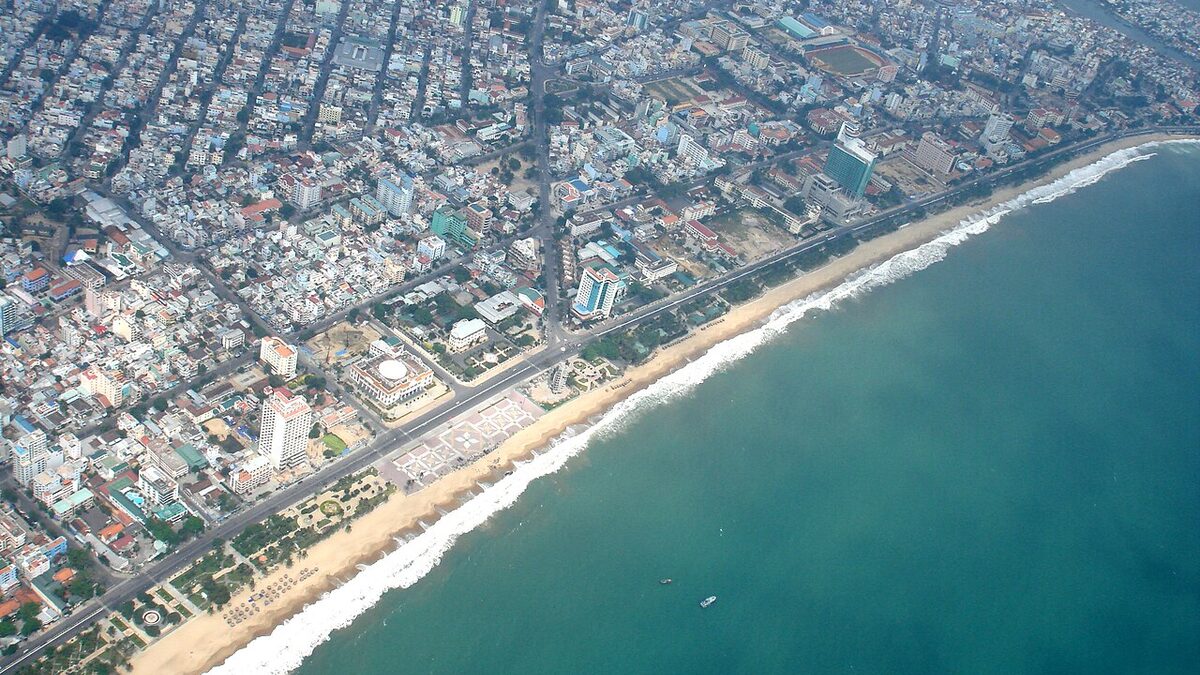
Cover image: Aerial view of the beachfront and resort strip at Nha Trang in Khanh Hoa province, Vietnam — photo by Kevin King, CC BY 2.0, via Wikimedia Commons.
Vietnam has approved a pilot visa exemption for Chinese tour groups visiting Khanh Hoa province, home to the beach resort city of Nha Trang. Signed on 12 October 2026 and effective immediately through 31 December 2027, the scheme lets mainland Chinese groups enter visa-free for up to 30 days, provided they fly direct into Cam Ranh International Airport on packages run by licensed Vietnamese operators. It is a targeted experiment in Vietnam's biggest source market, where growth has stalled.
China sent 3.9 million visitors in the first nine months of 2026, still ranked first at 22.4 percent of arrivals, but up only 1.5 percent while total arrivals grew 14.5 percent, according to Vietnam National Authority of Tourism (VNAT) data. The pilot, launched under the Vietnam-China Tourism Cooperation Year 2026-2027, gives Vietnamese inbound operators an exclusive group-tour product and could serve as a template for other Southeast Asian destinations.
Who qualifies for Vietnam's visa-free Chinese group scheme?
The conditions, reported by state-run VietnamPlus and Viet Nam News, are narrow. Travellers must hold valid ordinary passports issued on the mainland; Hong Kong and Macao SAR passports are excluded. Groups must number at least two people on package tours organised by Vietnamese international travel companies, and each tour may last no more than 30 days. Visitors must fly direct from mainland China to Cam Ranh and enter and leave Vietnam through that airport, keeping the experiment inside Khanh Hoa.
Administration is split three ways: the Ministry of Culture, Sports and Tourism sets the criteria for eligible travel companies, the Ministry of Public Security issues entry, exit and residence guidance, and the Ministry of Foreign Affairs handles promotion. The approval was signed by Deputy Prime Minister Phan Van Giang. The details come from the Vietnam News Agency's report of the government resolution, which China News Service also carried.
Why is Vietnam targeting Chinese group tours now?
The nine-month data shows why the China market matters. Vietnam drew 17.7 million international arrivals from January to September, up 14.5 percent and about 71 percent of its 25 million full-year target; September alone brought 1.77 million, up 16.1 percent. But the two giant Northeast Asian markets are dragging: China managed only 1.5 percent growth and South Korea fell 5.5 percent to 3.0 million, while Russia surged 160.6 percent past one million and Europe grew 55 percent.
| Market | Jan-Sep 2026 arrivals | Change |
|---|---|---|
| China | 3.9 million (22.4% share) | +1.5% |
| South Korea | 3.0 million (17.3% share) | -5.5% |
| Russia | Over 1 million | +160.6% |
| Europe (region) | Fastest-growing region | +55% |
| All markets | 17.7 million | +14.5% |
VNAT director general Nguyen Trung Khanh attributed the double-digit overall growth to the destination's appeal and stability, alongside market diversification and better air links. Against a global backdrop where UN Tourism says arrivals rose only 0.4 percent in the first half and cut its full-year forecast to 1-2 percent, Vietnam's problem is not demand but mix: the record run documented in August's Russia and India surge and the eight-month tally keeps growing strongly in most markets except its two biggest, China (up 1.5 percent) and South Korea (down 5.5 percent).
What does the pilot mean for the travel trade?
For Chinese outbound wholesalers and charter operators, the scheme creates a fenced product: direct flights into Cam Ranh, Vietnamese ground handlers only, Khanh Hoa only. Charter airlines eyeing Cam Ranh and hotels along the Nha Trang beachfront get a defined demand window running to the end of 2027. For independent travellers nothing changes; the standard rules in our Vietnam visa guide and the e-visa requirements still apply. No industry reaction or charter data has surfaced yet, so the honest read is that this is a government-led test whose commercial verdict comes later.
Frequently asked questions
Can Chinese tourists now visit Vietnam visa-free?
Only under narrow conditions: mainland ordinary-passport holders in groups of two or more, on package tours run by licensed Vietnamese operators, flying direct to Cam Ranh for stays of up to 30 days within Khanh Hoa. Independent travellers still need an e-visa or other valid entry permission.
How long does Vietnam's Chinese group visa pilot run?
From 12 October 2026 to 31 December 2027. It was approved as part of the Vietnam-China Tourism Cooperation Year 2026-2027.
Why is Vietnam waiving visas for Chinese groups?
China is Vietnam's largest market at 3.9 million arrivals but grew only 1.5 percent in nine months against 14.5 percent overall growth. The government has not stated a commercial goal beyond the Vietnam-China Tourism Cooperation Year 2026-2027, under which the pilot was approved, but it applies only to group tours into Khanh Hoa via Cam Ranh.
Do Hong Kong passport holders qualify for the pilot?
No. The exemption covers mainland-issued ordinary passports only and explicitly excludes Hong Kong and Macao SAR passports.
Sources
- VietnamPlus — Vietnam pilots visa exemption for Chinese tour groups visiting Khanh Hoa
- Viet Nam News — Viet Nam pilots visa exemption for Chinese tour groups visiting Khanh Hoa
- China News Service — Trial visa-free policy for Chinese visitors to Khanh Hoa
- Vietnam Investment Review — Vietnam attracts 17.7m international visitors in nine months