Winter tyres and snow chains in Europe for 2026-27, country by country: France's unenforceable €135 fine, the 34-département truth, M+S vs 3PMSF, tread depths and rental-car liability.
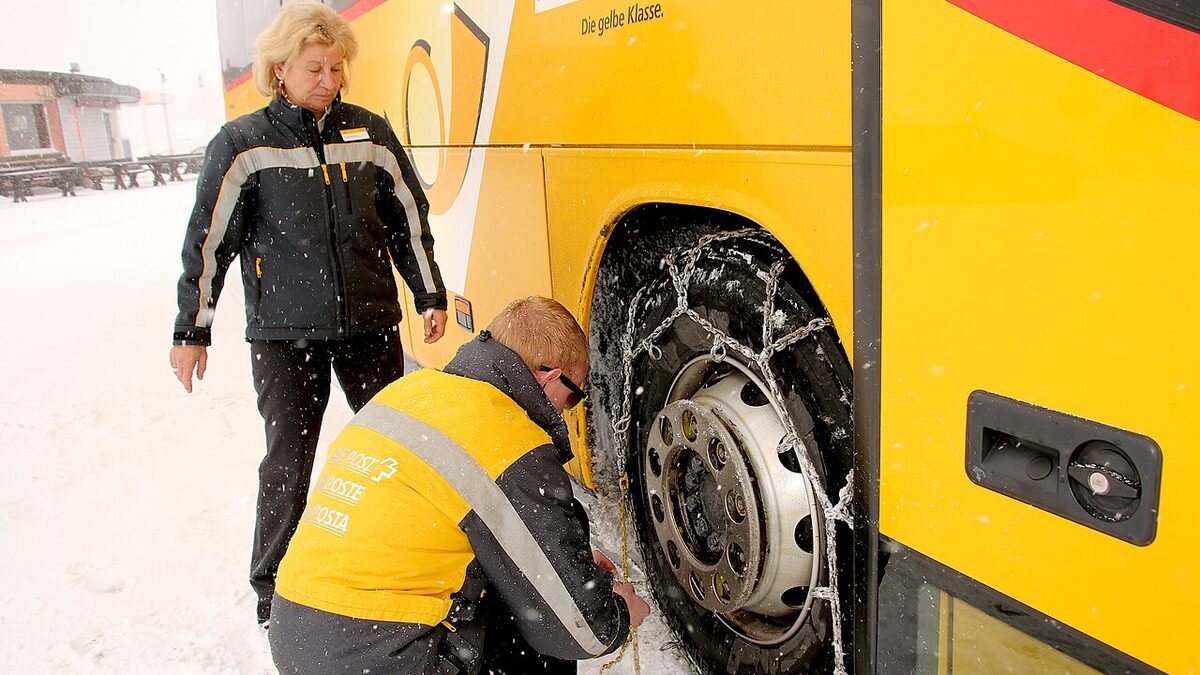
Cover image: A post bus driver fitting snow chains to a wheel in falling snow at the Simplon Pass, Switzerland — photo by Hp.Baumeler, CC BY-SA 4.0, via Wikimedia Commons.
Last checked: 16 October 2026. Driving to the Alps this winter? The rules change at every border: France requires winter equipment from 1 November to 31 March in 34 mountain départements, Austria from 1 November to 15 April but only when roads are wintry, Germany has no dates at all — its rule is triggered by actual ice and snow — and Switzerland has no winter-tyre duty whatsoever. This guide sets all eight regimes side by side from official and automobile-club sources, including three things page 1 gets wrong: France's oft-quoted €135 fine is currently unenforceable, the "48 départements" figure counts every département that had to issue a prefectoral order, including some (such as Yonne) whose order applies the rule to no road at all; the obligation actually applies in 34, and M+S tyres no longer count in France, Germany or Switzerland.
Which European countries require winter tyres in 2026-27, and from what date?
| Country | Rule type | 2026-27 window | Tyres that count | Chains or socks instead? | Minimum tread | Fine | Source |
|---|---|---|---|---|---|---|---|
| France | Fixed dates, signed zones only | 1 Nov 2026 – 31 Mar 2027 | 3PMSF only (M+S tolerance ended 1 Nov 2024) | Yes — chains/socks on at least 2 driven wheels | Legal 1.6 mm (ADAC and ÖAMTC recommend at least 4 mm) | €135 on paper, not currently enforceable | Sécurité routière, Service-Public, Senate answer 12 Feb 2026 |
| Austria | Situational (snow, slush, ice) | 1 Nov – 15 Apr (cars/vans ≤3.5 t); lorries 1 Nov – 15 Apr, buses 1 Nov – 15 Mar, regardless of conditions | M+S or snowflake still accepted | Only on continuously snow/ice-covered roads | 4 mm radial, 5 mm cross-ply (incl. all-season & studded) | About €35–60, up to €5,000 if others endangered | oesterreich.gv.at, BMIMI ministry |
| Germany | Situational (ice, snow, slush, frost) — "O bis O" is advice, not law | No dates | Alpine symbol only since 1 Oct 2024 | No: chains do not replace winter tyres; signs can require them in addition in mountain areas | Legal 1.6 mm; ADAC recommends ≥4 mm | €60 driver / €80 hindering / €100 endangering + 1 point each; holder €75 + 1 point | ADAC (8 Oct 2026) |
| Switzerland | No duty — but you must control the vehicle | — | M+S-only treated as summer tyres since 1 Oct 2024 | Only where "Schneeketten obligatorisch" is signed (incl. 4x4s) | 1.6 mm (CHF 100 per tyre below) | From ~€105 if you block traffic; licence withdrawal ≥1 month if others endangered | ch.ch portal, TCS, ÖAMTC |
| Italy | Signed roads only (set by road owners) | 15 Nov – 15 Apr (dates can shift locally) | M+S accepted | Yes — chains on board suffice | 1.6 mm general | €87–344; police can stop you continuing | ACI, Polizia di Stato |
| Italy: Aosta Valley | Fixed | 15 Oct – 15 Apr | M+S accepted | As above | 1.6 mm | As above | ÖAMTC / ECC |
| Italy: A22 Brenner–Affi, Bolzano area | Fixed, even without snow | 15 Nov – 15 Apr | M+S accepted | As above | 1.6 mm | As above | ÖAMTC / ECC |
| Sweden | Fixed window + winter conditions (police decide) | 1 Dec – 31 Mar (heavy vehicles 10 Nov – 10 Apr regardless) | Alpine symbol (3PMSF) or studded | Equivalent equipment allowed | 3 mm (heavy 5 mm) | Per police tariff | Transportstyrelsen (updated 10 Nov 2025) |
| Norway | Tread-depth windows | 1 Nov – first Sunday after Easter (north: 16 Oct – 30 Apr) | Studded or non-studded | Chains etc. where grip requires, even outside windows | 3 mm in window, 1.6 mm otherwise | Per police tariff | Statens vegvesen |
| Finland | Weather-dependent | November – March when weather requires | Non-studded must carry 3PMSF from December | Studded tyres count as winter tyres; chains not covered in the Traficom notice | 3.0 mm | Per police tariff | Traficom (17 Oct 2024) |
What does France's Loi Montagne require from 1 November, and where does it apply?
From 1 November 2026 to 31 March 2027, vehicles with four or more wheels in listed communes of 34 départements across six massifs — Alps, Corsica, Massif Central, Jura, Pyrenees, Vosges — must either wear winter tyres or carry chains or socks. Each prefect sets which communes are covered, so the rule is not département-wide. What counts: only 3PMSF (three-peak mountain snowflake) tyres — all-season or "4 saisons" tyres qualify only if they carry the symbol. You need winter tyres on at least two wheels of each axle (four total); the alternative is at least two chains or socks for the driven wheels. Studded-tyre cars are exempt, and licence-free microcars are not covered. The rule can only be enforced where entry/exit signs are installed, with a plate showing the winter period. If your winter trip is about skiing rather than driving, our European ski-trip cost guide covers the rest of the budget.
Will you actually be fined in France? The €135 question
On paper, yes: a fourth-class fine of €135 with possible immobilisation. In practice, no — and this is the finding no competitor page has. The Interior Ministry told the Senate on 12 February 2026 that "la mise en place d'une sanction nécessite le recours à un décret", that the decree could not be published in 2025, and that "depuis l'origine, la mesure a été appliquée de manière pédagogique, sans sanction". As of 1 October 2026, still no sanction decree had been published for the 2026–27 season. So the rule binds — police can still turn an unequipped car back from a snowbound route, and the B26 chains sign and prefects' temporary snow bans still apply on the day — but the €135 fine behind it does not currently exist. Re-check Légifrance before travelling; if the decree appears, this section changes.
Do M+S tyres still count, or do you need the 3PMSF alpine symbol?
It depends which side of the border you are on. Since autumn 2024, M+S-only tyres no longer count in France, Germany or Switzerland — France's tolerance expired 1 November 2024, Germany accepts only the Alpine symbol since 1 October 2024 (older pre-2018 M+S stock lost its grace period that autumn), and Switzerland treats M+S-without-snowflake as summer tyres from the same date. But Austria and Italy still accept the M+S marking — Austria's federal portal accepts "M+S", "M.S.", "M&S" or the snowflake, and Italy's police define qualifying winter tyres by the M+S sigla. The single most common page-1 error is presenting one answer for all of Europe; the table above is the correction. (Ignore the 2022 Austrian ministry line saying the snowflake is "not legally valid" in Austria — the current portal overrules it.)
Are snow chains or snow socks enough in Austria, Switzerland and Italy?
Sometimes — and the conditions differ. In Austria, chains on at least two driven wheels substitute for winter tyres only when the road is more or less continuously snow- or ice-covered; otherwise you need proper tyres. Under Austria's "Schneeketten vorgeschrieben" sign, chains are mandatory whatever you are wearing. In Switzerland, chains are obligatory only where the "Schneeketten obligatorisch" sign says so — and yes, that includes 4x4s unless a plate exempts them; TCS advises never exceeding 50 km/h on chains and advises checking the fit after 50–100 metres. In Italy, carrying approved chains (or certified snow socks meeting UNI 11313 / ON V5121, accepted since 2015) is a full alternative to fitting winter tyres on signed roads, again capped at 50 km/h. In France, on B26-signed snowy roads chains must actually be fitted — not merely carried — even outside the November–March window, unless your car has 3PMSF winter tyres and no plate under the sign demands chains specifically; ignoring a B26 sign is already a fineable second-class offence (up to €150). Chains are banned on dry roads, and the limit with them is 50 km/h. Drivers heading to Italy should also check whether they need an international driving permit for Italy.
How much tread do winter tyres need in each country?
The legal minimums look similar until you read the fine print. France, Germany, Switzerland and Italy sit at the EU baseline of 1.6 mm — but ADAC recommends at least 4 mm for safety, and replacing winter tyres after six years at the latest because the rubber compound hardens. Austria demands 4 mm on radial and 5 mm on cross-ply tyres, including all-season and studded tyres. Sweden requires 3 mm in wintry conditions (5 mm for heavy vehicles), Norway 3 mm inside the winter window, and Finland 3.0 mm. Switzerland fines CHF 100 per tyre below 1.6 mm. The practical lesson: a tyre that is legal in Munich (1.6 mm) is illegal in Innsbruck (4 mm) — measure before a multi-country drive.
What are the winter rules in Sweden, Norway and Finland?
The Nordics run on tread depth and weather, not equipment lists. Sweden: winter tyres or equivalent from 1 December to 31 March when there are winter conditions — snow, ice, slush or frost on any part of the road, as judged by the police — with 3 mm tread; heavy vehicles run 10 November to 10 April regardless of weather. Studded tyres allowed 1 October–15 April. The rule covers foreign-registered vehicles. Norway: 3 mm tread from 1 November to the first Sunday after Easter Monday (16 October–30 April in Nordland, Troms and Finnmark); studded tyres follow the same windows and must be on all wheels — but outside those periods you must still fit winter tyres, chains or similar if grip requires it. Finland: winter tyres November to March when the weather requires, 3.0 mm minimum, and since December non-studded tyres on cars and vans must carry the 3PMSF symbol. (Any page still quoting a fixed "December–February" obligation for Finland is citing the pre-2020 law.) Heading north of the Arctic Circle? Our Lapland trip-cost guide pairs with these rules.
Will your rental car come with winter tyres, and who pays the fine if it doesn't?
This is the question page 1 never answers. In Germany, the rental company must hand over a roadworthy car — one on summer tyres in winter conditions is not — so you may refuse it at handover, and the firm as holder risks the €75 fine. Firms often charge extra for winter tyres, so check the price at booking. For France and Italy, no official source says rental firms must supply winter equipment — so do not assume your Lyon or Milan hire car is compliant. The automobile clubs' advice: get winter tyres or chains confirmed in writing at booking, so you have grounds to refuse a car that turns up without them. Pairing the drive with festive stops? See European Christmas market dates for the season's other reason to be on these roads.
Frequently asked questions
Do I need snow chains in France if I have all-season tyres?
Only if they lack the 3PMSF symbol. All-season tyres with 3PMSF count as winter tyres; without it, chains or socks must be on board.
Are winter tyres mandatory in Germany on a fixed date?
No. The rule is situational — it triggers on ice, snow, slush or frost. "October to Easter" is advice with no legal force.
Does Austria accept M+S tyres?
Yes. Austria accepts tyres marked M+S (or M.S./M&S) or the snowflake symbol, with 4 mm minimum tread on radials.
Do snow chain rules apply to 4x4 cars in Switzerland?
Yes. A chain obligation applies to four-wheel-drive cars too, unless the sign's plate explicitly exempts them.
Sources
- Service-Public.fr — Winter tires, chains: obligations from November 1st (29 Oct 2025, in English)
- French Senate — Written question no. 06613 and Interior Ministry answer (12 Feb 2026)
- Sud Radio — Loi Montagne départements, dates and sanctions (1 Oct 2026)
- ADAC — Winterreifenpflicht in Deutschland (8 Oct 2026)
- ADAC — fines and the October 2024 M+S rule change (16 Sep 2025)
- oesterreich.gv.at — Compulsory use of winter tyres
- Austrian transport ministry (BMIMI) — fines and tread depths
- ÖAMTC — winter equipment in Austria and neighbouring countries
- TCS — when snow chains are compulsory in Switzerland
- ACI — winter tyres and chains: what to know (15 Nov 2025)
- Polizia di Stato — the 15 November winter tyre obligation (6 Nov 2023)
- Swedish Transport Agency — Winter tyres (updated 10 Nov 2025)
- Norwegian Public Roads Administration — Tyre requirements
- Traficom — winter tyre condition and symbols (17 Oct 2024)
- European Consumer Centre France — winter tyres in Europe (14 Oct 2025)