Thailand's proposed 1,000-baht departure tax draws travel-agent loss warnings as foreign arrivals run 4.12% behind 2025. Consultation closes 29 October.
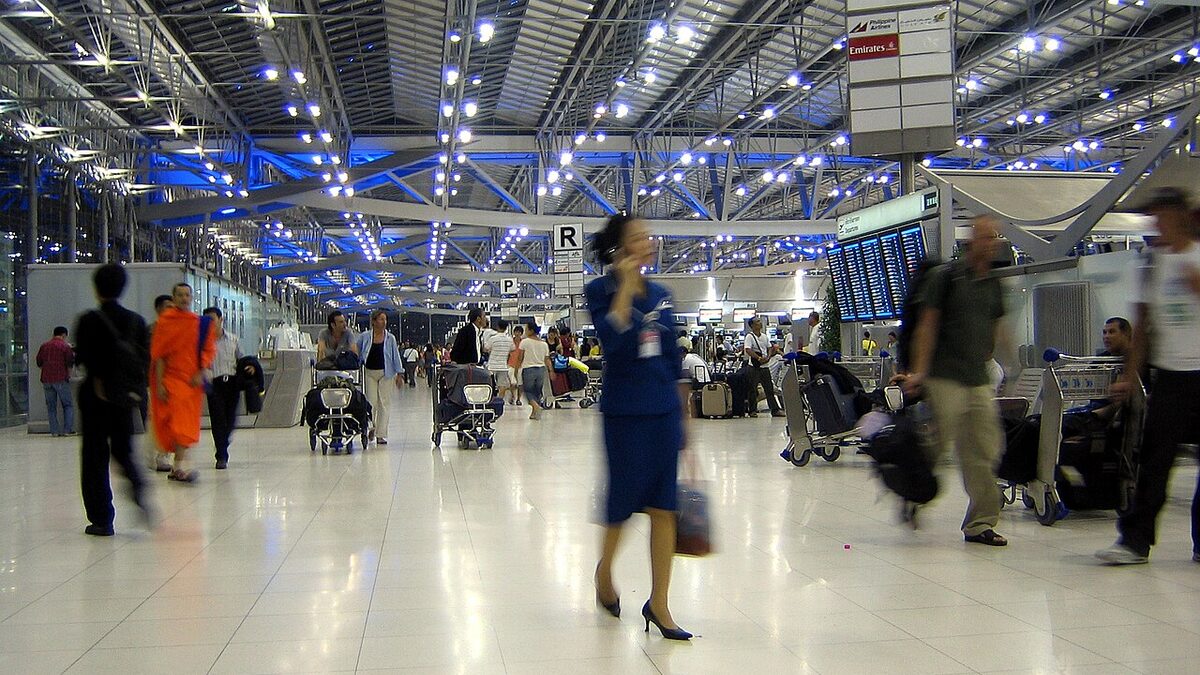
Cover image: The departures hall at Bangkok's Suvarnabhumi Airport (file photo) — photo by Khaosaming, CC BY-SA 3.0, via Wikimedia Commons.
Thailand's Finance Ministry is pushing a 1,000-baht (about €27) tax on air departures, payable by Thai and foreign travellers alike and collected through airline tickets. It is still a proposal: the Revenue Department's consultation on the draft Departure Tax Act closes on 29 October 2026, and nothing can be charged until legislation passes.
In a Bangkok Post report on 15 October, the Association of Thai Travel Agents (ATTA) put potential lost tourism spending at 50–150 billion baht a year, against roughly 45.9 billion baht the tax could raise. On 19 October, preliminary government figures showed 24,423,680 foreign arrivals from 1 January to 17 October, down 4.12% year on year.
What would the departure tax cost, and who would pay?
Finance permanent secretary Lavaron Sangsnit said 1,000 baht would be "appropriate" in current economic conditions, The Nation reported on 13 October. The draft caps the tax at 5,000 baht per departure; Lavaron said that ceiling guards against arbitrary increases and is not the planned rate.
Draft principles from the Revenue Department, reported by The Nation on 7 October, also say:
- land and sea departures would initially be exempt;
- airlines and their ticketing agents would collect the tax with the fare;
- the law would take effect 180 days after publication in the Government Gazette, and tickets bought before then would not be liable.
Why does the Finance Ministry want a departure tax?
Lavaron said the aim is to collect revenue from people with the means to holiday abroad and spend it on domestic tourism, while showing credit-rating agencies fiscal discipline.
Thailand has taxed departures before, under a 1983 law that covered Thais and foreign permanent residents and is no longer collected, The Nation reported.
How big are the losses the travel trade is warning of?
ATTA honorary secretary-general Adith Chairattananon drew on a 2023 Journal of Travel Research study finding that every 10% rise in tourism-related taxes cuts demand by 5.4%. A Naresuan University team calculated that the combined 2,570 baht in charges equals 5.14% of average spending of 50,000 baht per trip, according to the Bangkok Post.
Losing one million visitors would cost about 50 billion baht, Adith said; 150 billion baht is the worst case. These are industry scenarios for lost tourism spending, not lost tax revenue.
Airlines and hotels are opposed too. According to the Bangkok Post, Tassapon Bijleveld, executive chairman of Thai AirAsia operator Asia Aviation, said the seven-airline Airlines Association of Thailand opposes the tax, warning it would hurt competitiveness, notably against Vietnam. The Thai Hotels Association said on 9 October it had written to the Revenue Department seeking withdrawal or a full economic impact assessment, The Nation reported.
How does it differ from the 450-baht entry fee?
The Tourism and Sports Ministry's 450-baht entry fee is a separate plan for foreign arrivals only. It could start in the first quarter of 2027 for air passengers if the Cabinet approves it, according to Travel Tomorrow. The Finance Ministry wants to avoid overlapping charges, possibly by taxing only one leg of a journey, The Nation reported.
Of the charges in the table below, only the passenger service charge is collected today. Airports of Thailand (AOT) raised it from 730 to 1,120 baht on 20 June.
| Charge | Amount | Who pays | Status (19 October) |
|---|---|---|---|
| Departure tax | 1,000 baht (5,000 ceiling) | Thai and foreign air passengers | Draft; consultation to 29 October |
| Tourist entry fee | 450 baht | Foreign arrivals, air first | Proposal; needs Cabinet approval |
| Passenger service charge | 1,120 baht | International departures, six AOT airports | In force since 20 June |
| All three | 2,570 baht | Eligible foreign tourist | 1,450 baht would be new |
Where do Thailand's arrivals stand?
Foreign visitors spent 1,189.555 billion baht from 1 January to 17 October, according to Tourism and Sports Minister Surasak Phancharoenworakul. China led with 4,143,403 arrivals, ahead of Malaysia, India, Russia and South Korea.
The latest week was firmer. Arrivals for 11–17 October rose 0.83% on the previous week to 487,410, as long-haul climbed 10.55% and short-haul fell 4.04% after China's Golden Week.
The slide was already visible in the January–August figures, and visa-free stays were cut from 60 to 30 days for affected passports on 15 September. The Tourism Authority of Thailand expects about 33 million foreign visitors in 2026, roughly level with 2025, Travel Tomorrow reported.
Frequently asked questions
Is Thailand's 1,000-baht departure tax already in force?
No. As of 19 October 2026 it is a draft Departure Tax Act under public consultation until 29 October, with no start date set. If enacted, the law would take effect 180 days after publication in the Government Gazette, The Nation reported.
Would travellers who have already booked have to pay it?
Not under the current draft. Tickets bought before the law takes effect would not be liable, even for departures after the start date, The Nation reported. Tickets bought later would carry the tax, collected by airlines and their agents. The terms could still change after the consultation.
Is the departure tax the same as Thailand's 450-baht tourist fee?
No. The departure tax is a Finance Ministry plan covering Thai and foreign air passengers. The 450-baht fee is a separate Tourism and Sports Ministry plan for foreign arrivals that could start in the first quarter of 2027, subject to Cabinet approval. Neither is in force; only the existing 1,120-baht passenger service charge is collected.
Who would be exempt from the departure tax?
The draft would initially exempt everyone leaving Thailand by land or sea. Air exemptions would broadly mirror the passenger service charge, including children aged two or under, official government guests and international transit passengers who stay in designated transit areas, The Nation reported.
Sources
- The Nation, Foreign arrivals fall 4.12% in year to 17 October
- The Nation, Finance ministry backs 1,000-baht departure tax
- The Nation, Thailand weighs THB1,000 departure tax
- Bangkok Post, Warning over massive losses from exit tax
- The Nation, Thai Hotels Association opposes departure tax
- Travel Tomorrow, Thailand considers new arrival and departure taxes