PM Lawrence Wong and PM Anutin Charnvirakul held the Singapore-Thailand Leaders Retreat in Bangkok on 2 September, signing an MOU on social development and setting a multi-year ASEAN agenda for 2027-2028 with food, energy and AI in focus.
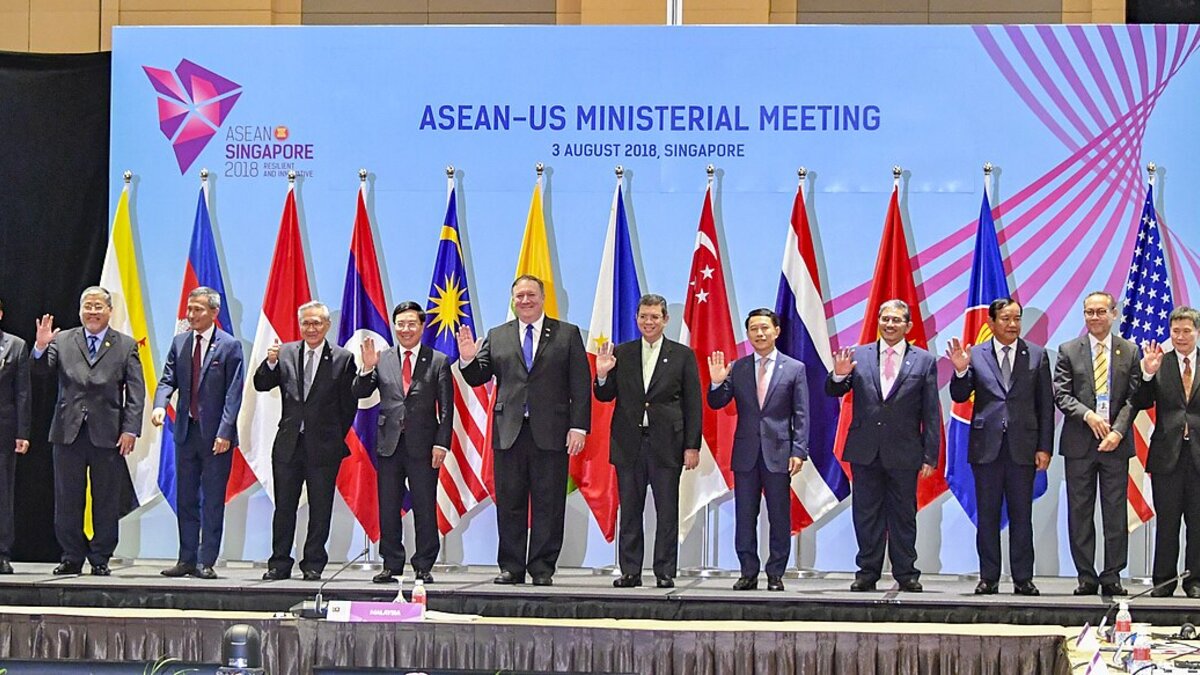
Cover image: ASEAN flags on stage at a ministerial meeting with Singapore and Thailand representatives — photo by U.S. Department of State from United States, Public domain, via Wikimedia Commons.
The first Singapore-Thailand Leaders’ Retreat in more than a decade was held in Bangkok on 2 September 2026, bringing together Singapore Prime Minister Lawrence Wong and Thailand Prime Minister Anutin Charnvirakul. The two leaders signed a memorandum of understanding on cooperation in social sector development and agreed to develop a multi-year agenda linking Singapore’s ASEAN chairmanship in 2027 with Thailand’s in 2028.
The retreat reset a format that had lapsed for over ten years. Talking points centred on food and energy security, emerging technologies including artificial intelligence, and connectivity already delivered through the world’s first linkage of two national real-time payment systems in 2021. A rice trade pact concluded last November was cited as an example of supply-network cooperation, while energy talks covered the ASEAN Power Grid and carbon-credit collaboration.
What was agreed on 2 September?
According to the Prime Minister’s Office Singapore, the retreat produced:
- An MOU on Cooperation in Social Sector Development, signed at the retreat to deepen collaboration beyond economics into health, education and social protection learning.
- A multi-year ASEAN agenda: Singapore chairs ASEAN in 2027 and Thailand follows in 2028. The pair will build a continuity platform so initiatives started in 2027 carry through the successive chairmanships.
- Food and energy workstreams: reinforcing rice trade and supply networks, plus power-grid interconnection and carbon market linkage.
PM Wong described ties as in excellent shape and called the retreat a chance to set direction after the hiatus. PM Anutin co-chaired the press conference and joint statement session in Bangkok.
Why does this matter for travellers?
The Leaders’ Retreat is not a tourism deal, but its workstreams affect travel directly. Food-security cooperation supports price stability in hospitality supply chains, which matters for hotel and restaurant costs in both countries. Energy and carbon-credit talks link to sustainable aviation and hotel operations. AI collaboration flagged for manufacturing, healthcare and tourism could show up in visitor services, from AI-assisted trip planning to smarter border processing.
Connectivity is the most tangible for visitors. The 2021 linkage of Singapore’s PayNow and Thailand’s PromptPay already allows real-time transfers by mobile number, easing small payments for travellers who use cross-border wallets. Discussions also covered logistics-hub development and fintech, which underpin smoother baggage, cargo and e-commerce flows that keep tourist shops stocked.
For Indian travellers, who are now a top source market for Thailand and a growing market for Singapore, the continuity message matters. Thailand logged 19.76 million arrivals to mid-August, with India third at 1.45 million, so stable supply chains and air links are a policy priority. Thailand’s cut to a 30-day visa-free stay from 15 September makes efficient entry and payment all the more relevant to short-stay visitors.
How does this fit ASEAN’s tourism picture?
With Singapore and Thailand chairing back-to-back, officials want a two-year arc rather than stop-start annual themes. Expect continuity on digital economy, resilient supply chains and people-to-people links. That aligns with ongoing tourism pushes on both sides. New attractions in Singapore in 2026 include refreshed waterfront and nature parks that benefit from cross-border logistics and joint sustainability standards discussed at the retreat.
Regional haze was also a backdrop. Penang’s haze hit heritage tourism this week, a reminder that environmental cooperation remains part of the ASEAN agenda even when the headline is bilateral.
What was Wong’s payment connectivity reference?
Wong cited the 2021 PayNow-PromptPay linkage as the world’s first between two national real-time payment systems. It lets users send money using just a mobile number across the border, a feature now used by travellers and small traders. The retreat reviewed its uptake and discussed next steps for broader fintech cooperation, though no new payment product was announced on 2 September.
Frequently asked questions
Is this a new visa or tourism deal?
No. The retreat signed an MOU on social sector development and set a multi-year ASEAN chair agenda. No visa changes were announced; Thailand’s separate 30-day visa-free rule from 15 September still applies.
Will Singapore-Thailand flights increase?
No flight increase was announced in the joint press conference. Air service is market-led. The agenda supports logistics and fintech that can indirectly help airlines and travellers.
What is the multi-year agenda?
A joint plan to ensure initiatives launched under Singapore’s 2027 ASEAN chairmanship continue through Thailand’s 2028 chairmanship, focusing on food, energy, digital and people-to-people continuity.
Does the payment link work for tourists?
Yes, for users whose banks participate. Travellers can send small amounts instantly by mobile number without traditional wire forms, subject to each bank’s limits and fees.
Sources
- Prime Minister’s Office Singapore — PM Lawrence Wong at Singapore-Thailand Leaders’ Retreat Joint Press Conference, 2 Sep 2026
- PMO Singapore — Joint Statement by PM Lawrence Wong and Thailand PM Anutin Charnvirakul, 2 Sep 2026
- The Straits Times — Singapore, Thailand to develop multi-year agenda for successive ASEAN chairmanships, 2 Sep 2026