

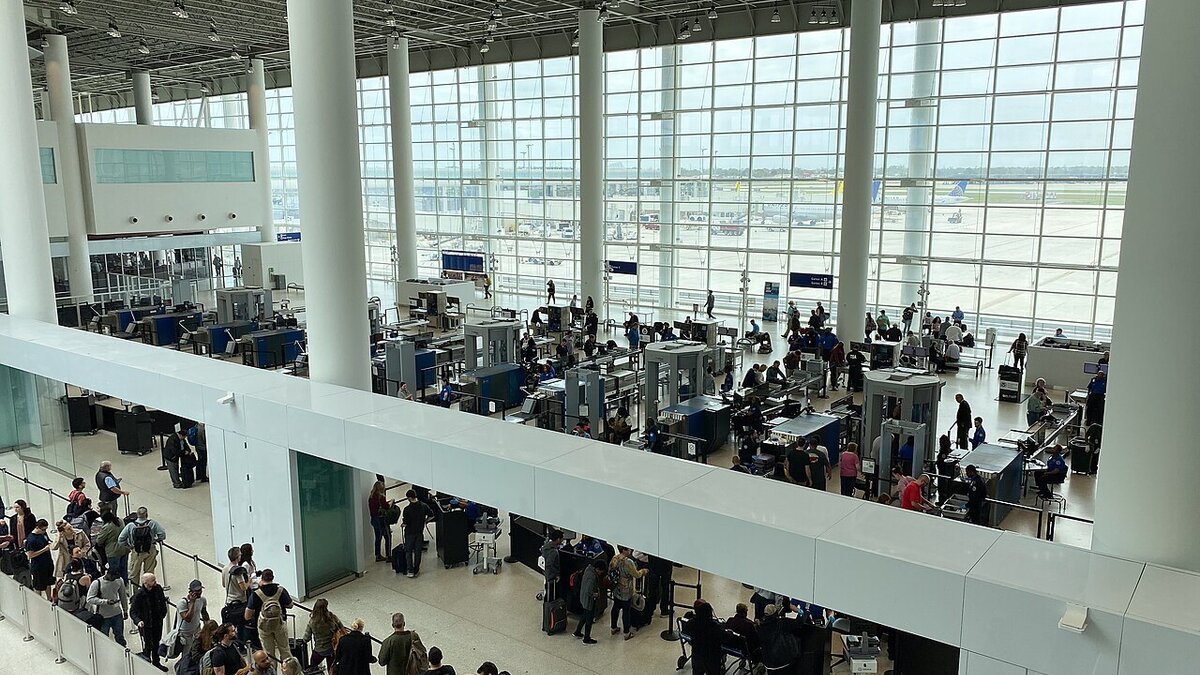
The TSA planned for nearly 18.7 million screenings over the July 4 2026 holiday week, with more than 3 million flyers on the peak day alone. The numbers confirm record demand, but also a plateau.
Cover image: passengers queuing at a US airport security checkpoint — photo by Tony Webster, CC BY 2.0, via Wikimedia Commons.
The 2026 Fourth of July holiday has delivered the busiest Independence Day air-travel period in United States history. The Transportation Security Administration (TSA), the federal agency that screens passengers at US airports, said it prepared to process nearly 18.7 million travellers between Tuesday 30 June and Monday 6 July, a record for the holiday. The single busiest day was forecast for Thursday 2 July, with more than 3 million passengers expected at checkpoints, a threshold the agency first crossed around a July 4 holiday in 2024, when it screened 3,013,413 people in one day. AAA, the US motoring and travel association, projected 72.2 million Americans would travel at least 50 miles from home between 27 June and 5 July, edging past 2025's record of 71.8 million, with 5.85 million of them flying domestically. American Airlines alone planned to carry 8.1 million customers on more than 80,000 flights, up nearly 10% year on year. Final checkpoint tallies for the closing days of the period are still being published, but every headline forecast pointed the same way: a record, if only just.
How many people flew over the July 4 2026 holiday?
The TSA's official forecast, issued on 25 June, put the seven-day total at nearly 18.7 million screenings, and the agency said checkpoints were fully staffed to keep standard-lane waits under 20 minutes and expedited lanes under 10. Enhanced touchless identity verification was in place at 65 major US airports, a deployment the agency has framed as a live test ahead of the FIFA World Cup knockout rounds and America250 events later this summer.
AAA's broader forecast of 72.2 million holiday travellers included 61.4 million going by road and 4.93 million by bus, rail or cruise, the last category growing 5.3% year on year, faster than air. Air travel's 0.2% increase over 2025 is a record, but a slender one. "While the overall number of Independence Day travelers appears to be plateauing, we're still expecting record volumes this year," said Stacey Barber, vice president of AAA Travel.
July 4 2026 travel by the numbers
| Measure | 2026 figure | Change / context |
|---|---|---|
| TSA screenings, 30 Jun–6 Jul | ~18.7 million | Record for the July 4 period (TSA) |
| Peak day (Thu 2 July) | 3 million-plus | Among the busiest days ever screened (TSA) |
| Total US holiday travellers | 72.2 million | Up from 71.8 million record in 2025 (AAA) |
| Domestic air travellers | 5.85 million | +0.2% year on year (AAA) |
| Average domestic return fare | ~$830 | Chicago and Denver routes ~5% dearer (AAA) |
What was the busiest day at US airports?
Thursday 2 July was pencilled in as the peak, with the TSA expecting checkpoint volume to clear 3 million passengers, placing it among the busiest days the agency has ever recorded. Alaska Airlines, by contrast, identified 3 July and 6 July as its own peak days across the 6,283 flights it scheduled for 3–6 July, a 2.5% increase on last year, a reminder that airline schedules and checkpoint peaks do not always align.
Operations were not entirely smooth. The Federal Aviation Administration (FAA), the US air-traffic regulator, paused flights at Washington's Reagan National Airport during the 3 and 4 July America250 celebrations in the capital, and airlines issued waivers for affected East Coast airports. Even so, the FAA was reported to be managing in the region of 51,000 to 52,000 flights a day through the holiday, described as its heaviest Independence Day workload in 15 years.
How did US airlines handle the record holiday?
The big network carriers leaned into the peak even as they trimmed the shoulder days around it.
- American Airlines expected 8.1 million customers on more than 80,000 flights across the holiday stretch, up almost 10% on 2025, including a symbolic Flight 1776 from Philadelphia to Boston on 4 July.
- United Airlines planned for roughly 6 million passengers over the holiday.
- Alaska Airlines scheduled 6,283 flights between 3 and 6 July, up 2.5% year on year.
Beneath the record headlines sits a more disciplined industry. Schedule data cited by Bloomberg and reported by AeroXplorer in late June showed Delta Air Lines, American, United, Spirit and Frontier all reducing scheduled domestic seats for the holiday week versus last year, protecting fares in a domestic market that suffered oversupply in earlier summers. That capacity discipline is one reason airline profits have stabilised in 2026 despite wafer-thin margins, and it helps explain why the average domestic return fare sat near $830 even with demand merely flat. Rising input costs are the other side of that equation, as Travel Market News set out in its analysis of how jet fuel is feeding through into 2026 airfares.
What do the record numbers say about summer 2026 demand?
Three signals stand out. First, US air travel keeps setting records, but the growth curve has flattened: a 0.2% rise in holiday flyers is a fraction of the post-pandemic surges of 2023–2025, and AAA itself calls the market "plateauing". Second, event-driven demand is doing real work this year: the semiquincentennial America250 programme and the FIFA World Cup, which is moving an estimated 6.5 million fans across North America, overlapped directly with the holiday and stress-tested airports that will face World Cup knockout crowds through mid-July. Third, airlines are choosing yield over volume, shifting capacity towards international routes where returns remain stronger, which mirrors the record 1.58 billion international arrivals forecast for 2026 globally.
For the trade, the takeaway is that the US summer peak is now a story of records won on operational execution rather than runaway demand, with fuller planes, firmer fares and less slack in the system when weather or airspace restrictions bite.
Frequently asked questions
Did the TSA break its screening record over July 4 2026?
The TSA forecast nearly 18.7 million screenings for 30 June to 6 July, a record for the Independence Day period, with more than 3 million passengers expected on 2 July alone. Final day-by-day figures for the whole window are published on the TSA checkpoint-volumes page with a short lag.
What was the busiest day to fly over the 2026 holiday?
The TSA projected Thursday 2 July as the single busiest day, topping 3 million screened passengers. Airlines saw their own peaks slightly later; Alaska Airlines flagged 3 July and 6 July as its heaviest days.
Were July 4 2026 flights disrupted?
Mostly no, but the FAA paused operations at Washington Reagan National during the 3–4 July America250 celebrations, and carriers issued travel waivers for several East Coast airports. Travellers were advised to arrive two hours early for domestic flights and three for international.




Post a comment